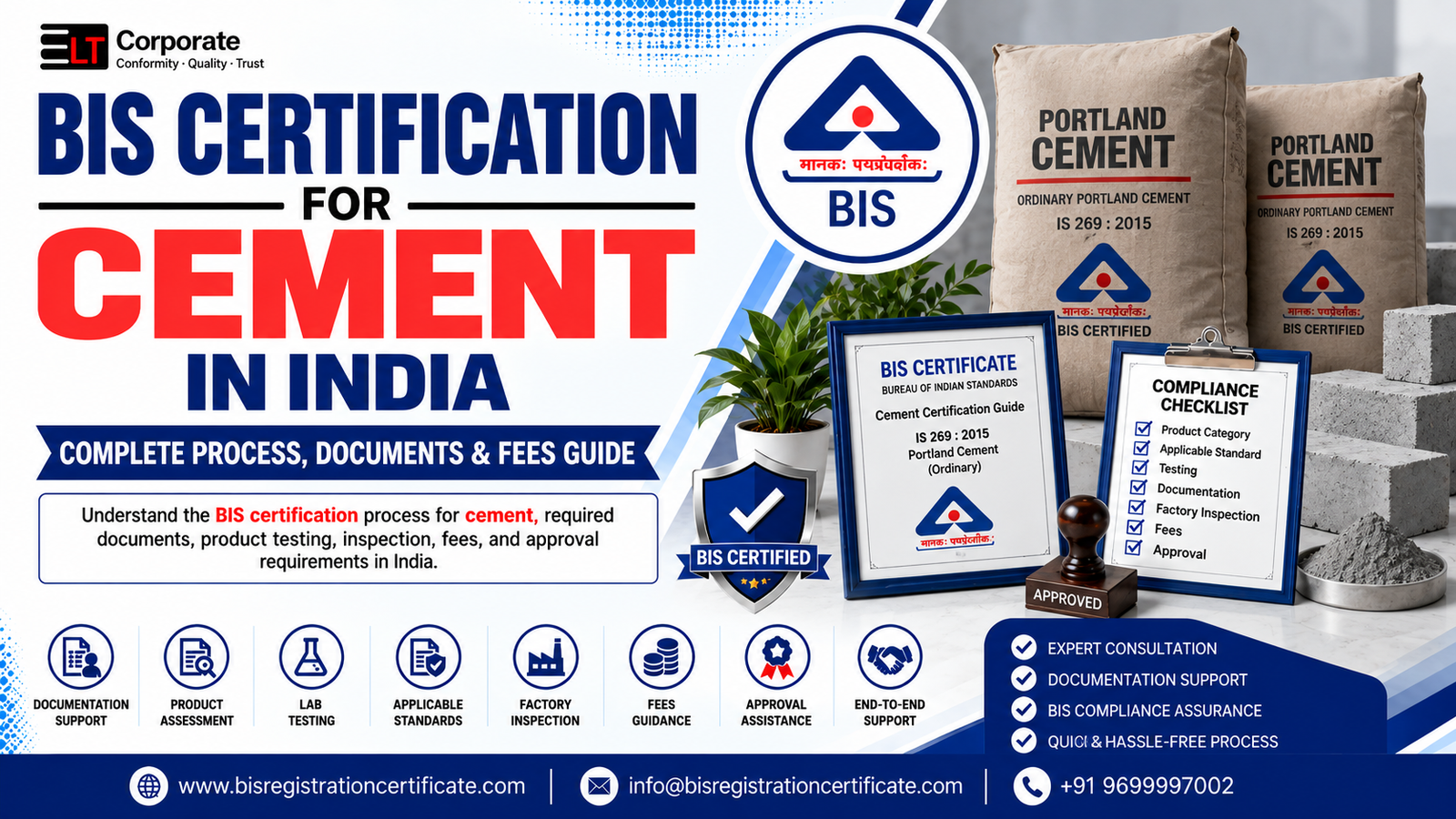
BIS Certification for Cement is an official license granted by the Bureau of Indian Standards that allows a manufacturer to mark its cement bags and bulk shipments with the ISI mark. This mark confirms that the cement meets the required quality benchmarks under the applicable Indian Standard for its specific type, grade, and strength class.
Since cement falls under a Quality Control Order as a scheduled product, BIS Certification for Cement is not optional—it is a legal requirement. No manufacturer can produce, store, sell, or import cement in India without holding a valid BIS license. This certification framework exists to safeguard both consumers and the construction industry from low-grade binder material that could weaken structural integrity.
Need Help With BIS Certification for Cement? Talk to Our Experts Today
WhatsApp Us Call Now Contact UsTypes of Cement Covered Under BIS Certification
BIS Certification for Cement applies across several cement categories, each governed by its own Indian Standard:
- Ordinary Portland Cement (OPC) – 33, 43, and 53 Grade
- Portland Pozzolana Cement (PPC)
- Portland Slag Cement (PSC)
- Rapid Hardening Portland Cement
- Sulphate-Resisting Portland Cement
- White Portland Cement and Masonry Cement
Why BIS Certification for Cement Is Mandatory in India
BIS Certification for Cement is a mandatory requirement for every cement manufacturer operating in India. Under the Bureau of Indian Standards (Compulsory Registration Scheme), no cement product can be legally manufactured, sold, or distributed in the Indian market without valid BIS Certification for Cement. This certification, issued under the ISI Mark scheme, confirms that your cement meets the strict quality, strength, and safety parameters defined by the Bureau of Indian Standards.
Whether you manufacture Ordinary Portland Cement (OPC), Portland Pozzolana Cement (PPC), or Portland Slag Cement (PSC), obtaining BIS Certification for Cement is the first legal step before commercial production. Without it, manufacturers face product seizure, financial penalties, and business shutdown risks under the BIS Act, 2016.
Which Indian Standards Apply to BIS Certification for Cement
BIS Certification for Cement is governed by multiple Indian Standards depending on the cement type manufactured. The key standards under which manufacturers must obtain BIS Certification for Cement include:
- IS 269 – Ordinary Portland Cement (OPC), 33 Grade
- IS 8112 – Ordinary Portland Cement, 43 Grade
- IS 12269 – Ordinary Portland Cement, 53 Grade
- IS 1489 (Part 1) – Portland Pozzolana Cement (PPC)
- IS 455 – Portland Slag Cement (PSC)
- IS 455 and related standards for specialized cement categories
Each standard defines specific parameters such as compressive strength, setting time, fineness, and chemical composition that must be tested before BIS Certification for Cement is granted.
Ready to get BIS Certification for Cement?
Talk to our experts for a clear, fixed-scope plan — most clients get a roadmap the same day.
Step-by-Step Process for BIS Certification for Cement
The process for obtaining BIS Certification for Cement follows the ISI Mark Scheme (Scheme-I) under BIS Compulsory Registration:
- Application Submission – File an application on the BIS Manak Online portal along with the applicable Indian Standard number for your cement type.
- Factory Documentation – Submit factory layout, manufacturing process flow chart, quality control manual, and calibration records for testing equipment.
- In-House Lab Verification – BIS verifies that your factory has an adequate in-house testing laboratory capable of conducting all required tests under the relevant IS standard.
- Factory Inspection – A BIS officer conducts a physical inspection of the manufacturing unit and checks raw materials, production process, and quality control systems.
- Sample Testing – Cement samples are drawn and tested either at the in-house lab (witnessed by BIS) or at a BIS-recognized independent laboratory.
- Grant of License – Once the samples pass and documentation is verified, BIS grants the BIS Certification for Cement license, allowing the ISI mark to be used on your product.
Completing BIS Certification for Cement typically takes 4 to 6 months, depending on factory readiness and testing timelines.
Benefits of BIS Certification for Cement (Detailed)
- Legal Market Access—Allows manufacturers to legally produce, stock, sell, and import cement in India without risk of seizure or penalty
- Consumer Trust – The ISI mark signals proven quality, helping buyers, builders, and contractors choose your product with confidence
- Competitive Edge – Certified cement stands out in tenders, government projects, and B2B contracts where BIS Certification for Cement is a mandatory bidding requirement
- Quality Consistency – Regular BIS surveillance and testing ensure your product consistently meets IS strength, setting time, and composition standards
- Reduced Liability—Compliance with the relevant Indian Standard lowers the risk of structural failures and related legal claims
- Export Credibility – BIS Certification for Cement strengthens your product’s standing when expanding into markets that recognize Indian quality benchmarks
- Brand Reputation—Long-term market credibility with dealers, distributors, and end consumers who associate the ISI mark with reliability
Documents Required for BIS Certification for Cement
To apply for BIS Certification for Cement, manufacturers must prepare the following documents:
- Factory registration certificate / MSME certificate
- GST registration certificate
- Factory layout plan and machinery list
- List of raw materials and suppliers
- Quality control manual and test equipment calibration certificates
- Manufacturing process flow chart
- Details of technical and quality control personnel
- Previous test reports (if any)
Accurate documentation significantly speeds up the BIS Certification for Cement approval timeline.
Fees Involved in BIS Certification for Cement
The cost of BIS certification for cement includes:
- Application fee – Nominal fee paid at the time of filing
- Marking fee – Based on annual production capacity
- Testing fee – Charged per sample tested at BIS-recognized labs
- Annual license fee – Payable to maintain certification validity
Total costs for BIS Certification for Cement vary based on plant capacity and cement type; our consultants can provide an exact fee estimate after reviewing your factory details.
Your Partner for Cement Certification
We prepare your quality control manual, in-house lab, and process documentation ahead of the BIS factory inspection for cement certification.
We handle Manak Online registration, application filing, and all follow-up with BIS officers for your BIS Certification for Cement.
For overseas cement plants exporting to India, we coordinate the AIR (Application for Inspection Requirement) and complete FMCS process.
We track your licence validity and surveillance audit schedule so your BIS Certification for Cement never lapses.
Let ELT Corporate Handle Your BIS Certification for Cement, Start to Finish
Get Free Expert Consultation WhatsApp Us Call Now Contact UsWhy Choose ELT Corporate for BIS Certification for Cement
Our team has helped numerous cement manufacturers across India secure BIS Certification for cement without delays or rejections. We assist with:
- Complete documentation preparation
- Manak Online application filing
- Factory audit readiness support
- Liaison with BIS officers during inspection
- Post-certification compliance and license renewal
Conclusion
BIS Certification for Cement is not just a regulatory formality—it is the foundation of trust between a manufacturer and the Indian construction market. From ordinary Portland cement to Portland pozzolana cement and Portland slag cement, every category sold in India must carry valid BIS certification for cement to be manufactured, stocked, or sold legally.
Manufacturers who obtain BIS Certification for Cement early avoid production delays, legal penalties, and loss of market credibility. With the right documentation, a compliant in-house lab, and expert guidance through the Manak Online application process, securing BIS Certification for Cement becomes a smooth and predictable process rather than a bottleneck.
If you are planning to manufacture or import cement in India, getting BIS Certification for Cement in place before commercial production is the safest and most compliant way forward.
Frequently Asked Questions
Yes, BIS Certification for Cement is mandatory for OPC, PPC, and PSC under India’s Compulsory Registration Scheme.
On average, BIS Certification for Cement takes 4 to 6 months from application to license grant.
No. Imported cement also requires BIS certification for cement before it can be sold in the Indian market.
Selling cement without valid BIS Certification for Cement can lead to product seizure, penalties, and legal action under the BIS Act.
Yes, BIS Certification for Cement is typically valid for 1-2 years and must be renewed before expiry to continue production legally.
Ready to get BIS Certification for Cement?
Talk to our experts for a clear, fixed-scope plan — most clients get a roadmap the same day.