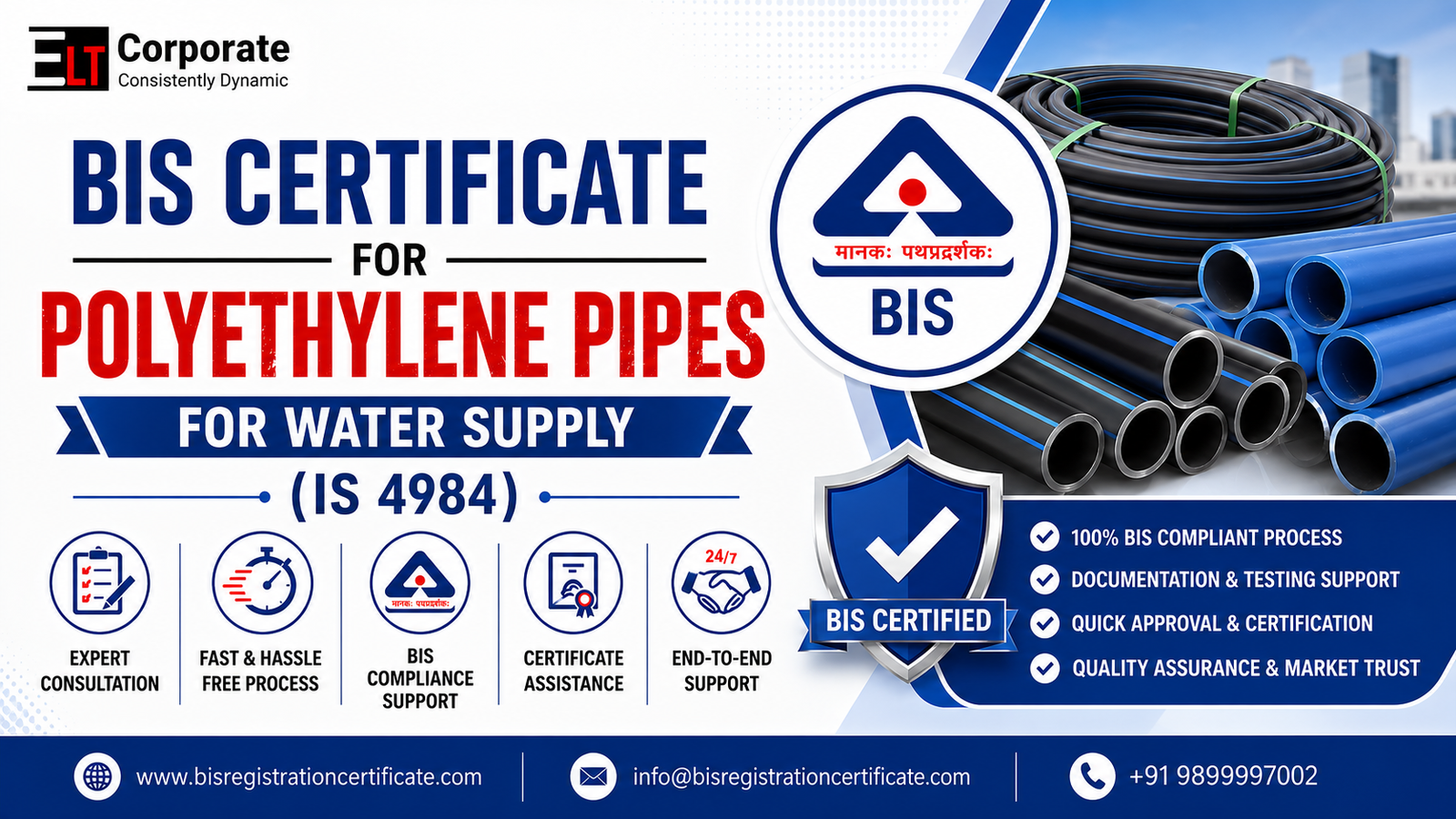
Polyethylene (PE) pipes are now the most popular option for sewerage, water supply, and irrigation systems for agricultural use throughout India. Their flexibility and durability as well as their lightweight construction and long life span ensure that they are superior to traditional concrete or metal pipes. But, since they carry the water supply for drinking and can be employed for critical infrastructure projects, their quality and safety are not at risk.
That is the rationale behind the certification requirement for polyethylene pipes under IS 4984, which is the Indian Standard specifying the guidelines for high-density polyethylene (HDPE) pipes used in water supply systems. In order to sell these pipes in India, any manufacturer or supplier of PE pipes in India must have BIS certification, also known as the ISI Mark.
In this article we’ll go over the essential information you need concerning BIS approval for polyethylene pipes. This includes the procedure, standard documents, testing guidelines, and more. We’ll also explain the ways ELT Corporate can assist you to become certified quicker.
What is IS 4984?
IS 4984 is the Indian Standard specification that governs high-density polyethylene (HDPE) pipes used for potable water supply, sewerage systems, and general industrial applications. This standard lays down detailed requirements covering:
- Pipe dimensions and tolerances permissible
- Material composition and classification of grades (PE 70, PE 80, and 100)
- Ratings for pressure (PN ratings) for different pipe types
- Hydrostatic strength and long-term burst pressure resistance
- Marking, labeling, and traceability requirements
- Opacity and UV resistance for outdoor-use pipes
Since this standard is notified under a Quality Control Order (QCO), manufacturing or selling non-certified PE pipes for water supply is not permitted under Indian law.
Why is BIS certification mandatory for PE pipes?
- Security assurance: Make sure pipes are able to withstand internal pressure without cracking, leaking, or even bursting
- Water safety in potable sources: Ensures that the polyethylene material used to make the water is not toxic and suitable for the transport of drinking water.
- Project eligibility for Government projects is mandatory for tenders from the government, PWD contracts, Jal Jeevan Mission along with municipal water supply and projects
- Credibility in the market: Creates trust between contractors, distributors, and retailers, as well as the final consumer.
- Legal compliance: Manufacturing without ISI Mark under the applicable QCO can lead to penalties and market restrictions
- Export advantage: Certified products are easier to position for institutional buyers and larger infrastructure projects
Documents Required for BIS Certification (IS 4984)
| Document | Purpose |
| Factory address proof | Verify manufacturing location |
| List of manufacturing machinery | Confirm production capability |
| Raw material test reports | Verify PE resin quality and grade |
| In-house testing lab details | Confirm quality control setup |
| Product test reports (BIS-recognized lab) | Validate compliance with IS 4984 |
| GST registration certificate | Business verification |
| Factory layout plan | Reference for site inspection |
| List of technical staff/QC personnel | Confirm technical competency |
Want expert help with your BIS certification? Fill this quick form →
BIS Certification Process for Polyethylene Pipes
| Step | Description |
|---|---|
| 1. Application Submission | Apply online via the BIS Manak portal (Form V) with required documents |
| 2. Document Verification | BIS scrutinizes factory details, product specs, and compliance documents |
| 3. Factory Inspection | A BIS officer visits the manufacturing unit to inspect machinery, raw materials, and QC processes |
| 4. Sample Testing | Pipe samples are drawn and tested as per IS 4984 parameters at an in-house or BIS-approved lab |
| 5. Compliance Review | BIS reviews test results against prescribed standard values |
| 6. License Grant | Upon successful review, the BIS ISI Mark license is issued for the specific pipe grade(s) |
The entire process typically takes 2 to 4 months, depending on document readiness, factory audit scheduling, and testing turnaround.
Key Testing Parameters Under IS 4984
To qualify for BIS certification, PE pipe samples must pass several critical tests, including:
- Hydrostatic pressure test — both short-term and long-term pressure resistance
- Dimensional accuracy — outer diameter, wall thickness, and ovality checks
- Elongation at break — measures material flexibility and ductility
- Melt flow rate (MFR) — verifies consistency of raw material grade
- Opacity test — ensures adequate protection against light-induced algae growth in water pipes
- Marking and traceability compliance—batch number, manufacturing date, and pipe class must be clearly marked
Manufacturers must maintain consistent quality across production batches, as BIS conducts periodic surveillance testing even after certification is granted.
PE Pipe Grades: PE 63 vs PE 80 vs PE 100
| Grade | Minimum Required Strength (MRS) | Common Use |
| PE 63 | 6.3 MPa | Low-pressure water supply, agricultural use |
| PE 80 | 8.0 MPa | Medium-pressure water and sewerage lines |
| PE 100 | 10.0 MPa | High-pressure municipal and industrial applications |
Higher-grade pipes allow thinner walls for the same pressure rating, making PE 100 pipes more material-efficient and increasingly popular for large infrastructure projects.
Conclusion
BIS approval in accordance with IS 4984 is a crucial prerequisite for producers of polyethylene pipes who want credibility to guarantee the safety of their product and also gain access to massive infrastructure and government projects. With the growing demand generated by initiatives such as Jal Jeevan Mission, as well as the modernization of urban water supply, the need for a valid ISI marking isn’t a luxury but essential for business.
Need Help Getting BIS Certification for Your Polyethylene Pipes?
📱 WhatsApp Us 📞 Call Now 📝 Free AssistanceFAQs
Q1. Is BIS certification mandatory for all PE pipe manufacturers?
Yes, under the applicable Quality Control Order, PE pipes for water supply cannot be manufactured or sold in India without a valid ISI Mark.
Q2. What is the difference between PE 63, PE 80, and PE 100?
These grades denote the minimum required strength (MRS) of the polyethylene material—PE 100 offers the highest pressure resistance and is most suited for high-demand infrastructure projects.
Q3. How long does BIS certification take?
Typically 2–4 months, depending on document readiness and factory inspection scheduling.
Q4. Can the importer or trader seek the BIS certificate?
Yes, importers can apply for the certificate through the Foreign Manufacturer’s Certification Scheme (FMCS) for polyethylene pipes manufactured outside India.
Q5. What is the cost of BIS certification for PE pipes?
Costs vary based on application fees, testing fees, inspection fees, and annual license fees. Contact ELT Corporate for a customized quote based on your production scale.
Q6. Is the factory inspection mandatory for certification?
Yes, factory inspection is required by BIS to certify the capacity of manufacture, quality of raw materials used, and testing facilities at the factory.
Need help with PE Pipe BIS Certification? WhatsApp us now →