
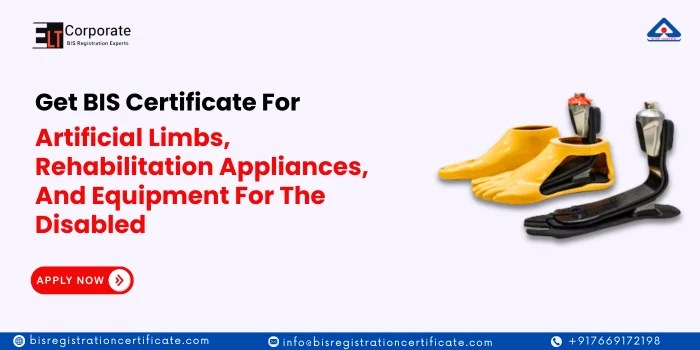
Obtaining BIS Certificate for Artificial Limbs, Rehabilitation Appliances, And Equipment For The Disabled is very essential for quality and safety. These products aren’t just tools, they’re life-changing aids that help people regain mobility, independence, and confidence. But how can you be sure these devices are safe and reliable? That’s where BIS certification comes in.
The Bureau of Indian Standards ensures that products meet strict safety and quality standards before they reach the market. For manufacturers, getting BIS certification isn’t just about following the rules—it’s about showing their commitment to creating top-notch, trustworthy products.
In this article, we’ll break down what BIS certification means for these essential devices, why it’s important, and how businesses can go about getting certified. Whether you’re a manufacturer, distributor, or someone curious about how these products are regulated, this guide will make it all clear and simple.
What Is BIS Certificate For Artificial Limbs, Rehabilitation Appliances, and Equipment For the Disabled?
The BIS certificate, an official document issued by the BIS, is an important quality assurance mark in India, established under the Bureau of Indian Standard Act, 1986. As a national body, BIS plays a significant role in developing and promoting standards across various sectors including medical devices for disabled persons.
The grant of the BIS certificate involves rigorous testing and evaluation of products to ensure compliance with relevant standards. BIS engages in various activities involving product certification, quality control, testing, hallmarking, calibration schemes, and many more.
Who Can Apply For BIS Certificate For Artificial Limbs, Rehabilitation Appliances, And Equipment For The Disabled?
Below are some mentioned applicants who can apply for BIS certificate for artificial limbs, Rehabilitation Appliances, and equipment for the disabled:
- Manufacturers or Companies producing artificial limbs for disabled persons can apply for a BIS certificate.
- Rehabilitation centres offering rehabilitation services can apply for a BIS certificate to ensure they meet quality standards in their services.
- Importers who want to import and sell artificial limbs in India can apply for a BIS certificate.
Benefits Of Obtaining BIS Certificate For Artificial Limbs, Rehabilitation Appliances, And Equipment For The Disabled
Here we have mentioned the benefits of obtaining BIS certification for Artificial Limbs, Rehabilitation Appliances, And Equipment For The Disabled. Here’s why it matters:
- Ensuring Safety and Quality: These devices come into direct contact with users and often bear heavy physical and emotional responsibility. BIS certification ensures that they are tested and approved for safety, preventing potential malfunctions or risks to the user.
- Building User Trust: For those who depend on these products, trust is everything. A BIS-certified product gives users confidence that the equipment they’re using is safe, reliable, and designed with their needs in mind.
- Legal Compliance: In India, BIS certification is mandatory for many medical and assistive devices. Manufacturers who comply avoid legal penalties and gain access to a wider market.
- Supporting Innovation with Accountability: Certification allows manufacturers to innovate while staying accountable to regulatory standards, ensuring advancements in design and functionality don’t compromise safety.
- Empowering Accessibility: By ensuring quality, BIS certification helps make assistive devices more effective, durable, and widely accepted, improving the lives of people with disabilities.
Hence, if you are a manufacturer or distributor get BIS certification for Artificial Limbs, Rehabilitation Appliances, and Equipment for the Disabled.
Documents Required For Obtaining BIS Certificate For Artificial Limbs, Rehabilitation Appliances, and Equipment For The Disabled
To apply for a BIS certificate for artificial limbs, Rehabilitation Appliances, and Equipment for the disabled, the applicant must prepare and submit the following documents:
- Application Form
- Company Documents
- Quality Management System (QMS) Documents
- Product Specification
- Test Reports
- Manufacturing Detail
- Labelling and Packaging
- Financial Documents
Procedure For Obtaining BIS Certificate For Artificial Limbs, Rehabilitation Appliances, and Equipment For The Disabled
Following are the steps involved in granting of BIS certificate for artificial limbs, Rehabilitation Appliances, and Equipment for the disabled:
- Visit BIS Website: Visit the BIS website to understand specific requirements related to artificial limbs.
- Submission of Documents: Prepare and submit the required documents as listed above.
- Fees Proof: Pay the required fees based on the type and number of products.
- Factory Inspection: BIS will review the submitted application along with the documents and may conduct an on-site inspection of your manufacturing facility to assess compliance with standards.
- Testing and Evaluation: The product may need to undergo testing at the BIS-recognized laboratory.
- Grant of Certification: Once the evaluation is successfully performed, BIS will issue the certificate.
What Are The Indian Standards For Artificial Limbs, Rehabilitation Appliances, And Equipment For The Disabled?
Here is a list of the Indian standards required for BIS Certification for Ear, Nose, and Throat Surgical Instruments. You can review them here:
| SI. No. | IS No. | TITLE |
|---|---|---|
| 1 | IS 10110: 1982 | Specification for table spoon terminal device for artificial limbs |
| 2 | IS 10111: 1982 | Specification for table fork terminal device for artificial limbs |
| 3 | IS 10537: 1983 | Specification for ankle bolt for sach foot |
| 4 | IS 10538: 1983 | Specification for kitchen knife terminal device for artificial limbs |
| 5 | IS 10539: 1983 | Specification for a sickle terminal device for artificial limbs |
| 6 | IS 10926: 1984 | Specification for a tweezer terminal device for artificial limbs |
| 7 | IS 10928: 1984 | Specification for table, tilting, and manual |
| 8 | IS 10929: 1984 | Specification for hook voluntary opening terminal device for artificial limbs |
| 9 | IS 10976: 1993/ISO 6440 | Wheelchairs – Nomenclature, terms and definitions (First Revision) |
| (1 Revision) | ||
| 10 | IS 11242: 1985 | Specification for lumbo-sacral flexion-extension and lateral-flexion control brace |
| 11 | IS 11243: 1985 | Specification for thoraco – Lumbo – Sacral flexion – Extension and lateral – Flexion control brace |
| 12 | IS 11279: 1985 | Specification for braille slate |
| 13 | IS 11316: 1985 | Specification for cosmetic hand, artificial limb |
| 14 | IS 11646: Part 1: 2003 | Cane for visually handicapped – Specification: Part 1 rigid, long and white (First Revision) |
| (1 Revision) | ||
| 15 | IS 11646: Part 2: 1986 | Specification for cane for visually handicapped: Part 2 folding type |
| 16 | IS 11647: 1986 | Specification for braille paper |
| 17 | IS 11708:1986 | Specification for hand, mechanical |
| 18 | IS 12104: 1987 | Specification for abacus for visually handicapped |
| 19 | IS 12152: 1987 | Specification for pocket frame, braille writing |
| 20 | IS 12184: 1987 | Specification for a stylus for braille writing |
| 21 | IS 12439: 1988 | Specification for signature guide for visually impaired |
| 22 | IS 12664 Part 1: 2003 | Artificial limbs – Sach foot for lower extremity prostheses: Part 1 design and dimensions (First Revision) |
| (1 Revision) | ||
| 23 | IS 12683 Part 1: 1989 | Measuring devices for visually impaired persons – Specification: Part 1 scale, general purposes |
| 24 | IS 12683: Part 2: 1989 | Artificial limbs – Measuring devices for visually impaired persons: Part 2 type |
| 25 | IS 12683 Part 3: 2000 | Measuring devices for visually impaired persons – Specification: Part 3 goniometer |
| 26 | IS 13017: 1991 | Rehabilitation equipment – Walker rollator – Specification |
| 27 | IS 13822: 1993 | Braille duplicating sheet specification |
| 28 | IS 13837: 1993 | Braille duplicating machine specification |
| 29 | IS 13970: Part 1:1995/ISO 8549-1 | Prosthetics and orthotics – Vocabulary: Part 1 general terms for external limb prostheses and external orthoses |
| 30 | IS 13970: Part 2: 1994/ISO 8549-2 | Prosthetics and orthotics vocabulary: Part 2 terms relating to external limb prostheses and wearers of these prostheses |
| 31 | IS 13970 : Part 3: 1994/ISO 8549-3 | Prosthetics and orthotics vocabulary: Part 3 terms relating to external orthoses |
| 32 | IS 14429: 1997/ISO 11040-3:2012 | Braille shorthand machine – Specification |
| 33 | IS 14723: 1999 | Artificial limbs – Knee shin Assembly – Specification |
| 34 | IS 14879: 2000 | Anterior spinal hyperextension (ASH) brace – Specification |
| 35 | IS 15376 Part 1: 2003/ISO 8670-1 | Ostomy collection bags: Part 1 Vocabulary |
| 36 | IS 15376 Part 2: 2003/ISO 8670-2 | Ostomy collection bags: Part 2 Requirements and test methods |
| 37 | IS 17034: 2018 | Specification for Jaipur foot |
| 38 | IS 17063: 2018 | Specification for rehabilitation equipment? rough terrain active wheelchairs, folding, rider – I, adult and child size |
| 39 | IS 17154: 2019 | Battery-operated motorized tricycle – Specification |
| 40 | IS 17155: 2019 | Tricycle, single hand propelled (?Right?/?Left?) (?Junior Size?) ? specification |
| 41 | IS 17157: 2019 | Multi-utility tricycle specification |
| 42 | IS 17194: 2019 | Surgical ankle boot with broad toe (Child And Adult Size) – Specification |
| 43 | IS 4534 : 1980 | Specification for adapter for terminal devices, artificial limbs (First Revision) |
| (1 Revision) | ||
| 44 | IS 4535: 1968 | Specification for saw – Grip terminal device for artificial limbs |
| 45 | IS 4554: 1968 | Specification for hammers terminal devices, ball pein and claw, for artificial limbs |
| 46 | IS 4555: 1980 | Specification for biprong terminal device, draughtsman, for artificial – Limbs (First Revision) |
| (1 Revision) | ||
| 47 | IS 4556 : 1968 | Specification for typing finger terminal device for artificial limbs |
| 48 | IS 4567: 1968 | Specification for pliers terminal device, quick – Grip, for artificial limbs |
| 49 | IS 4577: 1980 | Specification for spade – Grip terminal device for artificial limbs (First Revision) |
| (1 Revision) | ||
| 50 | IS 4609: 1980 | Specification for a pencil – A holding device for artificial limbs (First Revision) |
| (1 Revision) | ||
| 51 | IS 4675: 1968 | Specification for light split-hook device for artificial limbs |
| 52 | IS 4677: 1968 | Specification for steering appliance for artificial limbs |
| 53 | IS 5015: 1969 | Specification for knife – Terminal device for artificial limbs |
| 54 | IS 5143: 1988 | Specification for adjustable axillary crutches (Second Revision) |
| (2 Revision) | ||
| 55 | IS 5144: 1980 | Specification for metal forearm crutches (Canadian Pattern) (First Revision) |
| (1 Revision) | ||
| 56 | IS 5145: 1969 | Specification for walking sticks |
| 57 | IS 5150: 1969 | Specification for rubber tips for crutches and walking sticks |
| 58 | IS 5586: 1970 | Specification for metal component for sectional forearm |
| 59 | IS 5594: 1983 | Specification for wrist unit, rotary, for hand prosthesis (First Revision) |
| (1 Revision) | ||
| 60 | IS 5603: 1983 | Specification for mechanical elbow joint (First Revision) |
| (1 Revision) | ||
| 61 | IS 5607: 1970 | Specification for semi – Automatic elbow joint |
| 62 | IS 5665: 1982 | Specification for shoulder wheel (First Revision) |
| (1 Revision) | ||
| 63 | IS 5745: 1986 | Specification for heel socket and plate for orthosis (First Revision) |
| (1 Revision) | ||
| 64 | IS 5796: 1970 | Specification for disc type weight set for physio – Therapy exercisers other than pulley arrangements |
| 65 | IS 5809: 1986 | Specification for ankle joint for orthosis (First Revision) |
| (1 Revision) | ||
| 66 | IS 5810: 1986 | Specification for knee joint with lock for orthosis (First Revision) |
| (1 Revision) | ||
| 67 | IS 5827: 1982 | Specification for paraffin wax bath (First Revision) |
| (1 Revision) | ||
| 68 | IS 5956: 1986 | Specification for hip joint with lock for orthosis (First Revision) |
| (1 Revision) | ||
| 69 | IS 5963: 1971 | Specification for knee joint without lock for steel orthopaedic calipers |
| 70 | IS 5964: 1971 | Specification for round spur for orthopaedic calipers |
| 71 | IS 6069: 1971 | Specification for sliding seat exerciser |
| 72 | IS 6099: 1991 | Rehabilitation equipment – Invalid walkers with crutches – Specification (Second Revision) |
| (2 Revision) | ||
| 73 | IS 6205: 1982 | Specification for stationary cycle exerciser for adults (First Revision) |
| (1 Revision) | ||
| 74 | IS 6221: 1971 | Specification for a pelvic band for steel orthopaedic calipers and braces |
| 75 | IS 6222: 1971 | Specification for thigh band for orthopaedic calipers and braces |
| 76 | IS 6223: 1971 | Specification for calf band for orthopaedic calipers and braces |
| 77 | IS 6224: 1980 | Specification for tuber band for orthopaedic calipers and braces |
| (1 Revision) | ||
| 78 | IS 6275: 1971 | Specification for lower extremity full length brace with joints with locks |
| 79 | IS 6302: 1971 | Specification for whirlpool bath |
| 80 | IS 6414: 1972 | Specification for parallel walking bars, adult and child sizes, for the handicapped |
| 81 | IS 6571: 1991 | Rehabilitation equipment – Wheelchairs, non – Folding, adult size, institutional model – Specification (First Revision) |
| (1 Revision) | ||
| 82 | IS 6624333: 1972 | Specification for basic hand splint, palmar arch support |
| 83 | IS 66253333: 1972 | Specification for basic hand splint component |
| 84 | IS 6626: 1972 | Specification for basic hand splint, forearm piece |
| 85 | IS 6781: 1972 | Specification for staple ankle joint |
| 86 | IS 6802: 1986 | Specification for prosthetic hip joint (First Revision) |
| (1 Revision) | ||
| 87 | IS 6809: 1990 | Rehabilitation equipment – Fixed height walking frame – Specification (First Revision) |
| (1 Revision) | ||
| 88 | IS 6810: 1990 | Rehabilitation equipment – Metal tripod and tetrapod sticks- Specification (First Revision) |
| (1 Revision) | ||
| 89 | IS 6812: 2003 | The knee joint, uniaxial for below knee prostheses – Specification (Second Revision) |
| (2 Revision) | ||
| 90 | IS 6979: 1973 | Specification for cerebral palsy chai, tubular, institutional model |
| 91 | IS 6992: 1982 | Specification for cerebral palsy chair, domestic model (First Revision) |
| (1 Revision) | ||
| 92 | IS 6993: 1973 | Specification for pan knee joint |
| 93 | IS 6995: 1973 | Specification for cruciform below-knee joint |
| 94 | IS 7373: 2003 | Hip disarticulation joint unit for lower limb prosthetic fitments – Specification (Second Revision) |
| (2 Revision) | ||
| 95 | IS 7419: 1983 | Requirements for stairs for physical rehabilitation (First Revision) |
| (1 Revision) | ||
| 96 | IS 7454 : 1991 | Rehabilitation equipment – Wheelchairs, folding, adult size- Specification (First Revision) |
| (1 Revision) | ||
| 97 | IS 7924: 1976 | Specification for thigh blocks, wooden |
| 98 | IS 8086: 1991 | Rehabilitation equipment – Wheelchairs, folding, junior size- Specification (First Revision) |
| (1 Revision) | ||
| 99 | IS 8088: 2019 | Tricycle, hand-propelled specification (First Revision) |
| (1 Revision) | ||
| 100 | IS 8492 : 1985 | Specification for ankle blocks, wooden (First Revision) |
| (1 Revision) | ||
| 101 | IS 8511: 1985 | Specification for valves for suction socket for artificial limbs (First Revision) |
| (1 Revision) | ||
| 102 | IS 8798 : 1978 | Specification for wheel, multipurpose |
| 103 | IS 9471: Part 1: 1980 | Specification for modular lower limb orthotic components: Part 1 stirrups |
| 104 | IS 9471 : Part 2 : 1980 | Specification for modular lower limb orthotic components: Part 2 stirrups, split |
| 105 | IS 9471 : Part 3 : 1980 | Specification for modular lower limb orthotic components: Part 3 stirrup plates |
| 106 | IS 9471: Part 4: 1980 | Specification for modular lower limb orthotic components: Part 4 joint unit, ankle |
| 107 | IS 9471: Part 5: 1980 | Specification for modular lower limb orthotic components: Part 5 joint unit, knee |
| 108 | IS 9471: Part 5: Sec 2 : 2019 | Specification for modular lower limb orthotic components: Part 5 joint unit section 2 standard knee |
| 109 | IS 9471 : Part 6 : 2000 | Modular lower limb orthotic components part 6 orthotic hip joint (Joint Unit, Hip Drop Lock) – Specification |
| 110 | IS 9471 : Part 7 : 2000 | Modular lower limb orthotic components – Specification: Part 7 orthotic joint bars, ankle and knee (Upper And Lower) |
| 111 | IS 9797 : 1981 | Specification for cycle, fret – Saw |
| 112 | IS/ISO 16021: 2000/ISO 16021 :2000 | Urine-Absorbing Aids — Basic Principles for Evaluation of Single-Use Adult-Incontinence- Absorbing Aids from the Perspective of Users and Caregivers |
| 113 | IS/ISO 22523: 2006/ISO 22523:2006 | External limb prostheses and external orthoses – Requirements and test methods |
| 114 | IS/ISO 22675: 2016/ISO 22675:2016 | Prosthetics – Testing of ankle – Foot devices and foot units – Requirements and test methods |
| 115 | IS/ISO 7176: Part 26: 2007/ISO 7176-26: 2007 | Wheelchairs: Part 26 Vocabulary |
| 116 | IS/ISO 8669: Part 2:1996/ISO 8669-2:1996 | Urine Collection Bags Part 2 Requirements and Test Methods |
What Is The Validity Of BIS Certificate For Artificial Limbs, Rehabilitation Appliances, And Equipment For The Disabled?
A BIS certificate for Artificial Limbs, Rehabilitation Appliances, and Equipment for the Disabled is typically valid for one year, after which renewal is necessary. Renewal involves a reassessment of compliance with the standards and may require updated documentation and fees.
Timeline For Obtaining BIS Certificate For Artificial Limbs, Rehabilitation Appliances, And Equipment For The Disabled
The timeline for granting of BIS certificate for Artificial Limbs, Rehabilitation Appliances, and Equipment for the Disabled may take around 30-40 days based on the effectiveness of the application.
How ELT Corporate Can Assist You With BIS Certificate For Artificial Limbs, Rehabilitation Appliances, And Equipment For The Disabled?
At ELT corporate, we ensure the timely submission of applications and grant of BIS certificates. We specialize in obtaining BIS certificates for our clients navigating the regulatory framework backed by years of experience in the medical device sector.
Obtaining a BIS certificate through ELT corporate guarantees that your product meets stringent safety and quality standards. We make the certification process seamless, saving you time and effort. Let’s connect for further information.