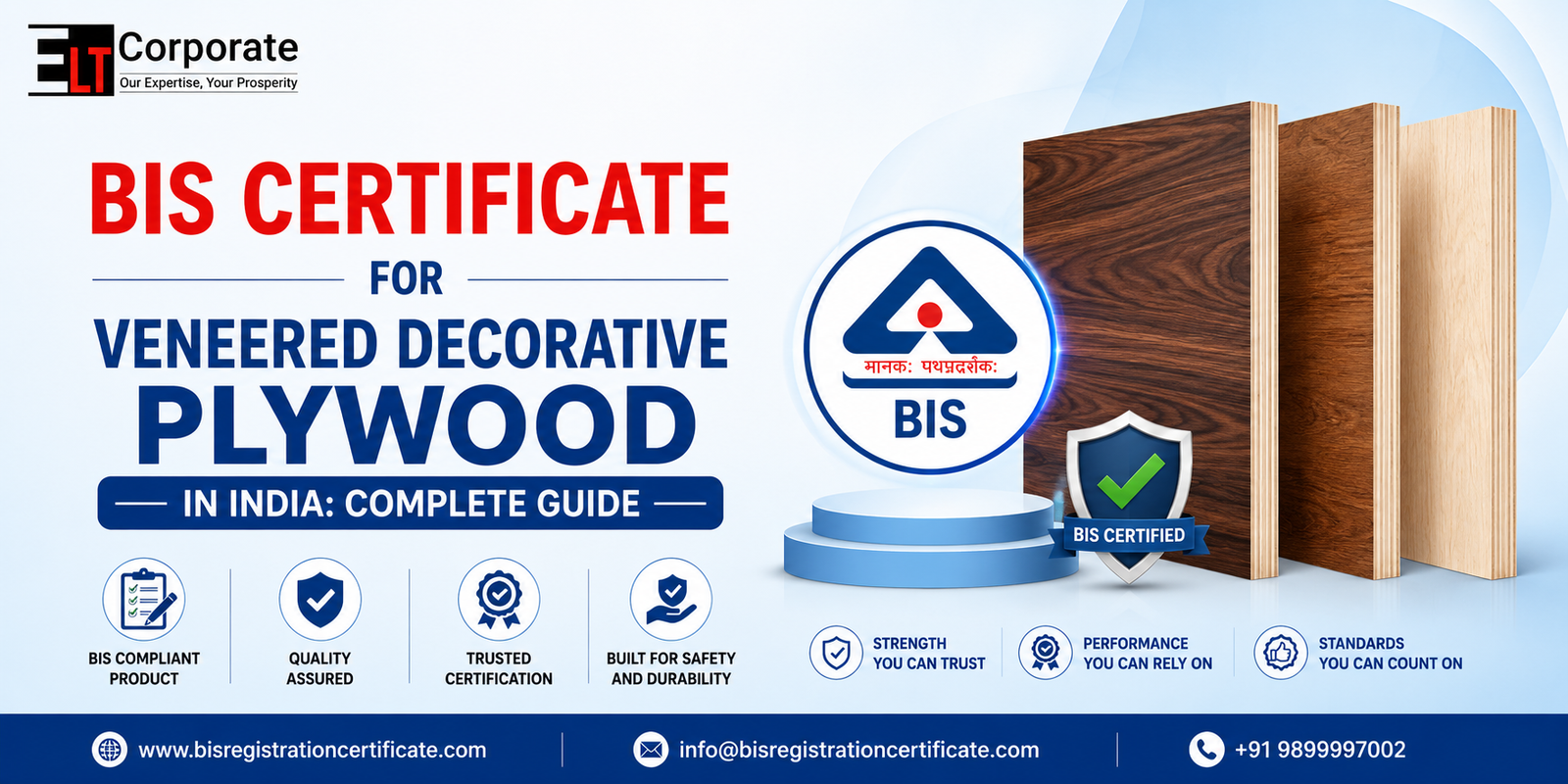
If you’re a seller or manufacturer of decorative plywood from India, BIS certification is not something you should ignore. The Bureau of Indian Standards (BIS) has set up ISI certification as a requirement for decorative plywood that has veneer in accordance with the Quality Control Order, and selling plywood that’s not certified to sell on the Indian market is thought of as a grave breach.
If you have a company that manufactures plywood and then sells it to construction companies or to furniture makers, this guide will help you be aware of when it comes to obtaining a BIS certification for veneered decorative plywood. It starts with the basic step-by-step process through the documents as well as the expense to conduct tests.
What Is Veneered Decorative Plywood?
Veneered decorative plywood is a type of engineered wood panel where a thin layer of decorative wood veneer is bonded onto a plywood base. It is widely used in:
- Interior furniture and cabinets
- Wall panelling and ceiling work
- Door shutters and partitions
- Hotel and office interiors
- Modular kitchen fittings
The decorative veneer gives the panel an aesthetic finish — often resembling premium hardwood — while the plywood core provides structural strength. This makes it one of the most commonly used materials in the Indian construction and furniture industry.
What Is a BIS Certificate for Veneered Decorative Plywood?
A BIS certificate for veneered decorative plywood is the ISI Mark certification issued by the Bureau of Indian Standards under the IS 1328 standard. Under the relevant quality control order, manufacturers of veneered decorative plywood must obtain a valid BIS license before manufacturing or selling this product in India.
The ISI mark on veneered decorative plywood confirms the following:
- The product meets Indian standards for bond quality, dimensional accuracy, and surface finish
- It has been tested at a BIS-recognised laboratory
- The manufacturer’s facility has been inspected and approved by BIS
Without this certification, your product cannot legally be sold in India.
Applicable BIS Standard
| Standard | Description |
| IS 1328: 1996 | Veneered Decorative Plywood — Specification |
This standard specifies requirements for dimensions, tolerances, moisture content, glue bond quality, species of face veneer, and surface finish for veneered decorative plywood.
Why Is BIS Certification Mandatory for Veneered Decorative Plywood?
The Government of India, through the Ministry of Commerce and Industry, has issued a quality control order making the ISI mark mandatory for plywood and wood panel products, including veneered decorative plywood. This was done to:
- Eliminate substandard and unsafe wood panel products from the market
- Protect consumers and contractors from low-quality materials
- Ensure structural integrity in construction and furniture applications
- Align Indian wood panel standards with international quality benchmarks
Penalties for Non-Compliance
- Fines up to Rs 2 lakh per offence under BIS Act, 2016
- Imprisonment up to 2 years for repeat violations
- Seizure and destruction of uncertified stock
BIS Certification Process for Veneered Decorative Plywood: Step-by-Step
Step 1 — Confirm Applicable Standard
Verify that your product falls under IS 1328 for veneered decorative plywood. If you manufacture other plywood types — such as commercial plywood or marine plywood — they fall under different IS standards.
Step 2—Apply on BIS Portal
Submit your application at manak.bis.gov.in. Create a manufacturer account, fill in company and product details, and upload initial documents.
Step 3 — Submit Product Samples for Testing
BIS will direct you to send product samples to a BIS-recognized test laboratory. Samples must be from your actual production line, not specially prepared batches.
Key tests conducted under IS 1328:
| Test | What Is Checked |
| Glue Bond Test | Adhesion strength of veneer to plywood core |
| Moisture Content Test | Moisture level within permissible limits |
| Dimensional Tolerance | Thickness, length, width accuracy |
| Surface Quality | Defects, cracks, delamination in face veneer |
| Species Identification | Verification of declared wood species |
Step 4 — Factory Inspection by BIS Officer
Unlike CRS registration for electronics, the ISI mark for plywood involves a mandatory factory inspection. A BIS officer visits your manufacturing unit to verify:
- Production process and machinery
- Raw material quality controls
- In-house testing facilities
- Record-keeping and batch marking systems
Step 5 — Grant of BIS License
If test results and factory inspection are satisfactory, BIS grants the ISI Mark License. You are now authorized to apply the ISI mark on your veneered decorative plywood.
Step 6 — Mark Products
Print or stamp the ISI Mark along with your license number on every panel or its packaging before sale or dispatch.
Required Documents for BIS Certificate
| Document | Details |
| Company incorporation certificate | From MCA / ROC |
| GST registration certificate | Active and valid |
| Factory address proof | Electricity bill, ownership deed, or rent agreement |
| Plant and machinery list | With capacity details |
| Raw material details | Species of wood, adhesive type used |
| In-house lab equipment list | Testing instruments available at factory |
| Product details | Sizes, grades, thickness range manufactured |
| Quality control plan | How you maintain product consistency |
| Trademark / brand details | If selling under a brand name |
Testing Requirements Under IS 1328
All testing must be done at a BIS-recognized laboratory. The main tests include:
Glue Bond Quality Test
This is the most critical test. The veneer must remain bonded to the core under specified temperature and soaking conditions. Delamination or peeling is a direct failure.
Moisture Content Test
The moisture content of the plywood must be within 5% to 15% as specified under IS 1328. Excess moisture leads to warping and fungal growth.
Dimensional Accuracy
Panels are measured for thickness, length, and width. Tolerances are tight — any significant deviation leads to rejection.
Surface Finish Inspection
The face veneer must be free from open defects, splits, knots, and delamination. Decorative panels are assessed visually and dimensionally.
Tips for Passing Tests First Time
- Use consistent adhesive quality across all production batches
- Maintain a dedicated in-house moisture meter and test logs
- Store raw veneer in controlled humidity conditions
- Do not submit freshly manufactured samples—allow adequate curing time
Timeline and Cost
Timeline
| Stage | Time Required |
| Application and document submission | 1–2 weeks |
| Product sample testing | 3–5 weeks |
| Factory inspection by BIS | 2–4 weeks after testing |
| BIS review and license grant | 2–3 weeks |
| Total (Typical) | 8–14 weeks |
Cost Breakdown
| Component | Approximate Cost |
| BIS application and marking fee | Rs 5,000 – Rs 20,000 per year |
| Lab testing charges | Rs 15,000 – Rs 40,000 |
| Factory inspection fee | Rs 10,000 – Rs 25,000 |
| Consultant / agency fee | Rs 20,000 – Rs 50,000 |
Total investment typically ranges from Rs 50,000 to Rs 135,000 for first-time certification.
Benefits of BIS Certificate for Veneered Decorative Plywood
For Manufacturers
- Legal right to manufacture and sell across India
- Access to government tenders — ISI mark is mandatory for public procurement
- Premium pricing—ISI-certified plywood commands better market rates
- Stronger credibility with architects, contractors, and interior designers
- Reduced returns and complaints due to standardised quality
For Buyers and Contractors
- Guaranteed product quality and dimensional consistency
- Protection against substandard materials in construction
- Easy identification of certified products via ISI mark and license number
Common Mistakes to Avoid
| Mistake | How to Avoid |
| Submitting specially made samples | Always test from regular production batch |
| Incomplete factory inspection readiness | Prepare in-house lab and records before BIS visit |
| A wrong IS standard applied | Confirm IS 1328 applies—not IS 303 or IS 710 |
| Missing raw material documentation | Keep adhesive and veneer supplier records updated |
| Not renewing the license on time | ISI licenses must be renewed annually—track expiry dates. |
| Selling without ISI mark after a license grant | Mark every panel before dispatch—BIS does surprise checks |
Conclusion
A BIS certificate for veneered decorative plywood is a legal requirement and a market necessity. With mandatory ISI mark enforcement in full effect, manufacturers who delay certification risk penalties, market bans, and loss of business to certified competitors.
The process — while involving factory inspection and product testing — is straightforward with the right preparation and guidance. Getting certified early protects your business, opens government procurement channels, and builds lasting credibility with buyers.
ELT Corporate Pvt Ltd (https://bisregistrationcertificate.com/) provides complete BIS ISI mark certification support for plywood
FAQs: BIS Certificate for Veneered Decorative Plywood
Q1. Is BIS certification mandatory for decorative plywood veneered in India?
Yes. In the quality control order, the ISI mark under IS 1328 is required for veneered decorative plywood that is manufactured and sold within India.
Q2. What is the IS standard for decorative veneered plywood?
IS 1328 The year 1996 is the most applicable BIS standard for decorative plywood veneered in India.
Q3. How do I get BIS certification for manufacturers of plywood?
Typically, 8 to 14 weeks, which include tests and inspections at the factory along with BIS reviews.
Q4. Is factory inspection compulsory for BIS plywood certification?
Yes, the ISI mark for plywood requires a mandatory BIS factory inspection before the license is granted.
Q5. How long is the BIS ISI label license in force for the wood?
The ISI mark license is valid for a year, and it must be renewed every year.
Q6. Can decorative plywood that is imported with veneer be offered for sale through India with no BIS?
No. Decorated plywood that is imported veneer must also conform to IS 1328 prior to it being able to be sold in India.
Q7. What if I decide to sell decorative plywood that is veneered without BIS certification?
You could be fined up to Rs. 2 lakh, confiscation of stock, and even possible prison time in accordance with the BIS Act, 2016.
Q8. Do I need separate BIS licenses for different thicknesses of plywood?
Generally, one license covers your full range under IS 1328. Confirm with BIS or your consultant based on your specific product range.
Q9. Can a small plywood manufacturer apply for BIS certification?
Yes. Any manufacturer producing veneered decorative plywood for sale must obtain BIS certification regardless of size.
Q10. How do I verify if a plywood product is genuinely BIS certified?
Check the ISI mark and license number on the product or packaging and verify it on the BIS official portal or BIS Care app.