Table of contents
- What Is BIS Certification for Import?
- Why Is BIS Certification Mandatory for Import?
- BIS Certification for Import: Step-by-Step Process
- Step 1 — Identify Your Product Category and Applicable Scheme
- Step 2 — Choose the Right Certification Route
- Step 3 — Select a BIS-Recognised Test Laboratory
- Step 4 — Submit Product Samples for Testing
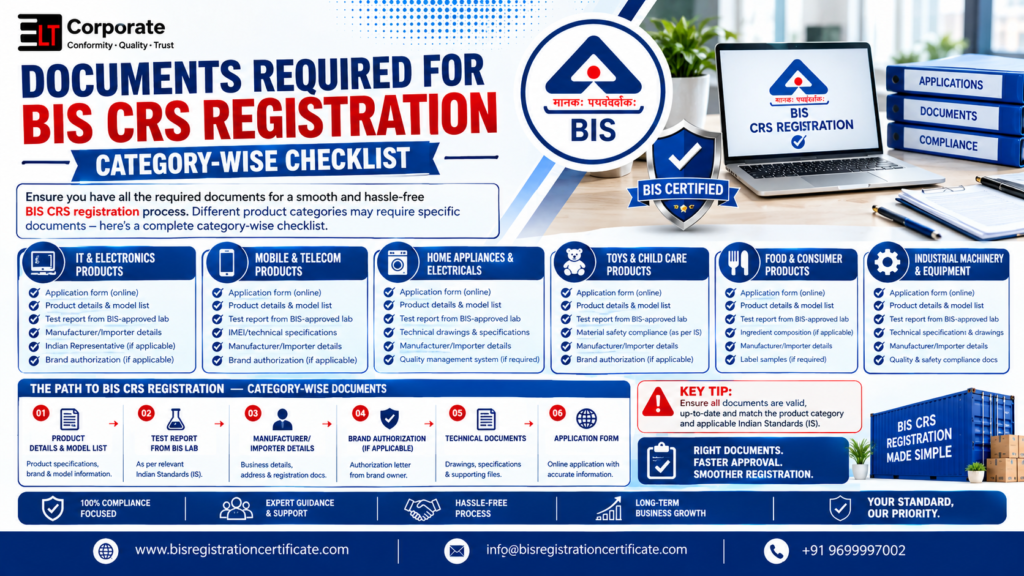
- Step 5 — Prepare All Required Documents
- Step 6 — Submit Application on BIS Portal
- Step 7 — BIS Review and Certificate Issuance
- Step 8 — Mark and Import Products
- Required Documents for BIS Import Certification
- Testing Requirements for BIS Import Certification
- BIS Import Certification: Timeline and Cost
- Benefits of BIS Certification for Importers
- Common Mistakes Importers Make (And How to Avoid Them)
- Why Delhi-Based Importers Need BIS Certification Urgently
- Conclusion
- FAQ ‘s
India is a growing market for imports. As it grows, there are rules to follow. If you plan to import electronics, IT products, or other specific items into India, you need BIS certification. It is not optional. It is a must.
The Bureau of Indian Standards makes rules for how safe and good products should be when they are sold in India. If the things you sell do not have a BIS certificate, they might get stopped at customs, taken away, or sent back to you. This can waste a lot of your time and money. Hurt your business.
This guide will tell you all about getting a BIS certificate in India. It will explain the plans, what you need to do step by step, what papers you need, how products are tested, how long it takes, and how much it costs. If you get things from China, South Korea, Germany, or some other country, then this guide is really for you; it will help you with BIS certification in India. I’ll tell you all about BIS certification.
What Is BIS Certification for Import?
The Bureau of Indian Standards certification is really important for importing things into India. This is something that you have to do because of the Bureau of Indian Standards Act from 2016. The Bureau of Indian Standards certification makes sure that the things we import are safe and good enough to be sold in India. The imported products have to meet the safety standards and the Indian quality standards and the Indian performance standards before people can buy them in India.
The BIS operates multiple certification schemes for imported goods. Depending on your product category and business model, you will fall under one of the following:
| Scheme | Full Name | Who It Applies To |
| CRS | Compulsory Registration Scheme (CRS) | Indian importers of notified electronics & IT products |
| FMCS | Foreign Manufacturers Certification Scheme | Foreign manufacturers exporting to India |
| ISI Mark | Indian Standards Institution Mark | Products requiring ISI certification (cement, steel, etc.) |
| Scheme X | Conformity Assessment Scheme | Products not covered under CRS or ISI |
For most electronics and IT product importers, CRS is the applicable scheme. For foreign manufacturers who want to certify in their own name, FMCS is the route.
Why Is BIS Certification Mandatory for Import?
The Electronics and IT Goods (Requirements for Compulsory Registration) Order, 2012, under MeitY, lists over 65 product categories that require mandatory BIS registration before import or sale in India. Similarly, other ministries have notified additional products under various BIS schemes.
Consequences of Importing Without BIS Certification
- Consignment detention at ports and ICDs
- Fines up to ₹2 lakh per offence
- Imprisonment up to 2 years for repeat violations
- Forced re-export or destruction of goods
- Delisting from e-commerce platforms like Amazon India and Flipkart
For importers operating through Delhi’s ICD Tughlakabad or ICD Patparganj, Customs officers routinely verify BIS compliance for notified product categories. A missing R-number or registration certificate leads to immediate detention of the consignment.
BIS Certification for Import: Step-by-Step Process
Step 1 — Identify Your Product Category and Applicable Scheme
The first step is to confirm whether your product falls under a notified category and which BIS scheme applies. Check the MeitY CRS list or consult a BIS expert. Common imported products requiring BIS certification include:
- Mobile phones and tablets
- Laptops and computers
- LED lights and luminaires
- Power banks and batteries
- CCTV cameras and surveillance equipment
- Set-top boxes and smart TVs
- Kitchen appliances and water heaters
Step 2 — Choose the Right Certification Route
If you are an Indian importer: Apply under CRS—you will hold the registration in your company’s name as the authorized representative of the foreign manufacturer.
If you are a foreign manufacturer: Apply under FMCS—your company holds the BIS license directly, which allows multiple Indian importers to use your certification.
Step 3 — Select a BIS-Recognised Test Laboratory
Your product must be tested at a BIS-recognized laboratory. Both Indian and overseas labs are accepted.
Top BIS-recognized labs in Delhi-NCR:
| Lab | Location |
| STQC ETDC | Okhla, New Delhi |
| Intertek India | Gurgaon |
| Bureau Veritas | Noida |
| TÜV Rheinland India | Gurgaon |
| SGS India | Greater Noida |
For products manufactured in China, testing at overseas BIS-recognized labs in Shenzhen or Guangzhou is widely preferred—it saves shipping time and cost.
Step 4 — Submit Product Samples for Testing
Send 3 to 5 production-ready units to the lab along with full technical documentation—circuit diagrams, BOM, user manual, and product specifications. The test report is the most critical document in your application.
Step 5 — Prepare All Required Documents
While testing is in progress, gather all supporting documents (see full list below). Doing this in parallel saves 1-2 weeks.
Step 6 — Submit Application on BIS Portal
Once the test report is ready, log in to manak.bis.gov.in, create your account, fill in all product and company details, upload documents, and pay the applicable government fee.
Step 7 — BIS Review and Certificate Issuance
BIS reviews your application. If documents are complete, the Registration Certificate (R number) is issued. If BIS raises queries, respond promptly—delays in response extend your timeline significantly.
Step 8 — Mark and Import Products
Once certified, print the BIS Standard Mark and R-Number on every unit. Your product is now cleared for import and sale across India.
Required Documents for BIS Import Certification
For Indian Importers (CRS)
| Document | Details |
| Company incorporation certificate | From MCA/ROC |
| GST registration certificate | Active and valid |
| Import Export Code (IEC) | Issued by DGFT |
| Authorisation letter from foreign manufacturer | Appointing Indian entity as an authorized representative |
| Foreign manufacturer’s factory address proof | In English or notarised translation |
| Test report from a BIS-recognized lab | In name of applicant |
| Product photographs | All sides — front, back, ports, labels |
| Product details | Model name, model number, specifications |
| Declaration of conformity | Signed by authorised signatory |
| Brand/trademark ownership or authorisation | Trademark certificate or brand letter |
For Foreign Manufacturers (FMCS)
| Document | Details |
| Foreign company registration certificate | — |
| Factory address proof | — |
| Quality management system certificate | ISO 9001 preferred |
| Test report from a BIS-recognized lab | — |
| Product technical documentation | — |
| Authorised Indian Representative details | — |
Delhi Tip: Importers operating from Delhi must ensure their IEC, GST, and company name match exactly across all BIS documents. Even minor discrepancies—like “Pvt Ltd” vs. “Private Limited”—trigger queries and delay registration by weeks.
Testing Requirements for BIS Import Certification
Testing requirements vary by product category. However, the general framework includes:
Common Tests Conducted
- Electrical Safety Tests — insulation resistance, dielectric strength, earth continuity
- EMI/EMC Tests — electromagnetic interference and compatibility
- Thermal and Fire Safety Tests — temperature limits, fire enclosure, abnormal heat
- Mechanical Safety Tests — stability, drop, crush resistance
- Battery Safety Tests — overcharge, short circuit, discharge (per IEC 62133 / IS 16046)
- Marking and Labelling—warning text, language, label permanence
Tips to Speed Up Testing
- Always submit final production samples—never prototypes
- Provide complete technical documentation upfront
- If your product has an existing test report from an overseas lab, check if it can be referenced
- Confirm lab’s specific scope of accreditation for your product’s IS standard
BIS Import Certification: Timeline and Cost
Timeline
| Stage | Time Required |
| Lab Testing (India) | 3–6 weeks |
| Lab Testing (Overseas) | 2–4 weeks |
| Document Preparation | 1–2 weeks |
| BIS Portal Review | 2–4 weeks |
| Total (Typical) | 6–10 weeks |
With experienced handling and complete documents, the entire process can be completed in 6–8 weeks.
Cost Breakdown
| Component | Approximate Cost |
| Lab Testing (India) | ₹40,000 – ₹120,000 |
| Lab Testing (Overseas) | USD 800 – USD 2,500 |
| BIS Government Fee | ₹1,000 – ₹5,000 |
| Consultant / Agency Fees | ₹15,000 – ₹60,000 |
Total per product model typically ranges from ₹70,000 to ₹200,000, depending on product complexity and testing location.
Benefits of BIS Certification for Importers
Legal and Regulatory Benefits
- Full legal compliance with Indian import regulations
- Smooth customs clearance at all ports and ICDs
- Avoid consignment seizures, fines, and forced re-exports
- Eligible to import continuously without regulatory interruptions
Business Benefits
- Access to Amazon India, Flipkart, and all major retail channels
- Preferred supplier status with Indian distributors and wholesalers
- Eligibility for government tenders and public procurement
- Stronger brand credibility in wholesale markets like Nehru Place, Delhi
- Protection of brand exclusivity—only your registered product can use your R number
Common Mistakes Importers Make (And How to Avoid Them)
| Mistake | How to Avoid It |
| Importing before getting BIS registration | Always get certified before shipment arrives |
| Submitting prototype samples for testing | Test only final production-ready units |
| Name mismatch across documents | Standardize legal names across IEC, GST, and BIS portals. |
| Generic authorisation letter from foreign manufacturer | Use a BIS-specific authorisation letter template |
| Registering one model and selling variants | Each distinct model needs its own R-number. |
| Ignoring renewal deadline | Registration valid for 2 years — renew 3 months early |
| Choosing wrong lab scope | Verify lab is accredited for your specific IS standard |
| Not checking product against CRS list | Confirm your product is notified before applying |
Why Delhi-Based Importers Need BIS Certification Urgently
Delhi is India’s largest import hub for electronics and consumer goods. Here is why BIS compliance is especially critical for Delhi-based importers:
- ICD Tughlakabad—one of India’s busiest dry ports, handles thousands of electronics consignments monthly. BIS checks are routine here.
- ICD Patparganj — another major import hub where non-compliant goods are frequently detained.
- Nehru Place and Lajpat Rai Market — Delhi’s wholesale electronics markets where buyers and distributors actively demand BIS-certified products.
- BIS Central Office at Manak Bhavan, New Delhi — headquarters for all CRS and FMCS matters, making Delhi the most accessible city for in-person consultations.
- Strong lab ecosystem — STQC Okhla, Intertek Gurgaon, Bureau Veritas Noida, and more — all within 30 km of Delhi.
Conclusion
BIS certification for import is a non-negotiable requirement for anyone bringing notified products into India. The process is clear and manageable when handled correctly — with the right lab, accurate documents, and experienced guidance.
For Delhi-based importers, especially, getting BIS certified before your shipment arrives is the difference between smooth clearance and expensive delays at ICD Tughlakabad or ICD Patparganj.
ELT Corporate Pvt Ltd handles end-to-end BIS import certification — from identifying the right scheme and coordinating lab testing to portal submission and certificate delivery. Reach out today and get your products import-ready.
FAQ‘s
Q1. Is BIS certification mandatory for all imported products in India?
No. Only products listed under “non-required schemes”—such as CRS, ISI, or FMCS—require mandatory certification. Check the MeitY CRS list or consult a BIS expert to confirm your product.
Q2. What is the difference between CRS and FMCS for importers?
CRS is for Indian importers who hold the registration on behalf of the foreign manufacturer. FMCS is for foreign manufacturers who want to register in their own name for the Indian market.
Q3. Can I import products while my BIS application is under review?
No, it must be granted before import and sale. Importing without valid certification risks detention and penalties at Customs.
Q4. How long does BIS import certification take?
Typically 6–10 weeks, including testing and BIS review. With experienced handling and complete documents, it can be done in 6–8 weeks.
Q5. Can I use test reports from outside India for BIS import certification?
Yes, BIS accepts test reports from labs that BIS recognizes and that are located overseas. This is often the case for products made and tested in countries like China before they are exported to India.
Q6. How long is BIS import certification valid?
BIS CRS registration is valid for 2 years. FMCS licenses are also renewed periodically. Always renew before expiry to maintain uninterrupted import compliance.
Q7. Is a separate BIS registration needed for each product model?
Yes. Each distinct model requires its own BIS registration and R number. Color or storage variants may share registration if hardware is identical—confirm with your consultant.
Q8. What documents does the foreign manufacturer need to provide?
The foreign manufacturer must provide proof of factory address, an authorization letter appointing the Indian entity as their representative, and manufacturing details. All documents must be in English or a notarized translation.
Q9. Can I check if a product already has BIS certification?
Yes. Use the BIS Care app (Android/iOS) or visit the BIS official portal. Enter the R-number printed on the product to verify registration status and validity.
Q10. What happens if my BIS registration expires and I continue importing?
Importing after registration expiry is treated the same as importing without certification — your consignments can be detained, fined, or destroyed. Always renew at least 3 months before expiry.