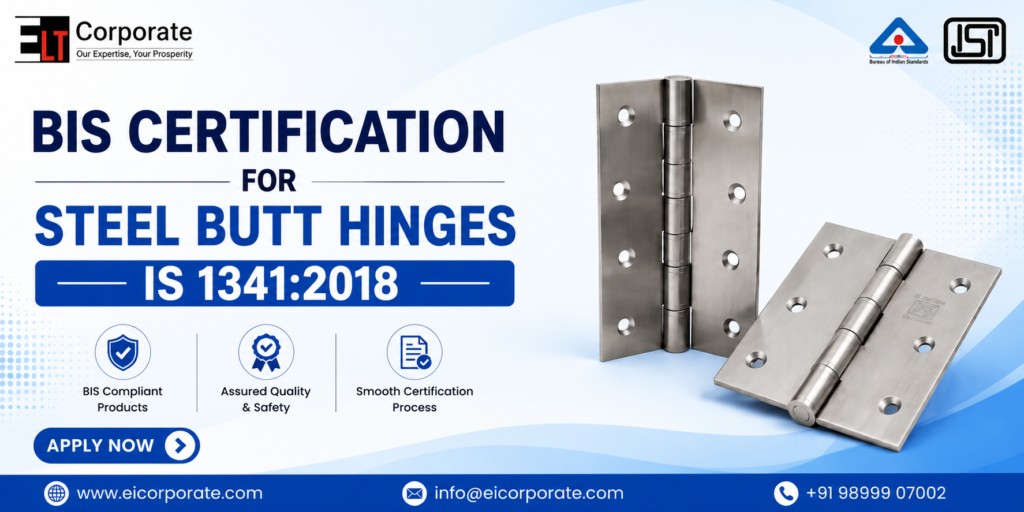
BIS certification is required for hinges made of steel, as in IS 1341:2018, which sets out the strict requirements for the materials, dimensions, manufacturing, and finishing procedures. Made primarily of steel, they represent the highest level of durability and endurance, which makes them invulnerable to wear, rust, or environmental damage.
Their robust structure makes them an ideal choice for areas that require heavy-duty, such as industrial or commercial settings in which large gates, doors, cabinets, or other structures require a flexible hinge mechanism. The flexibility and dependability that steel hinges provide are demonstrated by their ability to withstand the tests of time, ensuring stability and smooth operation in constant usage conditions.
Their reliability and durability ensure the best swinging and pivoting capabilities for gates and doors that ensure continuous operation in a range of maintenance, industrial renovation, construction, and situations. Because of their strength and flexibility, steel butt hinges are extremely sought-after and are essential hardware components in crucial areas where reliability is crucial.
Why Did the BIS Certificate for Steel Butt Hinges Become Mandatory?
The Government of India, through the Ministry of Commerce and Industry, issued the Hinges Quality Control Order (QCO), 2023, which brought hinges firmly under the mandatory BIS certification framework. The core reason? A significant volume of substandard hinges—both domestically made and imported—was flooding the market, causing product failures in everything from residential doors to industrial cabinetry.
The BIS Certificate for Steel Butt Hinges is now the government’s way of drawing a clear line: either your product meets the Indian Standard or it doesn’t enter commerce. This isn’t bureaucratic box-ticking. It’s a direct response to quality failures that were affecting consumers and eroding trust in the hardware sector.
The requirement is applicable to companies in the steel butt hinges IS 1341:2018 (Steel Butt Hinges) specification and includes lightweight, medium weight, broad, square, and heavyweight specifications with dimensional tolerances and finish requirements.
What IS 1341:2018 Actually Demanding?
Most people think of the BIS Certificate for Steel Butt Hinges as just a lab test. It’s much more than that. IS 1341:2018 sets out the following:
- Material Specifications — The steel used must conform to specific grades. Cheap substitutes that look the same visually but degrade faster under load simply won’t pass.
- Dimensional Accuracy — Hole locations, number of knuckles, and leaf thickness are all verified against specified tolerances. A small discrepancy can be cause for failing an audit.
- Surface Finish Standards — Hinges must be free from sharp edges, pitting, cracks, or any defect that would compromise either safety or longevity.
- Performance Under Load — The hinges are tested for their ability to bear operational stress over repeated use cycles, not just static weight.
This is why the BIS certificate for steel butt hinges carries real weight with procurement teams, builders, and institutional buyers—they know what it took to earn it.
The Step-by-Step Path to Getting Your BIS Certificate for Steel Butt Hinges
Here’s how the process actually works on the ground:
Step 1 — Internal Readiness Check Before you even file an application, audit your own manufacturing process against IS 1341:2018. Many first-time applicants lose time because they discover mid-process that their current raw material sourcing doesn’t align with the standard.
Step 2 — Document Compilation You’ll need your company incorporation certificate, GST registration, factory license, detailed product technical drawings, an ISO 9001 quality management certificate, and an authorized signatory declaration. Importers are also required to have the Import-Export Code (IEC) and relevant import documentation.
Step 3 — Application Submission (Form VI) The application goes to the relevant BIS regional office along with all supporting documents and the prescribed fee.
Step 4—Application Review BIS officials verify your submission. Inconsistent or incomplete documentation at this point causes major delays, another reason to be thorough up front.
Step 5 — Factory Audit An approved BIS auditor visits your facility to inspect your production line, quality control systems, and testing equipment. This is a hands-on inspection, not a paper review.
Step 6 – Product Testing The BIS-recognized laboratory sent the samples. The test reports shall be as per IS 1341:2018 for all relevant parameters.
Step 7 — License Grant: BIS is satisfied with the factory audit and test results; the certification license is awarded. You can now lawfully affix the ISI Mark on your steel butt hinges.
Hinge Types Covered Under the 2023 QCO
One of the many certifications required by 2023 (Quality Control Order) QCO is the BIS certificate for steel butt hinges. Here’s the full picture of what’s covered:
| Indian Standard | Product |
| IS 1341:2018 | Steel Butt Hinges |
| IS 12817:2020 | Stainless Steel Butt Hinges |
| IS 205:1992 | Non-Ferrous Metal Butt Hinges |
| IS 206:2010 | Tee and Strap Hinges |
| IS 362:1991 | Parliament Hinges |
| IS 3818:1992 | Continuous (Piano) Hinges |
| IS 3843:1995 | Steel Back Flap Hinges |
| IS 453:1993 | Double-Acting Spring Hinges |
| IS 18297:2023 | Cabinet Hinges |
If your product line spans multiple categories, you’ll need separate certifications for each.
What Happens Without a BIS Certificate for Steel Butt Hinges?
The consequences aren’t hypothetical. Non-certified hinges:
- Cannot legally be sold in India under the QCO framework
- Will be held at customs if being imported
- Expose the manufacturer or importer to penalties and potential seizure
- Are increasingly rejected by large contractors, real estate developers, and institutional buyers who conduct compliance checks before procurement
The market is actively self-correcting. Buyers who once overlooked certification are now making it a minimum requirement — not because they’re suddenly more diligent, but because their own liability exposure has grown.
Benefits of BIS Certification for Steel Butt Hinges
There is a tendency to look at the BIS Certificate for Steel Butt Hinges as a mere compliance hurdle, but manufacturers who have gone through the process often report unexpected commercial benefits:
- Better Export Positioning—The ISI Mark, while an Indian standard, is a quality signal to international buyers, especially in markets that have had issues with unverified Indian hardware exports.
- Reduced Returns and Warranty Claims — The process of getting certified typically forces internal quality improvements that reduce product defects downstream.
- Preferred Vendor Status — Government projects, large infrastructure contractors, and institutional buyers are increasingly mandating BIS-certified components in their procurement specifications.
- Customer Trust – For companies selling direct to consumers or to retailers, the ISI Mark on the packaging is a visible, recognizable sign of quality that competitors without certification cannot match.
Conclusion
Closing Thoughts: BIS certification for steel butt hinges is not just a regulatory hurdle; it’s becoming a standard feature in a market that’s becoming more quality-conscious year after year. For domestic manufacturers scaling up or foreign exporters looking to enter the Indian market, getting certification right the first time means shaving months off waiting periods and securing your place in the marketplace.
If you are at the beginning of this journey, begin with an honest internal audit of your existing manufacturing process against IS 1341:2018. That single step will tell you more about your readiness than any checklist can.
For certification assistance, visit bisregistrationcertificate.com
Frequently Asked Questions
Q1: BIS certificate for steel butt hinges for all manufacturers?
Yes. QCO by Hinges The 2023 BIS certification is compulsory for all manufacturers under IS 1341:2018. It is an offense to sell uncertified hinges in India.
Q2. How long does it take to get a BIS certificate for steel butt hinges?
The time can vary depending on how prepared you are and how fast you can get the factory audit and the lab test. On average companies that go in well-prepared can take 3 to 6 months. Delays mostly happen because of incomplete documents in the application or lab test product failure.
Q3. Can a small BIS (Bureau of Indian Standards) certification be for steel butt hinges?
Yes, scale of operation doesn’t disqualify a manufacturer from applying. However, small manufacturers have to be the same quality as big ones. Some MSME-specific provisions may apply regarding fee structures—it’s worth checking with BIS directly or through a certification consultant.
Q4. What Indian Standard is for steel butt hinges?
IS 1341:2018 Steel butt hinges This standard provides for five categories of hinges, namely, lightweight, medium weight, broad, square, and heavyweight. The standard specifies the dimensions, material grade, and surface finish of each category.
Q5. Do importers of steel butt hinges also need a BIS certificate for steel?
Yes. Foreign manufacturers exporting steel butt hinges to India have to either get BIS certification or have an authorized Indian representative (AIR) who will be responsible for the conformity. Hinges without papers will be blocked at customs.
Q6. What tests are done in a lab for steel butt hinges when BIS certified?
Testing checks whether it’s the right size, the right metal, how smooth it is, how much it can hold, and if it is free of pits or cracks. All tests are done in BIS labs, and they must pass every parameter defined in IS 1341:2018.
Q7. Is ISO 9001 certification required to apply for BIS certification?
ISO 9001 (Quality Management System certification) is one of the documents required during the application. It shows that your manufacturing plant has a good quality management system. BIS uses this as a part of its assessment.
Q8. What happens if a certified product fails the quality standard after being certified?
After certification, BIS undertakes surveillance activities such as market sample testing. If a certified product is found to be deficient, BIS can cancel the license and prosecute. That’s why keeping up your quality standards after certification is as important as passing the audit.
Q9. Is it possible to transfer BIS certification for steel butt hinges in case there is a change in ownership of the business?
No, a BIS certificate is issued to a legal entity and manufacturing location and cannot be transferred. In case there is a change in ownership or structure of the company or manufacturing address, fresh communication is to be made to BIS, which may require a fresh application or amendment process.
Q10. How often does BIS certification for steel butt hinges need to be renewed?
BIS licenses are valid for a term of one to two years in general. They need to be renewed before the expiration period. BIS can carry out periodic audits during the validity period of the license to check the compliance. The renewal process requires continuous adherence as per the guidelines of IS 1341:2018.