India’s regulatory landscape for product certification is becoming more stringent every year. Whether you are a domestic manufacturer or a foreign employer planning to move into the Indian market, Bureau of Indian Standards (BIS) certification is a regular must. However, the process is complex, heavy with documentation, and prone to delays if not dealt with effectively. This is one in which a professional BIS certification representative plays an important role.
In this booklet, you will find out the whole lot often BIS certification, why it is important to hire a representative, the entire type, costs concerned, and the way to choose the right BIS consultant in India.
What is BIS Certification in India?
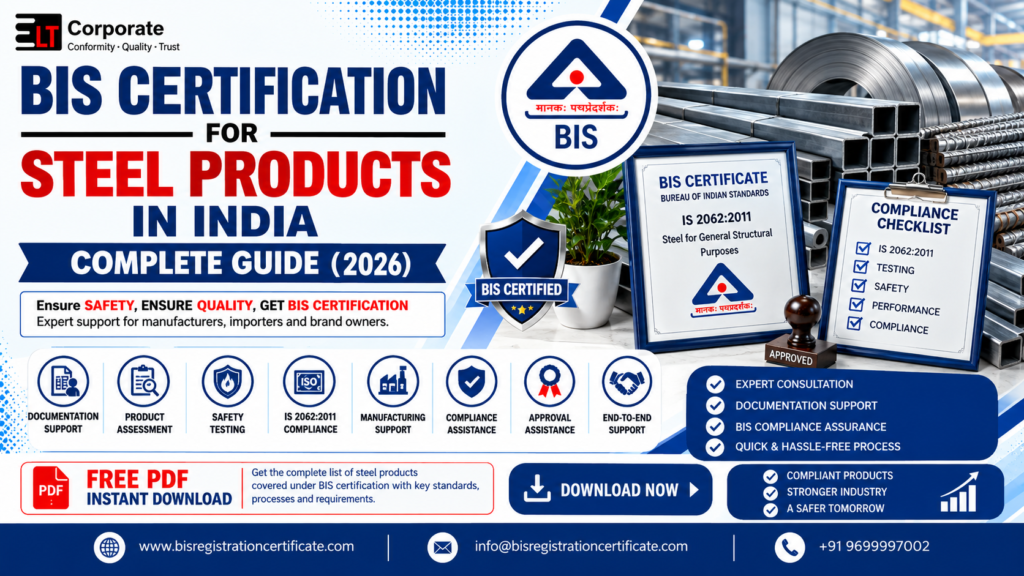
The Bureau of Indian Standards (BIS) is the country-wide authority responsible for setting first class and protection requirements for goods bought in India BIS certification guarantees that products meet specified Indian standards and are safe for buyers.
There are two styles of BIS certification depending on the product category:
- ISI Mark Certification – For domestic manufacturers
- CRS (Compulsory Registration Scheme) – for electronics and IT products
- FMCS (Foreign Manufacturer Certification Scheme) – For foreign manufacturers
If your product falls under mandatory certification, it cannot be legally sold in India without BIS approval.
Why You Need a BIS Certificate Consultant
Many corporations underestimate the complexity of BIS certification. A small error in the documentation or product category can result in a denial or a lengthy delay.
An expert BIS Certification Consultant enables you to:
- Fitting in your product IS thinking general
- To prepare proper documentation and applications
- Coordination with BIS-approved laboratories for check out
- Handling questions raised by BIS officials
- Manage inspection and compliance requirements
- Reducing approval time and heading off rejections
Without specialist operations, corporations routinely face multiple rejections, leading to multiplied fees and a lack of marketplace opportunity.
Types of BIS Certification in India
Understanding the ideal certification type is the first step to compliance.
1. ISI Mark Certification
Applicable to Indian manufacturers for products like metal, cement, kitchen appliance etc. It includes manufacturing facility inspection and product testing.
2. CRS registration
A must for electronics together with mobile phones, LED light fixtures, power banks and IT equipment. Testing is performed in BIS-diagnosed laboratories.
3. FMCS (Foreign Manufacturer Certification Scheme)
Designed for foreign producers who want to export goods to India. This includes audits of manufacturing facilities and strict compliance checks.
Choosing the wrong plan is one of the most common causes of software rejection.
Step-by-Step BIS Certification Process
BIS certification techniques vary slightly depending on the plan, but well-known steps are:
Step 1: Product Identification
Determine whether the right is common and relevant for your product.
Step 2: Documentation preparation
Prepare technical documents, check reports, organizational information, and compliance declarations.
Stage 3: Product testing
Send samples to BIS-approved laboratories for testing as per Indian standards.
Step 4: Application filing
Submit the software with all required documents through the BIS portal.
Step Five: Factory inspection (if applicable)
BIS officers may additionally check the production facility to confirm compliance.
Step 6: Query Handling
Respond to any questions or objections raised by the BIS.
Step 7: Grant of license
Once the composite has been tested, BIS allows certification or registration.
A representative guarantees that every step is dealt with effectively to avoid delays.
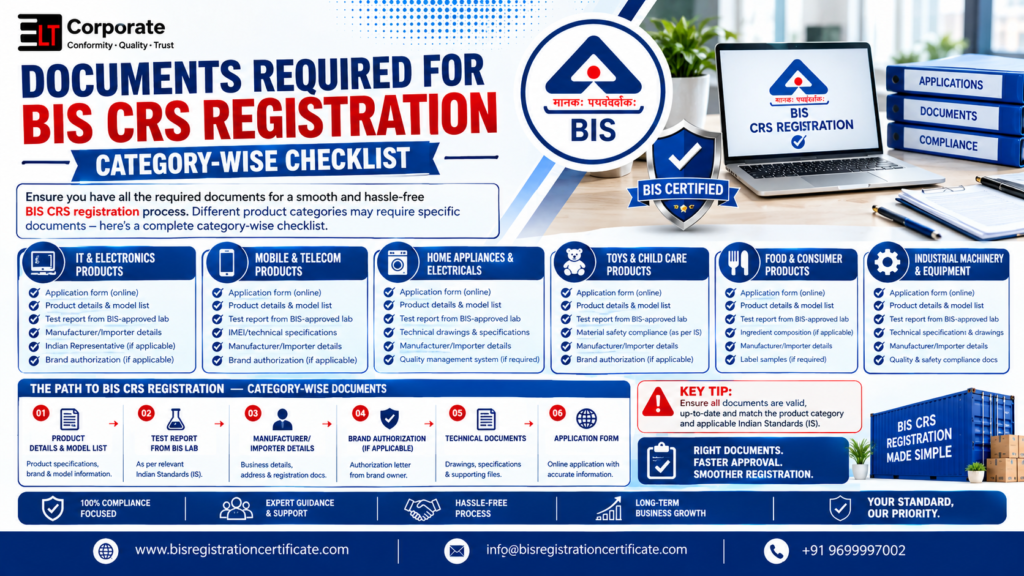
Documents Required for BIS Certification
Documentation requirements depend on the form of certification, but generally include the following:
- Company registration files
- Construction License Notice
- Product Technical Glasses
- Test reports from BIS-authorized laboratories
- quality control documents
- Trademark certificates (if relevant)
- Letter of Authorization (from traders or consultants)
Incomplete or inaccurate documentation is one of the most important of all reasons for rejection.
Cost of BIS Certification in India
The cost of BIS certification depends on multiple factors:
- Type of certification (ISI, CRS, FMCS)
- Product category and testing requirements
- Government fees
- Laboratory testing charges
- Consultant fees
For CRS, costs are relatively lower, while FMCS can be more expensive due to factory inspections and compliance requirements.
A good consultant helps you optimize costs by avoiding unnecessary testing and rework.
Common Mistakes That Lead to Rejection
Many applications get delayed or rejected due to avoidable errors. Some of the most common mistakes include:
- Incorrect selection of IS standard
- Mismatch in product details and test reports
- Incomplete documentation
- Poor coordination with testing laboratories
- Ignoring BIS queries or delayed responses
- Non-compliance during factory inspection
Avoiding these mistakes can significantly increase your chances of faster approval.
How to Choose the Top BIS Certificate Consultant in India
Not all consultants provide the same level of expertise. When selecting a BIS consultant, consider the following:
- Proven experience in BIS certification
- Knowledge of multiple schemes (ISI, CRS, FMCS)
- Strong documentation and compliance team
- Ability to handle BIS queries effectively
- Transparent pricing and timelines
- Experience with both Indian and foreign clients
A reliable consultant does not just file your application but manages the entire process end-to-end.
Why ELT Corporate is a Trusted BIS Consultant in India
When it comes to BIS certification, experience and execution matter more than anything else. ELT Corporate offers complete support for businesses looking to obtain BIS certification smoothly and efficiently.
Key strengths include:
- End-to-end BIS certification support
- Expertise across ISI, CRS, and FMCS schemes
- Strong documentation and compliance handling
- Dedicated team for query resolution
- Experience with complex and rejected cases
- Focus on faster approvals and minimal delays
The goal is not just to get certification but to ensure long-term compliance and business continuity.
Conclusion
BIS certification is not just a regulatory requirement but a gateway to enter and scale in the Indian market. However, the methodology involves technical expertise, proper documentation and ongoing coordination with the government.
Working with a top BIS certification representative in India guarantees that your software is accurate, compliant and processed without unnecessary delays. If you are planning to get BIS certification, taking professional guidance from the beginning can save you every time and fees and increase your chances of approval.
A professional BIS consultant isn’t always an option for extreme groups when it comes to coming into the Indian market—it’s a necessity.