
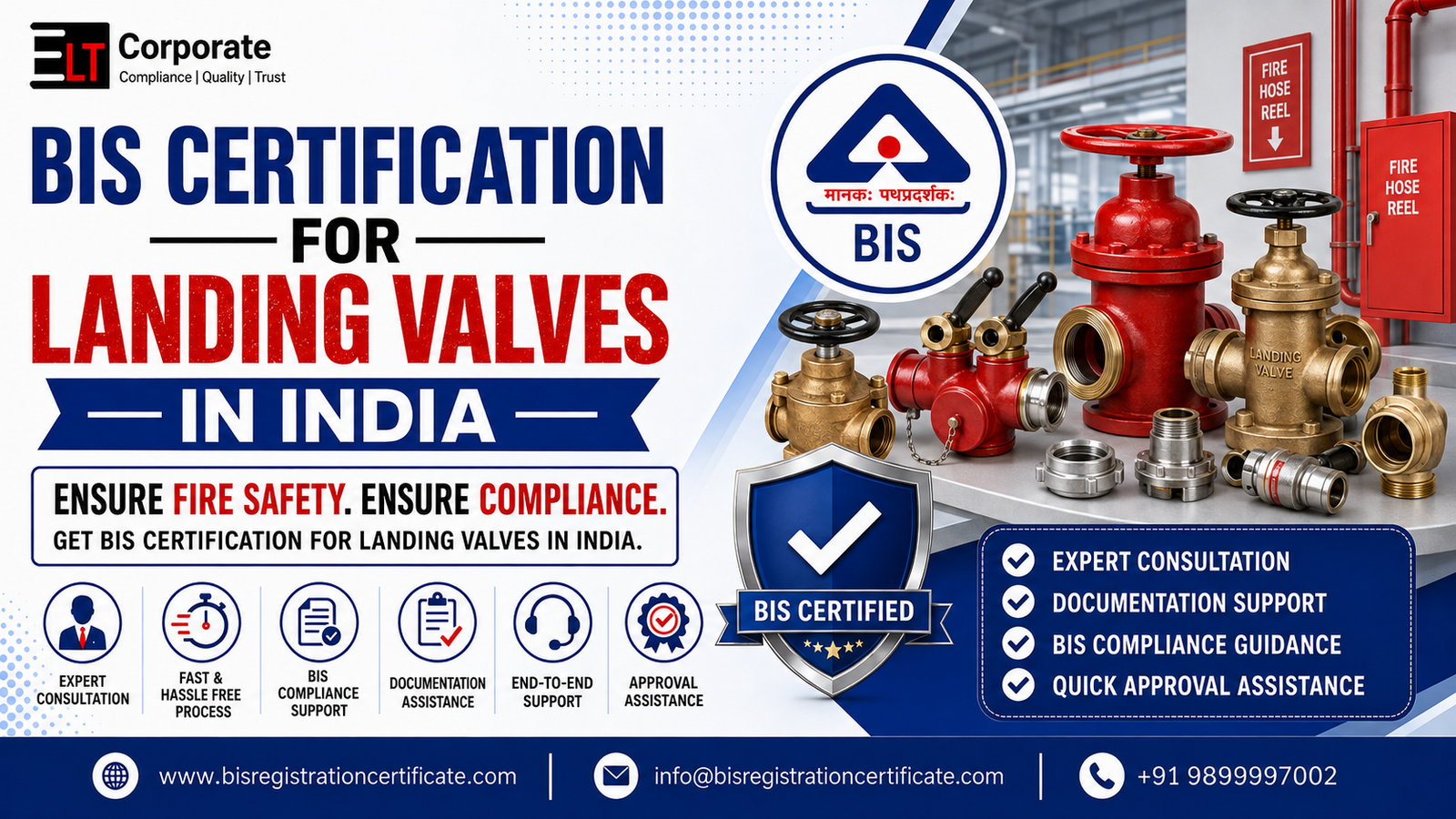
The landing valves make up one of the important elements of a structure’s infrastructure for fire safety. Installed on staircases as well as floor landings and water hydrant locations, the valves permit the firefighters to obtain a controlled and sufficient amount of water in the event of an emergency fire. Because of the vital role they serve in life safety, their role is vital to ensure that they’re safe. The Bureau of Indian Standards (BIS) has set out rigorous quality and performance standards for landing valves in accordance with IS 5290. BIS certification for landing valves has been an essential requirement for all manufacturers who wish to sell, distribute, or install these items in India.
In the blog in this article, we’ll explain what landing valves are and their purpose, why BIS certification is important for these valves, the standard that regulates their certification, and the process of obtaining them as well as the documentation and compliance measures manufacturers have to take in preparation.
Need BIS Certification for Your Landing Valves Under IS 5290?
What Are Landing Valves?
The landing valve can be described as a valve operated manually that is connected to a riser system. It is typically located on every floor landing in an industrial facility or a public structure. If a fire starts to spread, firefighters connect a hose to the outlet of the landing valve and then turn the valve on to draw water pressurised from the fire hydrant system. Since these valves are typically the first point of entry to water in emergencies, their durability as well as strength and leak resistance directly impact how fast and safely the fire is brought under control.
Landing valves are typically made out of leaded tin bronze alloy or stainless steel according to the purpose and whether the valve is exposed to fresh water as well as seawater. They can be broadly divided into two kinds:
- Type A Single-Outlet Landing Valve: With one outlet for one connection to a hose.
- Type B Double-Head Landing Valve: With two outlets that allow the connection of two hoses at once to increase the water flow rate.
Both are built to withstand pressures that are high while ensuring an encapsulated seal, smooth operation of the valve, and corrosion resistance through many years of usage.
Why BIS Certification Is Required for Landing Valves
Equipment for fire safety is not something that can be placed in the hands of fate. Landing valves aren’t any exception. BIS certification guarantees that every landing valve that is sold in India is tested and verified against a predetermined national standard for quality of material, precision of dimensional measurement, and pressure tolerance and long-term durability. This is the reason this certification is important:
1. Mandatory compliance of market entry landing valves falls into the category of products for which BIS approval is needed prior to their being legally manufactured, imported, sold, or made available in India. Without an official BIS licence as well as ISI certification and the ISI label, producers are unable to sell these valves to contractors, builders, fire safety contractors, or government-funded projects.
2. Guaranteed Safety: A fire-qualified landing valve will be tested to ensure that it can provide a stable and safe flow of water at a pressure without leaks or failing at joints. This is vital because a damaged valve in an emergency fire can result in the loss of life and even property.
3. Material and Build Quality Assurance: The standard specifies the precise types of bronze, aluminium alloy, and stainless steel that may be used in parts like valve bodies, spindles, the outlet spring, and parts. This will prevent the use of inferior metals, which could corrode, crack, or even seize as time passes.
4. Credibility and trust: Credibility, Trust, and Credibility Government or Private Projects Fire safety consultants, contractors, builders, and government departments require ISI-certified landing valves for factories and high-rise structures and hospitals, as well as public infrastructure. Certification grants manufacturers direct access to these huge-scale purchasing opportunities.
5. Legal Protection from Penalties: Supplying or selling uncertified landing valves in areas where BIS certification is required can be subject to penalties and seizure of products, as well as legal actions pursuant to lawful action under the BIS Act. Certification helps manufacturers comply with Indian regulations.
The Governing Standard: IS 5290
BIS approval for valves that land is granted under the IS 5290 standard, which is the Indian Standard specification for landing valves that are used in systems for fighting fire. The standard was first released in 1969 and was revised several times to be in line with the advancements in technology and fire safety regulations. The most current version is IS 5290:2025.
The standard covers various important parameters, such as:
- Specifications for the material of the valve body and stop valve, bonnet check outlet, and instantaneous, as well as blank caps, which allow particular grades of aluminium alloy or stainless steel, based on the application.
- Spring specifications, which require copper wire with phosphor bronze for alloy valves and stainless steel for aluminium alloys and zinc alloys, along with stainless steel valves.
- Dimensional and design specifications to be met for the Type A (single outlet) and Type B (double head, double outlet) landing valves.
- The requirements of surface finish, assuring the parts are free from sharp edges, burrs, casting defects, and illegal repair welding.
- Tests of pressure and leak-tightness to determine if the valve can stand up to pressure and never fail.
- Specific requirements for marking, such as the name of the manufacturer as well as the type of valve as well as the ISI mark after certification.
One of the key restrictions in this standard stipulates that valves for landing that are intended for use with seawater must not be made of aluminium alloy, as aluminium is susceptible to rust in a salty environment. Manufacturers have to consider this when choosing material based upon the use for the valve.
Documents Required for BIS Certification
In order to apply for a BIS licence for landing valves, producers are usually required to write an application that includes the following information:
- Business registration and factory registration documents
- A complete list of the manufacturing equipment and testing equipment that is available on-site
- Information on raw material sources and details about the suppliers for aluminium alloy, bronze or stainless steel components
- Internal quality control and testing arrangements in accordance with IS 5290.
- Technical specifications and product drawings for Type A and Type B valves.
- Testing reports of a recognised BIS lab, where appropriate
- The manufacturing unit’s details, including address proof as well as the layout
The BIS Certification Process for Landing Valves
The process of certifying landing valves typically is a series of steps:
Step 1: Submission of Application. The manufacturer must submit their application for BIS via the online portal together with the company’s information, along with product specifications, as well as other supporting documents.
2. Document Examination BIS officials scrutinise the documents that are submitted to verify that the manufacturing process and quality control procedures are able to meet the standards of IS 5290.
Step 3: Factory Inspection A BIS official visits the factory to examine the manufacturing process as well as raw material quality, testing equipment, and internal systems for quality assurance. The landing valves of sample valves are generally taken during this inspection for lab testing.
Step 4: Lab Testing The sample drawn is examined against the specifications in IS 5290. They cover the composition of the material, its dimensional accuracy, and pressure resistance, as well as leak-tightness.
Step 5: The grant of licence. When the inspections and tests at the factory are deemed to be satisfactory, BIS issues the certificate and permits the manufacturer to apply the ISI label on landing valves.
Step 6: Monitoring and renewal. BIS accreditation is not just a one-time event. The licensed manufacturers are subject to regular surveillance audits and market test samples to ensure compliance over time, and the licence must be renewed according to BIS timeframes.
Challenges Manufacturers Commonly Face
Manufacturers who are pursuing BIS certification for valves that land typically face some common challenges:
- Source of materials: Ensuring that the raw materials meet the specifications in IS 5290 isn’t easy, particularly for smaller companies that rely on multiple suppliers.
- Testing infrastructure in-house: The establishment of leak-tightness and pressure testing facilities at home requires the investment of money, but it also accelerates the process of certification.
- Accuracy of documentation: Incomplete or inconsistent technical documentation is among the most frequent reasons for delays in the examination phase.
- Continuously ensuring consistency post-certification: After passing the initial inspection, it is important to maintain consistency; that is just the beginning. Manufacturing companies must adhere to the same standards of quality across each production batch in order to pass surveillance audits.
Partnering with a knowledgeable BIS certification specialist can assist manufacturers in navigating the process of preparing factory documents, factory readiness, and application filing with greater efficiency, which can reduce the time required to get the licence.
Conclusion
Landing valves play a vital part in every structure’s fire safety system, and that’s why BIS has put the valves under mandatory certification via IS 5290. For manufacturers, this certification is more than an official requirement but also an endorsement of trust that can open doors to builders and fire safety contractors and government tenders all over India. With the correct documents, a compliant manufacturing process, and expert assistance through the application process and inspection, obtaining BIS approval for the landing valve is an easy and valuable process for any manufacturer of fire safety equipment.
Need BIS Certification for Your Landing Valves Under IS 5290?
FAQs
Q1. Is BIS certification required for valves that land?
Yes, landing valves need to be BIS certified in accordance with IS 5290 prior to their ability to be imported, manufactured, or even sold outside of India.
Q2. What is the standard that regulates the certification of landing valves?
IS 5290:2025 is currently the used standard covering material for the specifications for design and testing for landing valves.
Q3. What is the difference between two different types of valves for landing under IS 5290?
The Type A (single outlet) and Type B (double head, two outlets) are the other types of outlets covered by the standard.
Q4. Are landing valves made of aluminium alloy able to be used for seawater applications?
The landing valves shouldn’t be used to filter seawater because of the risk of corrosion.
Q5. What’s the average time to receive BIS certification for valves that land?
The timeframes vary depending on the manufacturing readiness and the documentation, but it typically takes a few months from application to grant of licence.
Q6. Does BIS certification require renewal?
Yes, the licence is subject to regular surveillance audits and is required to be renewed in accordance with BIS timeframes.