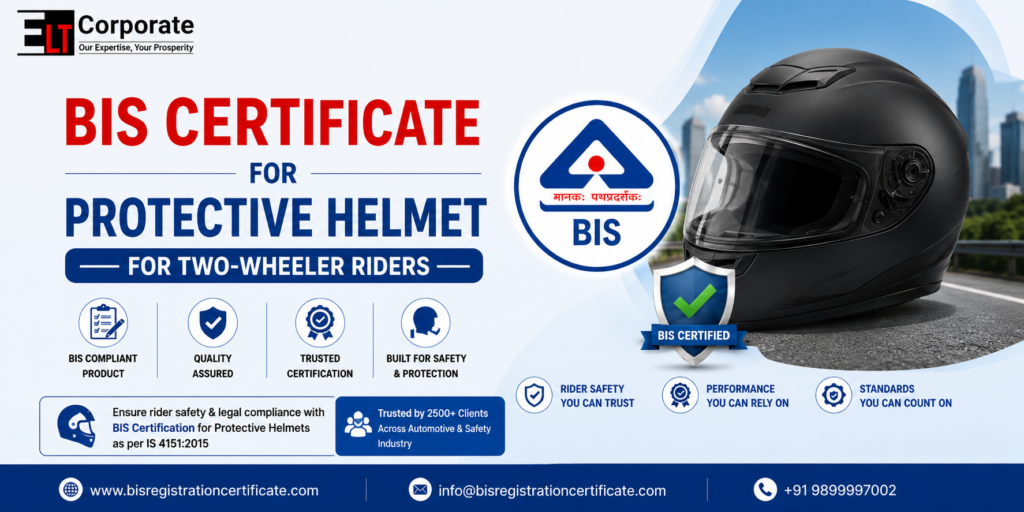
Every year thousands of two-wheeler riders from India use helmets to safeguard themselves on the roads. However, not every helmet gives the protection it claims to provide. To ensure that the helmet is safe, the government has put in place BIS certification, which is compulsory for all helmets used to protect the wearer that are manufactured, sold, or imported into the country. This blog will explain the reasons BIS certification is important, what standard is applicable to you, how it works, and the types of documents you’ll require.
Why is BIS Certification Mandatory for Helmets?
Protective helmets are covered in the Quality Control Order (QCO) issued by the Government of India. The QCO makes it mandatory for all manufacturers, brand owners, or importers to get BIS certification prior to allowing their helmets to get into the market. Making or selling helmets that do not have BIS certification is a criminal crime.
Failure to comply can result in:
- Legal action and severe penalities in the form of money
- Seizure of stocks that are not in compliance
- Reputation of brand damaged
- Restrictions on the future of business operations
For the consumer who purchases a helmet, the BIS label is a basic but powerful guarantee—it demonstrates that your helmet is safe and has gone through strict tests for safety and will safeguard the user, instead of just being an official sticker.
Applicable BIS Standard: IS 4151
The standard that regulates safety helmets for India is IS 4151. This standard provides detailed technical specifications that helmets must satisfy before it is able to bear the ISI label. The most important parameters testified to under this standard are the following:
- Absorption capacity of shock—how well the helmet absorbs the impact of a collision
- Penetration resistance, the ability of a helmet to stop the sharp edges of objects that could pierce
- Strength and durability of the retention system and the reliability of the strap for chin
- Vision field – making sure that the helmet does not block the rider’s view
- Quality of construction and weight general construction standard and quality of materials
Only helmets that pass all of these requirements in BIS-approved laboratory testing can be eligible for being awarded the ISI mark and are legal to sell in India. Indian market.
BIS Certification Process – Step by Step
To obtain BIS accreditation for helmets is a multi-stage, structured process. This is a quick overview:
| Step | Description |
| 1. Application | Submit an application through the BIS portal (Manak Online) with company and product details. |
| 2. Documentation | Register your company, provide specifications of the product, and share the test results from your previous reports. |
| 3. Factory Inspection | A BIS officer visits the manufacturing plant to review processes and quality control. |
| 4. Sample Testing | Samples of the helmet are taken to a BIS-approved laboratory to be tested against the IS 4151 standard. |
| 5. License Grant | After all tests have been cleared successfully, BIS issues the official certification license. |
| 6. Renewal | The license needs to be renewed regularly to ensure it remains current and compliant |
Each step requires precision and the proper documentation; even the smallest of mistakes can cause significant delays in the process, and that’s why many companies prefer working with a seasoned consultant.
Documents Required for BIS Helmet Certification
Be sure to have the following documents in hand before you apply:
- Proof of registration for the company (GST certificate PAN card, GST certificate, etc.)
- Addresses of factories or manufacturing units evidence
- Specific product technical specifications
- Test reports from the past If they are available
- Identification and signature evidence
A complete document helps to prevent unnecessary back and forth with BIS officials.
BIS-Certified Helmet vs Non-Certified Helmet
Knowing the distinction between non-certified and certified helmets can help manufacturers and users make informed choices:
| Parameter | BIS Certified Helmet | Non-Certified Helmet |
| Legal Sale | Allowed throughout India | It is not allowed. |
| Safety Standard | It was tested against the IS 4151 | There is no safety standard that can be guaranteed. |
| Consumer Trust | High in part due to ISI mark | Low, which is often regarded as unsecure |
| Penalty Risk | None | Risk of seizure and fines. |
| Market Reputation | Brand credibility is built over the long term. | Could damage the image of a brand |
This example demonstrates the reasons BIS certification isn’t only about legal compliance It’s an excellent business choice for growth over the long term.
Conclusion
A BIS certification for helmets that are protective is more than just an official checkbox to mark; it’s a guarantee of the safety of riders and the basis to ensure the trust of consumers. With the strict enforcement of this quality control order, manufacturers and importers are unable to avoid this certificate if they wish to be legally operating.
The process requires technical testing as well as detailed documentation as well as coordination with BIS officials. It’s time-consuming if you do not have any prior experience. Partnering with a knowledgeable BIS consultant can cut down the amount of time required and help you be certified faster.
If you’re a manufacturer of helmets or an importer based in Delhi and require advice from a professional on BIS certification Please get in touch with us on WhatsApp or by phone for a fast appointment.
FAQ’s
Q1. What can I do to market helmets with a BIS certificate?
There is no need; BIS certification is mandatory, and selling helmets without it is unlawful and could result in penalties.
Q2. Which BIS standard is applicable to helmets?
IS 4151, which is the most applicable standard for helmets that protect in India.
Q3. What’s the length of time BIS certification requires?
It typically takes between 2 and 3 months dependent on the level of documentation and the testing timeframes.
Q4. Does imported gear also require BIS certification?
The imported ones need BIS certification prior to their sale in India.