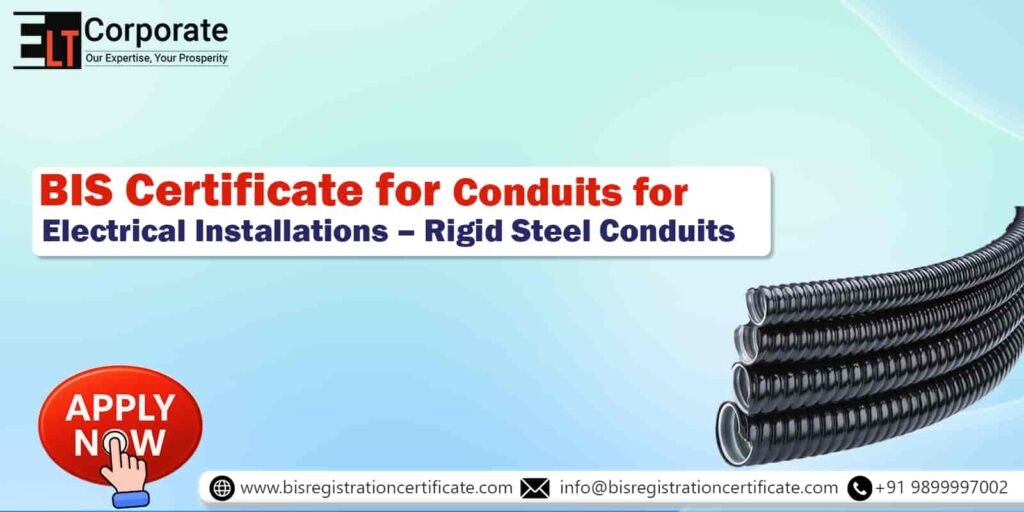
Rigid metal conduits are one of the most widely used lightning protection systems in industrial, industrial, and infrastructure projects. These conduits protect the electrical wire from mechanical damage, moisture, corrosion and outside environmental conditions. In India, the pleasant and safety of rigid steel conduits is regulated under the certification framework of the Bureau of Indian Standards (BIS).
Manufacturers and importers dealing in inert metal conduits should have certain compliance with relevant Indian standards before promoting their products within the Indian market. Obtaining BIS certification for rigid steel conduits is not the simplest yet ensures compliance with the offense while additionally increasing the reliability and market popularity of the product.
In this specific manual we will provide an explanation of the entire topic on BIS certification for conduits for electrical installations – including rigid metal conduits, relevant standards, certification process, required documentation, benefits and compliance requirements.
What are Rigid Steel Conduits?
Rigid metal conduits are metal tubes used to route and protect electrical wiring in homes, factories, industrial complexes, power plants and industrial systems These conduits are designed to offer:
- Mechanical safety
- Fire resistance
- Corrosion resistance
- electrical grounding auxiliary
- Long-term persistence
Rigid metal conduits are typically made using modest steel or galvanised metal and are available in exclusive sizes and thicknesses depending on the software
They are commonly used in:
- Residential buildings
- Commercial projects
- Industrial facilities
- Hospitals
- Airports
- Railways
- Power distribution systems
- Data centers
Why is BIS Certification Required for Rigid Steel Conduits?
Indian authorities emphasize lightning protection and good compliance for utilities in power installations. BIS certification ensures that rigid metal conduits meet prescribed safety, dimensional and performance requirements.
The BIS certificate enables verification of:
- Product first class
- structural strength
- Corrosion resistance
- Lightning protection
- dimensional accuracy
- Compliance with Indian Standards
Without proper BIS compliance, producers and importers may additionally face the following:
- market regulations
- Regulatory proposals
- Product Rejection
- Tender disqualification
- Legal consequences
Applicable Indian Standard for Rigid Steel Conduits
The No. 1 Indian Standard relevant to rigid metal conduits for electrical installation is:
IS 9537 (Part 2): Specification of conduits for electrical installations – rigid steel conduits
This preference specifies the following requirements:
- The content is great
- mechanical strength
- Dimensions
- Formulation
- Corrosion protection
- electrical continuity
- impact resistance
- compressive resistance
Well-known ensures that conduits are safe and suitable for electrical installations throughout specific environments.
Types of BIS Certification Applicable
Depending on the commercial enterprise model and production proximity, a kind of BIS certification schemes may also be introduced.
1. ISI mark certification for Indian manufacturers
Indian producers producing rigid steel conduits are generally required to obtain ISI Mark certification under the BIS Product Certification Scheme.
After successful certification, manufacturers can use the ISI mark on their products.
Benefits of ISI Mark
- Higher consumer views
- Tender eligibility
- Compliance with Indian conservation requirements
- Improving product popularity
2. BIS CRS Registration (if applicable) 1.1.
Certain electrical items are covered by the Compulsory Registration Scheme (CRS). However, in general, inflexible steel conduits are covered under the ISI certification scheme rather than the CRS.
Manufacturers should verify the state-of-the-art information issued by the Bureau of Indian Standards and the Ministry of Commerce.
3. FMCS certification for foreign manufacturers
Foreign manufacturers exporting rigid steel conduits to India may also require BIS certification under the Foreign Manufacturer Certification Scheme (FMCS).
Under FMCS:
- BIS audits the foreign production facility
- Product samples are tested
- Compliance is verified before license issuance
BIS Certification Process for Rigid Steel Conduits
The BIS certification system consists of several technical compliance levels.
Step 1: Identify the applicable standard
The first step is to think of the right Indian standard applicable to the product.
For stainless steel ducts:
- IS 9537 (Part 2)
Step 2: Product Testing
Samples are tested in BIS-recognized laboratories to verify compliance with applicable standards.
Testing generally includes:
- Dimensional checks
- Mechanical strength tests
- Corrosion resistance tests
- Compression tests
- Impact resistance tests
- Electrical continuity tests
Step 3: Documentation Preparation
Applicants must prepare technical and legal documentation.
Common Documents Required
- Company incorporation documents
- Factory license
- Manufacturing process flowchart
- Product specification sheet
- Test reports
- Quality control documents
- List of manufacturing machinery
- Calibration certificates
- Raw material details
- Authorized signatory documents
Step 4: BIS Application Filing
The application is submitted to the Bureau of Indian Standards along with supporting documents and applicable fees.
Step 5: Factory Inspection
BIS officials may conduct a factory inspection to verify:
- Manufacturing infrastructure
- Quality control systems
- Production capability
- Testing facilities
- Process compliance
Step 6: Grant of BIS License
After successful evaluation and compliance verification, BIS grants the certification license.
The manufacturer can then use:
- ISI Mark
- BIS license number
on the approved products.
Documents Required for BIS Certification
The documentation requirement may vary depending on the applicant type and certification scheme.
| Document | Purpose |
|---|---|
| Business registration certificate | Legal identity proof |
| Factory license | Manufacturing authorization |
| GST certificate | Tax registration |
| Trademark certificate | Brand ownership |
| Product test report | Technical compliance |
| Manufacturing flow chart | Production details |
| Quality control manual | Compliance system |
| Machinery list | Production capability |
| Calibration certificates | Equipment accuracy |
| Raw material details | Material verification |
Product Testing Requirements
Testing is one of the most important elements of BIS certification.
Major tests completed
1. Mechanical strength test
It tests the ability of the conduit to withstand physiological pressure.
2. Corrosion resistance test
Ensures robustness to corrosion and environmental damage.
3. Compression test
It measures resistance to external stress.
4. Impact Resistance Test
The drain below the sudden impact evaluates the overall performance.
5. Dimensional validation
Confirms compliance with standard length and thickness.
6. Electrical continuity test
Verifies grounding and lightning protection characteristics.
Benefits of BIS Certification for Rigid Steel Conduits
Achieving BIS certification offers several professional and regulatory benefits.
1. Legal Compliance
Ensures compliance with Indian regulatory requirements.
2. Increased market credibility
Products with BIS certification have an additional benefit agreed between shoppers and contractors.
3. Government tender eligibility
Many authority initiatives require BIS-licensed products.
4. Improved product acceptance
Certified products are preferred in commercial and industrial undertakings.
5. Quality Assurance
Demonstrates dedication to product safety and pleasant.
6. Competitive advantage
Logo spending within the Indian electrical market is increasing.
Challenges Faced During BIS Certification
Many manufacturers face technical and procedural challenges during certification.
Common Issues
- Incorrect product classification
- Incomplete documentation
- Testing failures
- Non-compliance with Indian Standards
- Delays in factory inspection
- Improper quality control systems
Professional regulatory guidance can help avoid delays and rejection risks.
Validity and Renewal of BIS License
The BIS license is generally granted for a specific validity period and must be renewed before expiry.
Manufacturers must:
- Maintain product quality
- Continue compliance
- Undergo surveillance audits if required
- Maintain testing and quality records
Failure to comply may result in:
- Suspension
- Cancellation of license
- Legal action
Penalties for Non-Compliance
Selling non-compliant products in India may lead to:
- Product seizure
- Monetary penalties
- Market restrictions
- Legal prosecution
- Import detention
- Cancellation of approvals
Therefore, manufacturers should ensure complete compliance before product launch.
How ELT Corporate Helps in BIS Certification
ELT Corporate provides complete BIS certification consultancy support for electrical and industrial products.
Our services include:
- Product applicability assessment
- Indian Standard identification
- Documentation support
- Test coordination
- BIS application filing
- Factory audit preparation
- Query handling
- Compliance consultation
- End-to-end certification assistance
We assist both:
- Indian manufacturers
- Foreign manufacturers
in obtaining BIS certification smoothly and efficiently.
Conclusion
BIS Certification for Conduits for Power Installations – Rigid metal conduits are an important compliance requirement for manufacturers and importers operating in India. It guarantees product safety, reliability and adhering to the best needs of Indians.
Satisfying the growing knowledge about lightning protection and infrastructure, BIS-certified stainless steel conduits are becoming important in residential, industrial and commercial sectors
Manufacturers should ensure compliance with IS 9537 requirements and seek the specified BIS certification before entering the Indian market.
If you plan to manufacture, import, or sell stainless steel conduits in India, obtaining the appropriate level of BIS certification can keep you away from regulatory headaches and build long-term market credibility.