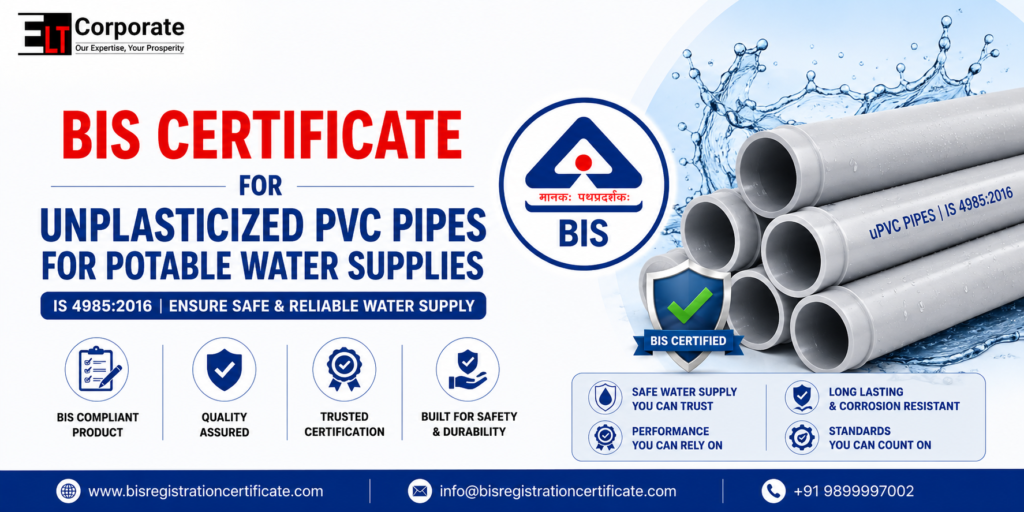
Safe drinking water is heavily dependent on the high-quality of the pipes used to provide it. Pipes made of unplasticized (uPVC) pipe are extensively utilized across India in potable water distribution systems due to the fact that they are durable, resistant to corrosion, and economical. To ensure that these pipes are safe for transporting drinking water in India, the Indian government has put in place BIS certification as obligatory in the case of uPVC pipes. This blog explains the reasons why BIS certification is necessary and what standards are applicable and how the certification process functions.
Why is BIS Certification Mandatory for uPVC Pipes?
Pipes made of PVC that are not plasticized and used to supply potable water fall within the Quality Control Order issued by the Government of India. This requires producers to get BIS certification before pipes are legally produced and sold or distributed to drinking water systems.
Failure to comply can have grave consequences:
- Pipes are manufactured and sold for sale illegally
- Legal action and heavy penalties from authorities
- Securing of non-compliant stocks from the market
- Rejection of municipal and government water tenders for supply
For government agencies and consumers as well as contractors, the BIS label confirms that pipes meet the safety and quality standards necessary to transport drinking water with no risk of contamination.
Applicable BIS Standard: IS 4985
The most widely used standard for non-plasticized PVC pipes that are used for water distribution systems can be found in IS 4985. The standard defines specific requirements, such as:
- Dimensional accuracy—pipe diameter wall thickness and length tolerances
- Hydrostatic pressure resistance – the ability to withstand internal pressure without causing failure
- Material composition – making sure that the PVC material is free of harmful additives
- Opacity and resistance to impact—protection from sun degradation and physical impact
- The marking requirements are to be properly labeled with the size, pressure rating and details of the manufacturer
Pipes that have passed these tests are able to carry the ISI mark and can be used in water supply projects that require potable water.
BIS Certification Process for uPVC Pipes – Step by Step
Need BIS Certification for Your uPVC Pipes?
WhatsApp Us NowHere’s how the process of obtaining certification generally works:
| Step | Description |
| 1. Application | Submit an application via the BIS portal (Manak Online) with product information |
| 2. Documentation | Incorporate your company and provide manufacturing information, and specifications for the product |
| 3. Factory Inspection | BIS officer examines the manufacturing facility and the in-house testing setup |
| 4. Sample Testing | Pipe samples are tested in an accredited BIS lab to test against IS 4985. |
| 5. License Grant | BIS gives the certification license after all tests have been cleared |
| 6. Renewal | The license needs to be renewed regularly to stay valid. |
Because uPVC pipes are employed in water infrastructures with a high degree of criticality testing, it is common to include both pressure and physical tests, which makes the accuracy of documentation and sampling vital.
Documents Required for BIS Certification of uPVC Pipes
Before implementing, manufacturers should have the following information ready:
- Proof of registration for the company (GST certificate PAN card, GST certificate, etc.)
- Address of the factory or manufacturing unit document
- Specifications for the product in detail (sizes, pressure ratings wall thickness)
- Test reports from the past If they are available
- Identity of the signatory and other information about the signatory’s identity.
A complete and accurate document reduces the time and hassle of BIS officials during the review process.
BIS-Certified uPVC Pipes vs Non-Certified Pipes
| Parameter | BIS Certified Pipes | Non-Certified Pipes |
| Legal Sale | Allowed throughout India | It is not allowed. |
| Safety Standard | It was tested against IS 4985 | There is no quality guarantee. |
| Government Tenders | Eligible | Not qualified |
| Water Safety | Verified, contamination-free | The risk of leaching harmful substances |
| Penalty Risk | None | A high risk of seizures and fines |
This is a good illustration of the reasons BIS certification isn’t merely a requirement for compliance, as it directly impacts the health of the public and also a business’s ability to participate in large-scale projects.
Conclusion
A BIS certification for plasticized PVC pipes used for the supply of potable water is vital to ensure that the drinking water infrastructure is reliable, safe, and free of contamination. It’s also a requirement for participation in municipal and state drinking water projects. But, because the certification requires detailed testing in accordance with IS 4985, which covers the material’s safety, pressure resistance, and dimensional precision, it can be complicated for manufacturers who aren’t familiar with BIS procedures.
A partnership with an experienced BIS consultant can streamline documentation, coordination of testing, and approvals, thereby cutting down on time and effort.
If you’re a uPVC pipe maker located in Delhi seeking BIS certification assistance, contact our team via WhatsApp or phone us to get a quick appointment.
FAQ’s
Q1. Is BIS certification required in the case of uPVC pipes?
It is true that BIS certification is mandatory for uPVC pipes that are used for water distribution systems that are potable.
Q2. Which BIS standard is applicable for these pipes?
IS 4985, which is the most applicable standard for non-plasticized PVC pipes used for potable water supply systems.
Q3. What’s the length of time BIS certification lasts to be completed for uPVC pipes?
It usually takes between 2 and 3 months, depending on the documentation and testing schedules.
Q4. Can pipes that are not certified be used in water projects?
It is not required. BIS certification is needed for the eligibility of municipal and government tenders.
Need BIS Certification for Your uPVC Pipes?
Avoid penalties & win government tenders — get certified with expert guidance on IS 4985 compliance.
Get Free Consultation Call Now