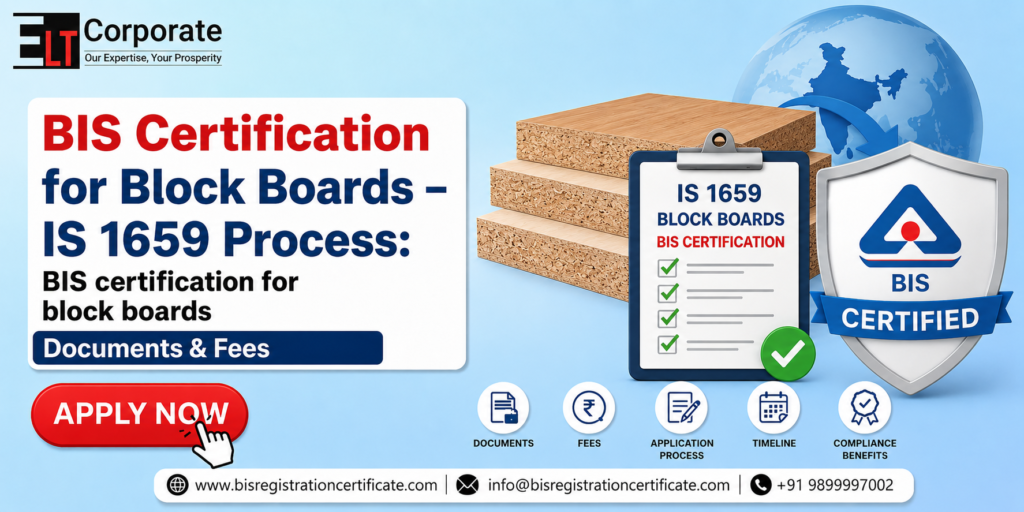
If you manufacture or import blockboards in India, there is one thing you cannot afford to ignore anymore: BIS certification. Since the government made it mandatory under the Block Boards Quality Control Order 2023, selling uncertified block boards is not just a business risk; it is a legal violation.
This guide will walk you through everything — what the certification involves, who needs it, what documents are required, how long it takes, and what it will approximately cost you.
What Exactly is BIS Certification for Block Boards?
Blockboards are composite wood panels used for different purposes such as furniture, interior design, door shutters, and building applications. The Bureau of Indian Standards (BIS) has prescribed quality standards for these panels under IS 1659:2004 covering commercial & decorative block boards meant for interior & exterior applications.
The BIS certification, popularly known as the ISI Mark, is a mark of independent testing and compliance with those benchmarks for your product. And for block boards, this certification is no longer optional.
Is It Really Mandatory?
Yes, completely. The Block Boards Quality Control Order 2023 brought block boards under mandatory BIS certification. This means:
- No Indian manufacturer can produce and sell blockboards without a valid ISI Mark’s license
- No importer can bring block boards into India unless the foreign manufacturer holds a valid FMCS license under IS 1659:2004
- Traders and retailers cannot stock or sell non-certified blockboards.
If BIS enforcement teams find non-certified blockboards in the market—and they do conduct regular raids—the consequences include stock seizure, fines, and, in serious cases, criminal prosecution under the BIS Act, 2016.
Who Needs to Apply?
| Type | What is Required |
| Indian Manufacturer | ISI Mark License |
| Foreign Manufacturer | FMCS License under IS 1659:2004 |
| Importer (foreign brand) | Foreign supplier must hold valid FMCS |
| Importer (own brand) | Separate FMCS license in your name |
What Does IS 1659:2004 Actually Test?
This is where many people get surprised. BIS certification is not just a paperwork exercise. Your product goes through serious testing:
- Adhesive quality—Whether the adhesive used meets BWP, MR, or Interior grade requirements
- Core construction — Width, species, and arrangement of core strips
- Face and back veneers — Thickness, grading, and bonding quality
- Dimensions and tolerances — Length, width, and thickness checked against specified limits
- Resistance to water — Product tested under boiling water conditions
- Adhesion of plies — How well the layers hold together under stress
- Modulus of Rupture and Elasticity — Structural strength under load
- Moisture content—Must be within permissible range at time of testing
- Mycological test — Checks resistance to fungal attack
- Spot test — Chemical identification of adhesive type
All these tests are carried out at a BIS-recognized laboratory. Only their reports are accepted.
Documents Required
Getting your paperwork right before applying saves weeks of back-and-forth with BIS.
For Indian Manufacturers:
- Company incorporation certificate
- GST registration certificate
- Factory license
- Plant layout and process flow chart
- List of machinery and in-house testing equipment
- ISO 9001 certificate
- Raw material test reports
- Lab test report from BIS-recognized laboratory as per IS 1659:2004
- Calibration certificates for testing instruments
- Authorized signatory ID and declaration
For Foreign Manufacturers and Importers:
- All documents listed above
- Import Export Code (IEC)
- Appointment of Authorized Indian Representative (AIR)
- Country of origin manufacturing license
- Accredited lab test reports as per IS 1659:2004
Step-by-Step Certification Process
Step 1 — Internal Gap Analysis Before you file anything, sit down and honestly review your manufacturing process against IS 1659:2004. Check your raw materials, production method, and in-house testing setup. Most delays happen because gaps are discovered after the application is submitted, not before.
Step 2 — Laboratory Testing Send your product samples to a BIS-recognized lab. The test report needs to confirm compliance on every parameter in IS 1659:2004. If your samples fail even one test, you will need to retest after making corrections.
Step 3—Application Filing: Submit Form VI on the BIS portal—ManakOnline—along with all documents and the prescribed government fees. Make sure every document is accurate and complete. Even a small inconsistency can trigger a query from BIS officers and delay the process.
Step 4 — Application Review BIS officials go through your submission. If they have questions or find anything missing, they will raise a query. Respond quickly and accurately to keep things moving.
Step 5 — Factory Audit A BIS auditor visits your manufacturing plant. They will inspect the production line, quality control systems, in-house testing equipment, and raw material records. This is a physical inspection, not a desk review. Being well-prepared here matters a lot.
Step 6 — License Grant Once the auditor is satisfied and the lab results are cleared, BIS issues the ISI Mark license. The license is valid for 1 to 2 years and needs to be renewed before expiry.
Timeline
| Stage | Approximate Time |
| Document preparation | 2 – 3 weeks |
| Laboratory testing | 3 – 4 weeks |
| BIS application review | 4 – 6 weeks |
| Factory audit scheduling | 2 – 4 weeks |
| License grant after audit | 2 – 3 weeks |
| Total (well-prepared applicant) | 3 – 5 months |
For Indian manufacturers, BIS targets a standard timeframe of around 30 days for processing once the application is complete. For foreign manufacturers applying under FMCS, the standard timeframe is approximately 180 days.
Cost Estimation
The total cost of BIS certification for block boards depends on your company size, product variants, and how prepared you are before you start. Here is a rough estimate to help you plan:
| Cost Component | Approximate Range |
| BIS-recognized lab testing | ₹15,000 – ₹40,000 |
| BIS government application fee | ₹10,000 – ₹30,000 |
| Consultant / professional charges | ₹25,000 – ₹100,000 |
| Total Estimated Cost | ₹50,000 – ₹200,000 |
This is an indicative range only. Actual cost varies based on company turnover, number of product types, and document readiness. Contact us for an exact quote.
What Happens After Certification?
Getting the license is not the end of the road. BIS continues to monitor your products through:
- Periodic surveillance audits of your facility.
- Market surveillance — inspectors can pick up your products from the market and test them.
- License renewal every 1 to 2 years.
Maintaining the same quality standards after certification is just as important as passing the initial audit. BIS has the authority to cancel licenses if certified products are found to be substandard.
Why BIS Certified Block Boards Have a Market Advantage
Beyond just compliance, the ISI Mark gives you a real edge:
- Large contractors, government projects, and institutional buyers are increasingly making BIS certification a minimum requirement for procurement
- Furniture manufacturers and interior designers are becoming more quality-conscious and prefer certified boards
- The ISI Mark on your packaging is a visible, recognizable quality signal that non-certified competitors simply cannot offer
- It opens doors for export, as international buyers view the ISI Mark as a credibility indicator.
Conclusion
BIS certification for block boards is no longer just a regulatory requirement—it is a business necessity. With the QCO 2023 already in effect, every day without certification is a day of legal and commercial risk. Manufacturers and importers who get certified early gain a clear market advantage — better buyer trust, access to government tenders, and zero fear of BIS raids or stock seizure.
If you are ready to start the process or just want to understand your options, our team at ELT Corporate is here to help.
Frequently Asked Questions
Q1. Is BIS certification mandatory for all types of block boards?
Yes. Under the Block Boards Quality Control Order 2023, BIS certification is mandatory for all block boards under IS 1659:2004—commercial and decorative, both. No exemptions.
Q2. Can a small or MSME manufacturer apply for BIS certification?
Yes. Any manufacturer regardless of size can apply. MSME-registered companies may also get fee concessions on the government application fee.
Q3. What happens if my product fails the lab test?
You will need to fix the issue—raw material, adhesive, or process—and resubmit samples for testing. This is the most common reason for delays.
Q4. How long is the ISI Mark license valid?
Generally 1 to 2 years. Renewal must be done before expiry. BIS also conducts surveillance audits during the validity period.
Q5. Do I need a separate license for multiple types of block boards?
It depends on the product categories. BWP and MR grade boards may need separate testing. A BIS consultant can confirm based on your product range.