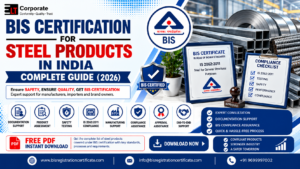
Steel is one of the most strictly regulated product categories eligible for BIS certification in India. If you are importing, manufacturing, or trading steel products, be aware of which categories need to be certified and how you can obtain such certification without encountering any fines, delays in shipping, or problems in the course of doing business.
Here we discuss all you need to know about BIS certification of steel products, including IS codes, certification procedure, documentation requirements, and fees.
Ready to Get Your BIS Certification?
Talk to our experts today — documentation, audits, and approvals, fully handled.
What Is BIS Certification for Steel Products?
BIS certification proves that a product made of steel meets the safety and performance standards established by the Bureau of Indian Standards. In accordance with different Quality Control Orders (QCOs), different kinds of steel products are unable to be legally produced, imported, and sold within India without an official BIS certification. Steel plays a direct role in structural safety—in buildings, bridges, and infrastructure—which is why the government has steadily expanded mandatory certification across steel categories in recent years.
Steel Products That Require Mandatory BIS Certification
TMT bars are regulated under IS 1786. TMT bars that are used for construction are among the frequently approved steel products due to their direct impact on structural security.
Structural Steel—Covered under IS 2062, this is the case for hot-rolled steel for general construction and engineering structures.
Stainless Steel Products—Pipes, utensils, and sheets fall under specific product IS codes, such as IS 9111 for cooking equipment.
Steel Pipes and Tubes—Used in industrial and construction applications that are classified by IS 1239, IS 3589, and similar codes based on the type.
Galvanized and cold-rolled steel sheets are widely used in construction and manufacturing and are certified to meet standards such as IS 277.
This isn’t a complete list. New steel subcategories are frequently added to the list under QCO modifications; therefore, it is important to verify the specific status of your product prior to making or importing.
Why BIS Certification Matters
Importing or selling steel products that are not accompanied by BIS certification. BIS certification could lead to:
- Securing of goods at the ports, or when inspecting
- Customs officials may refuse imports. customs
- Penalties are imposed under penalties under the BIS Act, 2016
- Credibility issues in B2B buyer circles.
For importers, clearance through customs is usually delayed until the proper certification is obtained, making timely compliance crucial to ensure that there are no delays in shipping.
Certification Method: ISI Mark vs. FMCS
Domestic steel producers submit an application for factory-specific ISI. Mark’s license is granted after BIS examines the manufacturing process and quality control system as well as the capability to test in the plant. After granting the license, the company is able to put the ISI mark on each manufactured unit that is certified at the manufacturing facility.
Exporters from overseas who export steel to India opt to go through an alternative process called the Foreign Manufacturers Certification Scheme (FMCS), which includes BIS reviewing the foreign manufacturing facility through an audit of the physical facility or, in some instances, a remote audit—followed by a test of samples. FMCS applications typically require more time and are more expensive than those for domestic ISI applications due to the additional logistics involved in international coordination.
Get Your ISI Mark Certification
Sell steel products legally in India — without customs delays, penalties, or rejected shipments.
✅ End-to-end documentation support
✅ Factory inspection guidance
✅ Faster approval, zero guesswork
⏱ Limited slots this month — apply early to avoid delays
BIS FMCS Registration
Export to India without shipment holds — get your foreign factory FMCS-certified the right way.
✅ Authorized Indian Representative (AIR) support
✅ Factory audit coordination — remote or on-site
✅ Sample testing & documentation handled end-to-end
Trusted by international brands exporting to India
Ready to Get Your BIS Certification?
Talk to our experts today — documentation, audits, and approvals, fully handled.
Documents Required for BIS Certification of Steel Products
- Proof of registration for the company (GST or incorporation certificate)
- Factory/manufacturing unit details and layout
- Sheet of product specifications that corresponds to the appropriate IS code
- Test results from the BIS audit, followed by
- Quality Control and Manufacturing Process Documentation
- Signatory authorization details
BIS Certification Process for Steel Products
- Find the appropriate IS codes for your particular steel product
- Apply to the BIS web portal (Manak Online)
- Documents and product samples
- Factory inspection conducted by an BIS officer
- Tests on products in an accredited or BIS-approved laboratory
- The granting of a license and ISI mark after the successful completion of
Exporting steel from overseas producers to India, the same procedure applies to the Foreign Manufacturers Certification Scheme (FMCS); however, the timeframes are usually longer because of international audits of factories and testing logistics.
Timeline and Fees
BIS approval for products made of steel generally requires 2-4 months for local manufacturers who have a simple application. It can take up to four to eight months in the case of FMCS applicants. The length of time depends on the state of the factory testing results, as well as the speed at which document issues can be resolved.
The cost of the product varies based on the product’s category, the factory’s location, and the applicable scheme and generally comprises the BIS application cost, laboratory testing fees, and related inspection costs. Our team is able to give an accurate estimate of costs for your particular product.
Ready to Get Your BIS Certification?
Talk to our experts today — documentation, audits, and approvals, fully handled.
Common Mistakes to Avoid
- You are applying under the wrong IS code, since a number of steel types have very similar but distinct standards
- Equipment that is not calibrated or inaccessible to testing when it is time for inspection at the factory
- Incomplete documentation or a mismatch with the app and what inspectors see on site
- Overestimating the time needed for factory readiness. Most first-time applicants require several weeks of preparation inside the factory prior to inspection
The BIS certification is for importers as opposed to domestic manufacturers
Importers and manufacturers in the US have different challenges to overcome, even although the underlying legal requirement is identical.
For importers, the key risk is timing—certification (via FMCS or a supplier’s existing license) must be in place before goods are shipped, not arranged after a shipment gets held at customs. Because FMCS applications for factories overseas take longer than applications for domestic manufacturers, importers should prepare for certification far in advance of their scheduled import dates.
For manufacturers in the US, licenses are factory-specific. If you manage multiple production units, each one will require an individual license. Manufacturers also have to undergo greater frequency BIS surveillance inspections than the one-time clearance of imports, and maintaining a consistent quality control following approval is just as important in the beginning as the approval.
Renewal and Ongoing Compliance
BIS licenses aren’t issued for a lifetime; they have the same validity but with a time limit at which point renewal is mandatory. It is best to begin the renewal process prior to the expiry date, as an expired license means that you cannot continue using ISI marks until renewal is complete. ISI mark until the renewal is complete.
The licensed factories are also subjected to periodic audits of surveillance, in which BIS can retest samples and look over quality records to ensure continuous compliance. Failure to meet the requirements of surveillance can cause license suspensions, and that’s why compliance must be considered as a continual obligation, not just a one-off approval to get and forget.
Why Work With Us
We assist steel producers and importers in getting BIS certification from beginning to end, from finding the right IS code through documentation, factory inspection coordination, and finally, final approval. No guesswork, no delays.
Frequently Asked Questions
Q1. Is BIS certification required for all stainless steel items?
Only products that fall under the current Quality Control Order (QCO) are required to have BIS certification. Coverage is continually expanded; therefore, it is important to verify your particular product classification.
Q2. Which IS code is applicable for TMT bars?
TMT bars are regulated under IS 1786, covering grades that include Fe 415 as well as Fe 500 and Fe 500.
Q3. Do I have the ability to import steel products in India in the absence of BIS certification?
No. Steel products with mandatory certifications cannot be legally imported. Customs authorities can refuse or block any shipment that is not in compliance.
Q4. How long will BIS certification be on steel-based products?
It is typically 2-4 months for local manufacturers and four to eight months in the case of foreign companies who apply under FMCS.
Q5. Do I need a separate certificate for each manufacturing facility?
Yes, most of the time. ISI Mark certificates are specific to the factory, which means that each manufacturing unit usually needs its own license.
Q6. What happens when my facility does not pass the BIS inspection?
This doesn’t necessarily mean a rejection outright. BIS generally issues a list of corrective measures the factory has to address prior to the next inspection being scheduled; however, this can add time to the procedure.
Q7. How can a consultant accelerate speed up the BIS approval process?
Although no consultant is able to override BIS’s inspection and testing schedules, a skilled consultant can greatly delay delays due to insufficient documentation, inaccurate IS code selection, or inadequate preparation for inspections, the most common delays that can be controlled.
Ready to Get Your BIS Certification?
Talk to our experts today — documentation, audits, and approvals, fully handled.