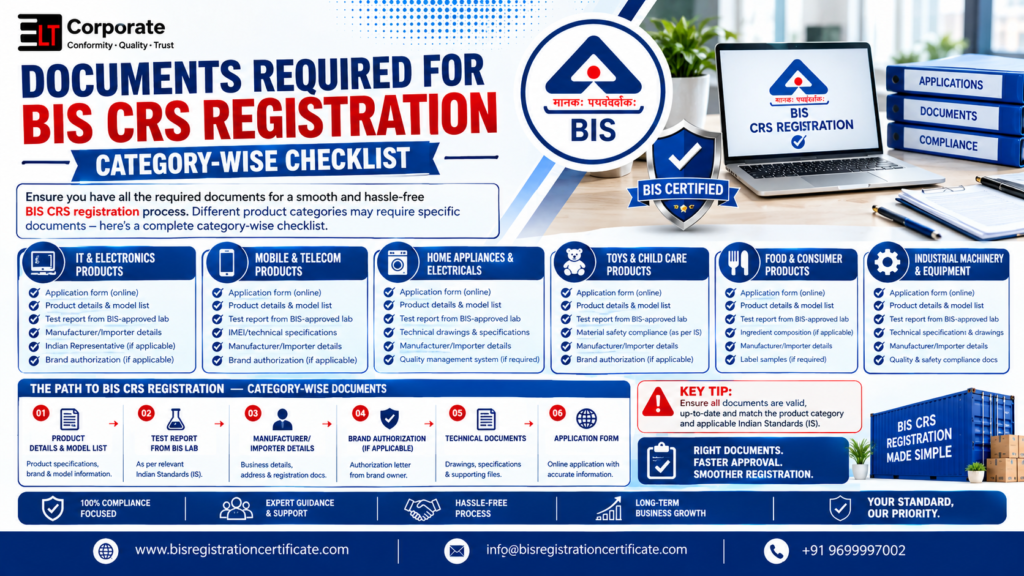
Getting BIS CRS Registration approved on the first attempt depends heavily on one thing: having the right documents ready before you apply. A large share of application delays and rejections happen not because of product quality issues, but because of missing paperwork, mismatched details, or incomplete authorization documents.
In this article we provide the complete document checklist required for BIS CRS registration, which includes specific requirements for electronic products, IT equipment, and IT-related products, as well as foreign manufacturers, ensuring that you can submit your application in the correct way the first time around.
Core Documents Required for Every BIS CRS Application
Regardless of your product category, these documents form the base requirement for any CRS registration:
- Test Report from a BIS-recognized laboratory, confirming conformity to the applicable Indian Standard (must generally not be older than 90 days at the time of application)
- Business Registration Proof—company incorporation certificate, GST registration, and PAN copy
- Self-Declaration of Conformity, filled as part of Form-I on the BIS CRS portal
- Factory/Manufacturing Unit Address Proof, along with details of the scope of business activity
- Authorisation Letter from the CEO or top management, authorising the signatory to file and sign the application
- Technical Specification Sheet of the product, including model and variant details
- User Manual and Label Specimen showing how the product will be marked post-registration
- Trademark or Brand Registration Certificate, where applicable
Additional Documents for Electronics and IT Products
Electronics and IT products, which form the bulk of CRS-registered items, often require additional technical documentation:
- Critical Component List (CCL)—a detailed list of key components used in the product
- Circuit Diagram Format (CDF) — technical circuit documentation for the product
- PCB Layout and Chipset Information, especially for products like laptops, mobile phones, and networking devices
- ISO Certificate of the manufacturer (required in several product categories)
Additional Documents for Foreign Manufacturers
If you are a foreign manufacturer exporting to India, you cannot apply for CRS registration directly—you must appoint an Authorized Indian Representative (AIR) and submit the following additional documents:
- AIR Nomination Letter, formally appointing the Indian representative
- Authorisation Letter from AIR’s Management, empowering the authorised signatory to execute the affidavit and related filings
- Legal Status Document of the AIR, establishing their authority to act on the manufacturer’s behalf
- Affidavit, notarized as per BIS requirements, confirming the AIR’s role and responsibilities
Document Checklist by Category
| Category | Key Documents Beyond the Core List |
| Laptops, Desktops & IT Equipment | CCL, CDF, PCB layout, chipset details |
| Mobile Phones & Chargers | ISO certificate, circuit diagrams, model variant list |
| LED Lighting Products | Technical drawing, photometric test report |
| CCTV & Surveillance Equipment | GST and PAN copy, sample photos, packaging images |
| Foreign-Manufactured Products (any category) | AIR nomination, AIR authorization letter, notarized affidavit |
Common Reasons Applications Get Delayed or Rejected
Most CRS application issues are documentation-related rather than technical. The most frequent causes include:
- Mismatched model or variant numbers between the test report and the application form
- Submitting a test report that is older than the accepted validity window
- Missing or improperly notarized affidavits for foreign manufacturers
- Incomplete authorisation chains—for example, a signatory who is not formally authorised by company leadership
- Failure to submit hard copies of the application within the required timeframe after online submission
How to Avoid Documentation Errors
- Cross-check every product detail (model number, variant, technical specs) across all documents before submission
- Keep test reports updated and within the valid submission window
- Prepare AIR-related documents well in advance if you are a foreign manufacturer, since notarization can take time
- Maintain a master checklist specific to your product category rather than relying on a generic document list
Why Choose ELT Corporate for Your CRS Documentation
The preparation of accurate, specific documentation for each category is usually the longest component of the registration process. ELT Corporate helps manufacturers and brand owners, as well as importers, create the right documents to meet their specific product type, cross-check the information before submitting, and oversee the entire filing process so that there is no risk of delays or rejections.
Conclusion
Having the right documents ready—and correctly matched across your test report, application form, and supporting paperwork—is the single biggest factor in getting your BIS and CRS registration approved without delays. Since document requirements vary by product category and by whether you are a domestic or foreign manufacturer, it’s worth verifying your specific checklist before you begin the application process.
If you’re looking for assistance in preparing your documentation or determining what is required for your particular product, connect with us via ELT Corporate for guidance tailored to your specific industry.
Frequently Asked Questions
Q1. What is the most commonly missing document in BIS CRS applications?
The Critical Component List (CCL) and Circuit Diagram Format (CDF) are frequently missing or incomplete, especially for first-time applicants in electronics categories.
Q2. How old can a test report be at the time of application?
Test reports are generally required to be no older than 90 days from the date of application submission.
Q3. Do foreign manufacturers need different documents than Indian manufacturers?
Yes. Foreign manufacturers must additionally submit AIR nomination documents, an authorization letter from the AIR’s management, and a notarized affidavit confirming the AIR’s role.
Q4. Is an ISO certificate mandatory for all CRS applications?
Not always—it depends on the specific product category and applicable Compulsory Registration Order (CRO). Some categories require it while others do not.
Q5. What happens if hard copies of documents aren’t submitted on time?
If hard copies are not received by BIS within 15 days of online submission, the application can be closed and may need to be resubmitted.
Q6. How long is BIS CRS registration valid once granted?
Initial registration is typically valid for 2 years, with renewal options available for 2-, 3-, or 5-year terms depending on the category