Table of contents
Battery-powered Bluetooth speakers have magnets within their driver cones for speakers and occasionally the wireless chargers. If these products are delivered through air transport, regulators and airlines must have confirmation they can be sure that the electromagnetic field created does not interfere with the aircraft’s navigational and communication systems.
This is the reason magnetic field test reports are also known as “magnet reports.” IATA magnetic test certificates are now a requirement for manufacturers and exporters shipping their products by air.
If you are a manufacturer, import and export battery-powered Bluetooth speakers. This guide will explain the purpose of this report as well as the reasons why it’s needed and how you can get one.
What Is a Magnetic Field Test Report?
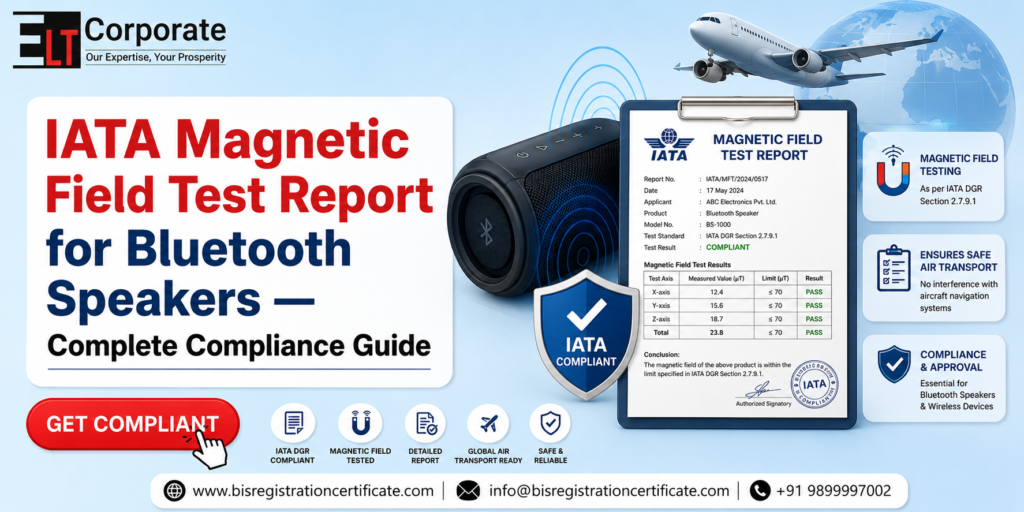
A Magnetic Field Test Report is a lab-issued document that measures the strength of the magnetic field emitted by a product at specific distances from its surface. The test is conducted to confirm whether a product qualifies as “magnetized material” under air transport regulations and, if it does, whether the field strength falls within permissible limits for safe carriage by air.
Why Is It Required — IATA DGR Packing Instruction 953
The International Air Transport Association’s Dangerous Goods Regulations (IATA DGR) classify magnetized materials under Packing Instruction 953. Products containing magnets, including loudspeakers and Bluetooth speakers, may fall under this classification depending on the strength of the magnetic field they emit.
As per this regulation, the test must measure field strength at two standard distances:
- 2.1 metres (7 feet) from the surface of the package
- 4.6 metres (15 feet) from the surface of the package
If the magnetic field strength exceeds the threshold limits at these distances, the product is classified as a restricted article and may require special handling or labeling or, in some cases, be deemed unfit for standard air cargo.
What the Report Must Include
A compliant magnetic field test report typically contains the following:
- Measured field strength values in Gauss or A/m at both 2.1 m and 4.6 m distances, recorded during actual testing—not theoretical calculations.
- Product and packaging details, including the magnet type, speaker model, battery specifications, and how the product was packaged during the test, since packaging materials can affect field readings.
- Test methodology, describing the equipment and procedure used to measure the magnetic field, along with the date of testing.
- Accredited laboratory details, including the lab’s name, accreditation number, and authorized signatory, since reports from non-accredited labs are often rejected by airlines and customs.
- A compliance declaration, confirming whether the product’s magnetic field falls within the allowable Gauss limits for safe air transport.
Why Bluetooth Speakers Specifically Need This
Bluetooth speakers use permanent magnets in their audio drivers to produce sound. Combined with a lithium-ion battery, this makes them a frequently flagged category in air cargo inspections. Without a valid magnetic field test report, shipments can face the following:
Cargo rejection at the airline’s screening stage, customs delays while documentation is sought retroactively, and increased scrutiny on future shipments from the same exporter.
Having this report ready before shipment helps avoid these disruptions entirely.
How to Get a Magnetic Field Test Report
The process generally involves submitting product samples to an accredited testing laboratory, where the magnetic field is measured at the prescribed distances using calibrated equipment. The lab then issues a report confirming compliance, which can be submitted to airlines, freight forwarders, or customs as required.
At ELT Corporate, we help manufacturers and exporters of battery-powered Bluetooth speakers navigate this process—connecting you with accredited testing facilities, reviewing documentation for compliance, and ensuring your report meets IATA DGR PI 953 requirements before your shipment is due to fly.
Conclusion
Magnetic field tests are no longer optional documentation. It’s now a required compliance document for batteries that are shipped via air. Bluetooth speakers. Making sure you get perfect the first time will save you from delays in shipping as well as customs problems and the cost of testing repeatedly. Need assistance in obtaining an answer to your magnetic field test report? Reach out to ELT Consult an expert regarding the required documentation for air cargo shipping.
Frequently Asked Questions
Q1: Is a magnetic field test report mandatory for all Bluetooth speakers shipped by air?
A- It’s required for battery-powered Bluetooth speakers containing magnets above a certain field strength threshold, as defined under IATA DGR Packing Instruction 953. Most consumer Bluetooth speakers with standard drivers fall under this requirement.
Q2: What is the difference between testing at 2.1m and 4.6m?
A- These are the two standard distances IATA specifies for measuring magnetic field strength. The 2.1 m reading determines compass safe distance classification, while the 4.6 m reading is used to assess whether the product needs to be classified as a restricted article for cargo aircraft.
Q3: How long is a magnetic test report valid for?
A- Validity depends on the lab and airline requirements, but reports are typically tied to a specific product model and packaging configuration. Any change in magnet type, battery, or packaging usually requires retesting.
Q4: Can I use the same report for multiple speaker models?
A- No. Each report is specific to the tested product and its exact configuration. A different speaker model, even from the same brand, generally needs its own test report.
Q5: Who can issue this certificate?
A- Only accredited testing laboratories with the equipment and authorization to measure magnetic field strength as per IATA standards can issue a valid report. Reports from non-accredited sources are usually not accepted by airlines or customs.
Q6: Does ELT Corporate conduct the magnetic field test directly?
A- ELT Corporate facilitates the process by connecting you with accredited testing labs and ensuring your documentation meets IATA DGR PI 953 requirements for smooth air transport compliance.