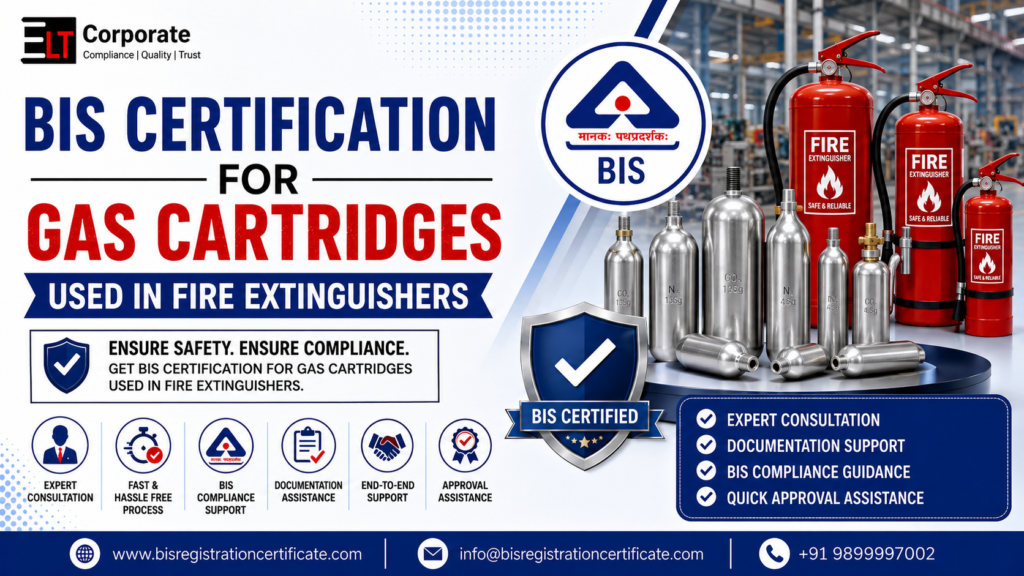
Gas cartridges are tiny but essential components that are used to pressurise specific kinds of fire extinguishers to ensure that the agent used to extinguish fires can effectively be released in the event of an emergency. Since they function as highly pressurised containers, their quality of manufacture directly impacts the effectiveness and safety of the fire extinguisher that they are placed in. This is why the Bureau of Indian Standards (BIS) has issued specific specifications, IS 4947, governing gas cartridges that are used in fire extinguishers. BIS certification according to this standard is required for companies that wish to offer these cartridges in India.
The blog in this article will discuss the gas cartridges, the reason they require special certifications, their specifications under IS 4947, the process for obtaining certification, and the typical challenges that manufacturers have to overcome.
Need BIS Certification for Your Gas Cartridges Under IS 4947?
What Are Gas Cartridges for Fire Extinguishers?
Gas cartridges are tiny, sealed, pressurised cylindrical containers, usually containing less than 500 ml of gas. It is used when the extinguisher is turned on; a mechanism opens the cartridge, releasing the gas compressed in the extinguisher’s body. The extinguishing agent is then pressurised and pushed out via the hose or nozzle, which allows you to target it toward the fire.
Because the cartridge is able to hold gas at high pressure inside the small, sealed body, the wall thickness, the quality of the material, and the sealing technique need to be precise. An unsuitable cartridge could not pressurise the extinguisher when required, and, in some cases, it could rupture in a dangerous way. This is the reason why gas cartridges are considered an individual, critical product in accordance with Indian Standards.
Why Gas Cartridges Need a Separate BIS Standard
One of the main reasons gas cartridges are subject to their own specific standard, rather than being governed by general regulations for cylinders, is their dimensions. Because they have a capacity usually less than 500 millilitres, which is less than 500 ml, they don’t fall into the remit of regulations for gas cylinder rules that apply to larger cylinders that are pressurised.
To ensure that this gap isn’t compromising the safety of the cylinder, BIS introduced a separate standard specifically for gas cartridges in equipment for fighting fires, making sure that these smaller pressurized containers are made as well as tested and marked according to a specified safety standard before they go on the market.
Why BIS Certification Matters for Gas Cartridges
1. It is mandatory for markets: Sale of gas cartridges used in fire extinguishers operated by cartridges has to be BIS-certified as well as carry the ISI mark before being able to be legally produced, imported, and sold within India because these fire extinguishers are themselves regulated by the Quality Control Orders.
2. This ensures that the extinguisher is reliable: an approved cartridge will be tested by a certified technician to prove it can reliably pressurise the extinguisher upon demand. This directly impacts whether the extinguisher is actually working in the event of a fire.
3. Protects against manufacturing defects: The standard specifies precise materials, wall thicknesses, and grades as well as sealing and coating requirements, which reduces the chance of weak seams, corrosion, and premature breakdown of the body of the cartridge.
4. Building Trust with Extinguisher Manufacturers: The manufacturers of fire extinguishers only purchase cartridges from BIS-certified suppliers because the extinguisher’s BIS certification is contingent on each element comprising the gas cartridge conforming to the requirements of the Indian Standard.
5. Legal and Regulation Compliance Gas cartridges that are not certified in cases where certification is required could result in fines, seizures of products, and legal repercussions pursuant to the BIS Act, apart from disrupting the business relationship with manufacturers of extinguishers.
Key Requirements Under IS 4947
IS 4947 was first published in 1968 and was later revised to reflect the current availability of material and safety procedures. The standard covers a number of key aspects of the production of gas cartridges:
- Capacity and design: This standard defines the rationalised capacities of gas cartridges, which ensures the same sizes across different kinds of extinguishers.
- Material Requirements: This document defines the types of metal that can be used for the body of the cartridge in accordance with the availability of indigenous materials for the strength and durability of the cartridge.
- Surface Coating: Recent revisions to the standard have shifted from lead-tin coatings to epoxy powder coating, which has improved the durability and resistance to corrosion of the body of the cartridge.
- Testing for Leaks and Pressure: Cartridges need to be tested to ensure that they are safe to hold and release gas at the desired pressure, without leaks or breaking prematurely.
- Puncture Mechanism and Sealing Compatibility: Cartridges must be constructed to ensure that they can be punctured with the strike trigger of the extinguisher, guaranteeing instant gas release when they are activated.
- The marking requirements for every certified cartridge have to bear markings that indicate capacities and the manufacturer’s details as well as the ISI marking once certified.
Documents Required for BIS Certification
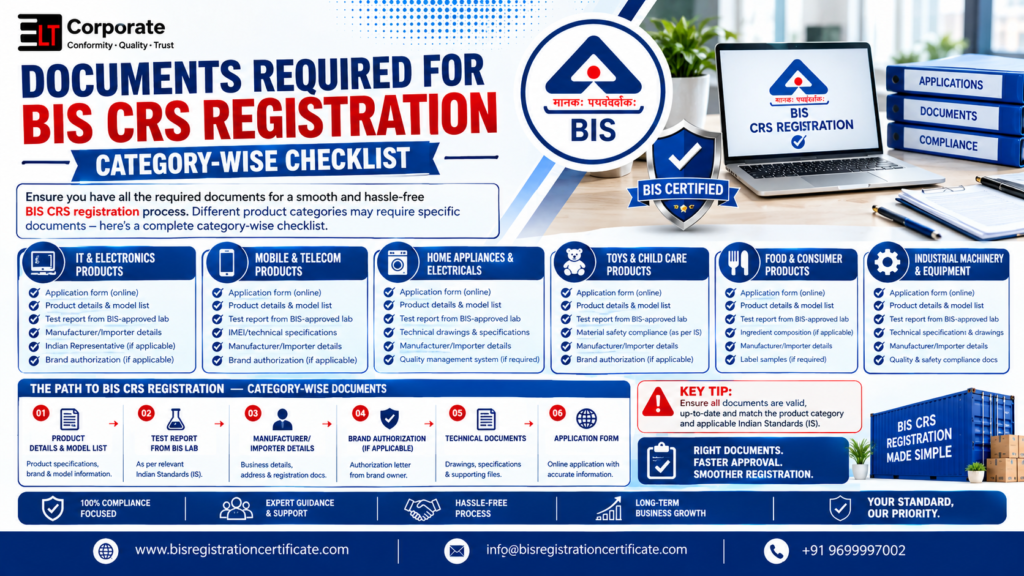
Manufacturers who apply for BIS licences for gas cartridges must submit the following: A BIS certificate for gasoline cartridges is usually required to provide the following documents:
- Registration of a factory and business registration documents
- Manufacturing machinery and test equipment on-site
- Information on the source of raw material for the body of the cartridge and coating materials
- Internal quality control and testing arrangements in accordance with IS 4947.
- Technical specifications and drawings of the product, including capacity variations produced
- Reports of tests from recognised BIS labs, where appropriate
- Address proof from the factory and layout information
You may also like
The BIS Certification Process for Gas Cartridges
Step 1: Submission of Application The manufacturer submits their application via the BIS online portal and submits information about the company, product specifications, and other additional documents.
Step 2: Document Examination BIS scrutinises the documentation to ensure that the manufacturing process and the quality control procedures are in line with IS 4947 standards.
Step 3: Factory Inspection The BIS inspector inspects the factory, examining the quality of raw materials, production processes, manufacturing procedures, and testing equipment. The sample cartridges are drawn to be tested in a laboratory during this inspection.
Step 4: Laboratory Test The samples are tested to determine resistance to pressure, leak-tightness, and composition and coating quality, as per IS 4947.
Step 5: Grant of Licence Once the test and inspection results are acceptable, BIS grants the licence, which allows the manufacturer to apply the ISI seal on gas cartridges.
Step 6: Monitoring and Renewal Certified manufacturers are regularly subject to surveillance audits as well as market sample testing, and the licence has to be renewed according to BIS timeframes to ensure that it is valid.
Common Challenges Manufacturers Face
- Precision manufacturing: Maintaining a consistent thickness of the wall and seal quality throughout the entire unit is a matter of strict process control.
- Transition to coating: Companies that are using lead-tin coatings that are older should switch to epoxy powder coatings to be in line with the latest version of the standard.
- Testing in-house: Pressure and leak testing infrastructure needs expenditure but can significantly speed the process of certification.
- Consistency across batches: As gas cartridges are an essential safety component, ensuring that they are of the same quality throughout every batch of production is crucial to be able to pass continuous inspections.
Working with a knowledgeable BIS certification specialist can assist manufacturers in streamlining documents, preparing the factories for inspection, and guiding the process of application without causing unnecessary delays.
Conclusion
While small in terms of size, gas cartridges play an important role in how an extinguisher is effective in the most critical situations. BIS certification in accordance with IS 4947 ensures that every cartridge that enters the Indian market complies with established standards of material strength and pressure handling as well as reliability. For manufacturers, this certification serves as an obligation under the law and a symbol of credibility that allows for long-term relationships with the manufacturers of fire extinguishers throughout the country.
FAQs
Q1. Is BIS certification required for gas cartridges to extinguish fires?
Gas cartridges that are used in fire extinguishers with cartridges have to be BIS-certified according to IS 4947 prior to being sold in India.
Q2. What standard is applicable to gas cartridges used in fire extinguishers?
IS 4947 “Gas Cartridges for Use in Fire Extinguishers—Specification” regulates these products.
Q3. Why is it that gas cartridges aren’t covered by the gas cylinder regulations?
As their capacity is usually less than 500 millilitres and they aren’t within the remit of the Gas Cylinder Rules, which is why an independent IS standard was developed.
Q4. What is the coating that current gas cartridges have in accordance with the standard?
Recent revisions have specified epoxy powder coating instead of lead-tin coating.
Q5. Do manufacturers of fire extinguishers require gas cartridges that have been certified?
Yes, as extinguisher certification is contingent on each element, including the gas tank being in compliance with the specific BIS standard.
Q6. Do you think the BIS licence for the gas cartridges has to be renewed?
Yes, it is subjected to periodic surveillance audits and has to be renewed according to BIS schedules.