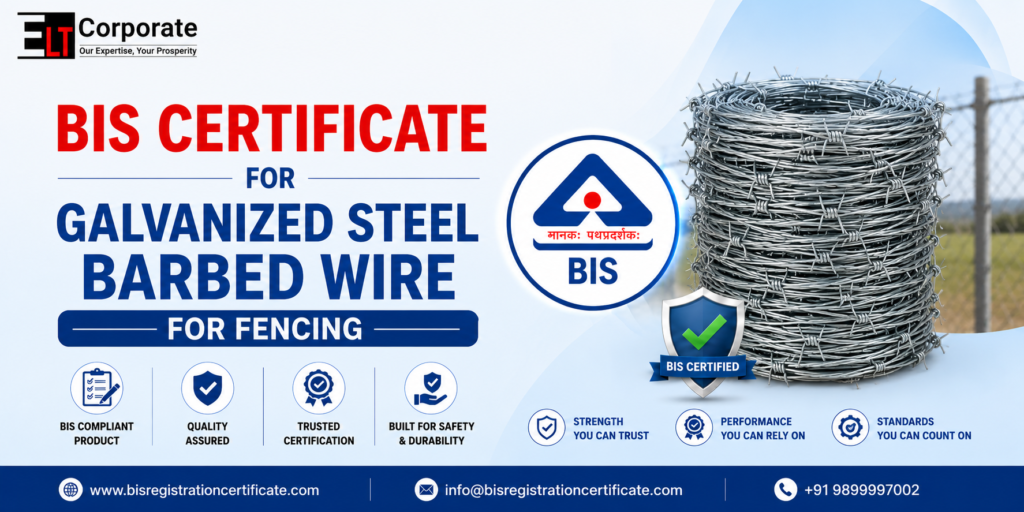
Galvanized barbed wire from steel is among the most commonly utilized materials to secure industrial sites and agricultural land defense installations, as well as residential boundaries throughout India. Due to its crucial importance in security and safety, it is the reason that the Bureau of Indian Standards (BIS) has mandated it as obligatory for all producers, regardless of whether they are Indian or from a foreign country, to get a BIS certificate for the galvanized steel barbed wire fencing before selling or providing the product to India. Indian market.
In this blog we’ll explain everything you must learn about this certification. the standard that governs it and the reason it’s mandatory and the process for obtaining certification, document requirements, test guidelines, cost, and timeframes.
What is IS 278:2009?
IS278:2009 (Fourth Revised) is the Indian Standard released by BIS that defines the specifications of galvanized barbed steel wire that is used for fencing.
It includes two kinds of strand-wire barbed wire:
- Type A (Iowa Type)
- Type B (Glidden Type)
The standard specifies requirements relating to the raw material, barb spacing, wire diameter, the number of layers, tension strength, zinc (galvanizing) coating conductivity, non-resistance to imperfections, and tolerances that are permissible that ensure the wire functions consistently in tough weather and outdoor conditions.
Key reference standards that go with IS 278 include the following:
- is 282 steel wires that is mild for general engineering use (base of the raw materials)
- is 4826 Hot-dipped galvanized coatings for round wires of steel
- is 12753 Electrogalvanized coatings on round steel wire
- Is 1340 – Code of Practice for treatment of chromate
Why is BIS Certification Mandatory for Barbed Wire?
In accordance with section 14 under the Bureau of Indian Standards Act 1986, the Department for Promotion of Industry and Internal Trade (DPIIT), Ministry of Commerce and Industry, has issued a Quality Control Order (QCO) that brings galvanized steel barbed wire in compliance with the mandatory BIS certification. This translates to:
- A manufacturer cannot manufacture or sell, trade, import, or supply barbed wire from India without having a valid BIS license and an ISI mark.
- The rule is equally applicable to manufacturing companies in India as well as foreign companies exporting their products to India.
- Infractions can result in the confiscation of property, fines, and legal actions.
Benefits of BIS Certification
- Legal permission to manufacture and sell products in the Indian market
- We assure buyers of consistency in quality, durability, and resistance to corrosion
- Brand credibility and increases customer confidence
- Allows participation in government tenders as well as large supply contracts for B2B/institutional.
- Reduces the risk of recalls, rejection or legal sanctions
Key Quality Parameters Tested Under IS 278
To get the BIS Certificate for Galvanized Steel Barbed Wire for Fencing, the samples are analyzed at BIS-recognized labs to test the following:
- The wire diameter as well as the tolerance
- Bar spacing, construction (number of layers)
- Tensile Strength
- The thickness and mass of the zinc coated (galvanization)
- Ductility as well as workmanship
- Free from surface imperfections
- Resistance to corrosion
BIS Certification Process (Scheme-I) — Step by Step
- Application Filing – Submit an application through the BIS online portal (Manak Online) together with the necessary documents.
- Document submission – Provide details about the factory such as the manufacturing process flow chart, test equipment list, and quality control system.
- factory inspection The BIS officer visits the manufacturing facility to check the infrastructure and in-house testing facilities, as well as production procedures.
- Test of Samples Samples of the product are tested and drawn at a BIS-approved laboratory as per IS 278:2009.
- Compliance review: The compliance review BIS examines the results of inspections and test reports.
- Grant of License If the product complies, BIS grants the license that allows the use of the Standard (ISI) Mark on the product.
Documents Required
- Factory registration/incorporation certificate
- List of manufacturing equipment and test equipment that is in-house
- Production process flow chart
- Raw Material Purchase Details (conforming the requirements of IS 280)
- Quality Control and records of calibration
- Signatory authorization details and application forms
Timeline and Validity
- Indie Manufacturers: Processing time for standard orders is approximately thirty days (subject to the factory’s readiness and test results).
- Foreign Manufacturers: The standard processing time is approximately 180 days as per the Foreign Manufacturers Certification Scheme (FMCS).
- The BIS license is typically granted for a predetermined time period and has to be renewed on a regular basis, with monitoring audits as well as market sample tests carried out during the license period.
Who Needs This Certification?
- Manufacturers of barbed wire galvanized from steel (Type A, Type B) that is sold in India.
- Foreign companies exporting barbed wire for the Indian market.
- Barbed wire is a barbed-wire product that is designed to be used in Indian fencing applications.
Conclusion
It is important to note that the BIS certificate for galvanized steel barbed wire for Fencing in accordance with the IS 278:2009 is not a requirement It is legally required for all those manufacturing, importing, or selling the item in India. Beyond the compliance requirements, it’s an assurance of quality, which reassures industry and farmers as well as security agencies that fencing wire can be used effectively for many years. If you produce or import galvanized steel barbed wire, starting BIS certification early will ensure that you are in compliance. The BIS certification process as early as possible can help you stay clear of regulatory hurdles and be able to enter the market with confidence.
Frequently Asked Questions (FAQs)
Q1. Is BIS certification required for galvanized barbed wire made of steel?
Yes. In accordance with the DPIIT Quality Control Order, BIS certification pursuant to IS 278:2009 is required for all importers and producers of galvanized steel barbed wire that is sold in India.
Q2. The Indian Standard governs barbed-wire certification?
Galvanized steel barbed wire for fences is controlled by IS 278:2009 (Fourth Revision) that covers the Type A (Iowa) and Type B (Glidden) wire.
Q3. What are the test procedures used for BIS barbed wire certification?
Tests cover barb spacing, wire diameter, tension strength, tensile strength, coating thickness, ductility, and resistance to corrosion.
Q4. How long will it take to receive BIS approval for barbed wire?
It usually takes about 30 to 60 days in the case of Indian manufacturers and as long as 180 days in the case of foreign manufacturers, based on the outcome of inspections and tests.
Q5. Can foreign manufacturers get BIS certification for barbed wire?
Yes, foreign companies can apply to the BIS Foreign Manufacturers Certification Scheme (FMCS) to get certification to export to India.