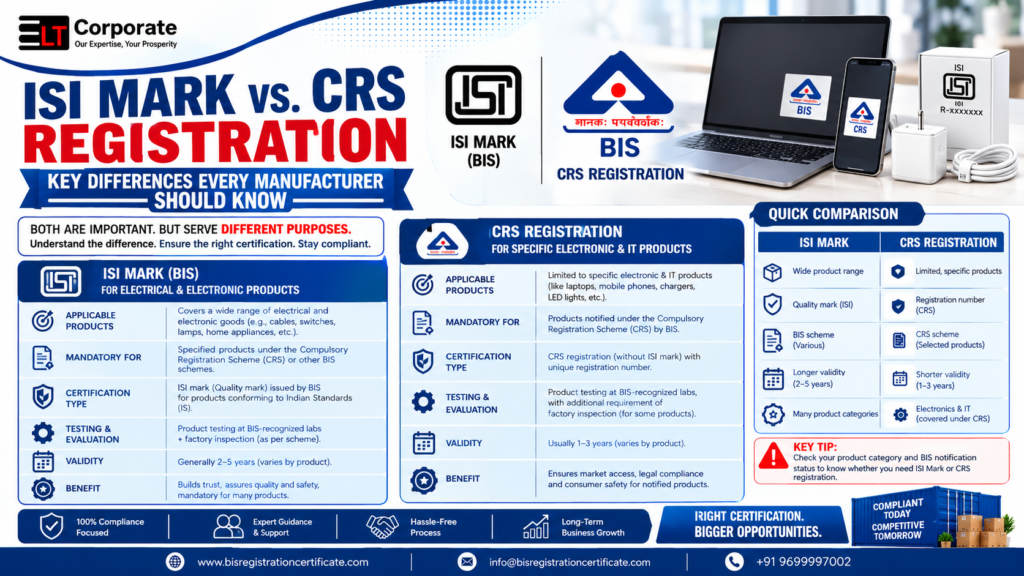
If you’re looking to make, import, or sell goods in India, it is likely that you’ve encountered two terms—ISI Mark and the CRS Registration—both of which are issued by the Bureau of Indian Standards (BIS). While they all fall under the same authority for regulation, they’re different types of products, employ different procedures, and follow different compliance deadlines. Many importers and manufacturers get confused by the two categories, selecting the wrong plan or applying under the wrong category, which can delay entry into the market by weeks or even months.
In this guide, we break down what ISI Mark and CRS Registration mean, how they differ in scope and process, which products fall under each, and how to determine the right scheme for your product before you begin your BIS registration journey.
A Brief Background: From ISI to BIS
Before examining the distinctions, it is important to know the origins of these terms. The Indian Standards Institution (ISI) was India’s first national standardization organization, established in 1947. For many years, over the years, the ISI symbol was for decades the most prominent indicator of safety and quality in India. Indian market. In 1986, the Parliament adopted legislation known as the Bureau of Indian Standards Act, and in 1987, BIS officially took over the position previously held by ISI.
The ISI mark itself never disappeared—it continues to exist today as the BIS Standard Mark, issued under Scheme-I of BIS’s certification framework. So when you see an “ISI mark” on a product today, it has technically been issued by BIS, not by any separate organization. The BIS Act, 2016, which came into force in 2017, further expanded the Bureau’s powers, giving it authority over hallmarking, product recalls, and the introduction of newer registration schemes like CRS.
What is ISI Mark Certification?
The ISI mark is a certification by the Bureau of Indian Standards. Indicates that a product conforms to the Indian Standards set by BIS. It stands for the Indian Standards Institute. The former name of BIS and quality. safety, and reliability. Products bearing the ISI mark have undergone strict testing and quality checks to ensure they meet the required specifications. It is mandatory for several products, such as electronic appliances. cement, LPG cylinder, and more, helping consumers make informed and safe choices in the market.
The ISI certification process is more rigorous compared to CRS. It involves:
- A factory audit was conducted by BIS officials to assess manufacturing processes and quality control systems.
- Sample testing at a BIS-recognized or in-house laboratory.
- Submission of an application in Form V along with technical documentation.
- Ongoing surveillance, including periodic factory visits and market sampling, even after the license is issued.
The entire process typically takes 30 to 90 days, depending on the product category and how quickly documentation and testing are completed. Once granted, the ISI license is valid for one year and must be renewed annually, with BIS continuing to monitor compliance throughout the validity period.
What is CRS Registration?
BIS Certification is a quality management system operated by the Bureau of Indian Standards, which is the national standards body of India. The system guarantees that the product conforms to Indian Standards with regard to safety, quality, and performance.
Whether BIS certification is voluntary or mandatory is determined by whether the product falls under a Quality Control Order (QCO). BIS certification is compulsory for car rims based on government notifications.
The defining feature of CRS is that it relies on self-declaration of conformity rather than direct inspection by BIS. Here is how the process typically works:
- The manufacturer gets the product tested at a BIS-recognized laboratory
- Test reports, along with company and product documentation, are submitted through the BIS CRS portal
- BIS reviews the documents—there is no factory audit involved at this stage
- Once approved, a unique registration number (R-Number) is issued, which must be marked on every certified unit
Because there is no factory inspection, the CRS process is generally faster, typically completed within 20 to 30 days. However, since it relies on the manufacturer’s self-declaration, the responsibility for maintaining consistent product quality rests heavily on the applicant—false declarations or repeated nonconformity can lead to registration cancellation and penalties.
Read More: BIS CRS Registration
Key Differences Between ISI Mark and CRS Registration
| Feature | ISI Mark (Scheme-I) | CRS Registration (Scheme-II) |
| Applicability | Cement, steel, appliances, food, LPG cylinders, etc. | Electronics, IT products, LED lighting |
| Factory Audit | Mandatory | Not required |
| Basis | Certification after inspection | Self-declaration backed by lab test report |
| Time Required | 30–90 days | 20–30 days |
| Validity | 1 year, renewable | Typically longer, renewal required |
| Foreign Manufacturers | FMCS route via Indian representative | An authorized Indian Representative (AIR) is required. |
| Marking | ISI Mark | BIS Standard Mark with R-Number |
| Ongoing Monitoring | Periodic factory visits, market sampling | Market surveillance, no scheduled factory visits |
How to Know Which Scheme Applies to Your Product
Determining the correct scheme is the most important first step, since applying under the wrong one wastes both time and money. As a general rule:
- In the event that your products fall within IT equipment, electronics, or LED lighting, like mobile phones, laptops, power banks, and wireless keyboards — it is likely to be a CRS registration.
- In the event that your products fall into the categories of construction materials such as appliances for homes, food items, or industrial products such as steel, cement, pressure cookers, or packaged drinking water, it is likely to have to be certified by ISI.
- A few new product categories, especially those that are related to low-voltage switches and control equipment, have been relocated to a different framework known as Scheme-X, which was first introduced in 2022 and will be implemented in stages until 2027. These follow requirements similar to ISI but under a distinct scheme classification.
Foreign manufacturers face an additional layer of process. Those exporting products under the ISI Mark category typically apply through the Foreign Manufacturers Certification Scheme (FMCS), which is handled by BIS’s Foreign Manufacturers Certification Department. Foreign manufacturers exporting electronics under CRS, on the other hand, must appoint an Authorised Indian Representative (AIR) who manages the registration and compliance process on their behalf within India.
You can confirm the exact requirement for your specific product using our Check Your BIS Standard tool or by consulting directly with a BIS registration expert to avoid misclassification.
What Happens If You Skip Certification
Selling products within India without the appropriate BIS Certification or the CRS Registration is an explicit infraction of the BIS Act, 2016. The consequences can include:
- The confiscation and seizure of products that are not compliant at ports or on the market.
- Financial penalties for the brand owner or importer, as well as the brand owner.
- Legal proceedings, which could include criminal liability for repeat infractions.
- The loss of retailer and buyer trust, given that many of the largest online retailers and e-commerce sites require evidence of BIS compliance prior to listing items.
In light of these risks Given these risks, it’s cheaper to get the proper certification in advance rather than deal with fines and product recalls or reputational damage later.
Why Choose ELT Corporate for BIS Registration
Choosing the wrong scheme, missing a documentation requirement, or misjudging your product’s classification can significantly delay your market entry. ELT Corporate helps manufacturers, brand owners, and importers correctly identify whether their product falls under ISI Mark, CRS, FMCS, or Scheme-X and manages the entire registration process end-to-end—from laboratory coordination and documentation to portal filing, follow-up with BIS, and ongoing renewal support.
Conclusion
Each ISI Mark and CRS Registration is designed to fulfill the same purpose to ensure the quality and safety of the products sold on the Indian market. However, they are applicable to various categories of goods and follow distinct compliance pathways. ISI Mark involves a more thorough process with factory audits and is suited to categories like construction materials and appliances, while CRS Registration is a faster, self-declaration-based route built for the fast-moving electronics and IT sector.
The early identification of the most effective scheme in the process of planning your product saves substantial time, reduces the chance of rejections of applications, and guarantees an easier route to market. If you’re not sure what certification is applicable for your item, connect with us by email at ELT Corporate for expert guidance that is specific to your particular product type.
Frequently Asked Questions
Q1. Is ISI Mark the same as BIS certification?
Yes. The ISI Mark is formally called the BIS Standard Mark and is issued under Scheme-I of BIS’s certification framework. The name “ISI” refers to the older Indian Standards Institution, which BIS replaced in 1987.
Q2. Can a product need both the ISI Mark and CRS Registration?
No, a product falls under only one scheme based on its category. Electronics and IT products fall under CRS, while most other regulated categories fall under ISI Mark.
Q3. Which is faster—ISI Mark or CRS Registration?
CRS registration is generally faster (20–30 days) since it does not require a factory audit, unlike ISI Mark certification (30–90 days).
Q4. Do foreign manufacturers need a different process?
Yes. Foreign manufacturers use the FMCS route for ISI Mark products and must appoint an authorized Indian representative (AIR) for CRS registration.
Q5. How long is a BIS registration valid?
ISI Mark licenses are valid for one year and must be renewed annually. CRS registration validity varies and also requires timely renewal to remain active.
Q6. What is Scheme-X, and how is it different from ISI and CRS?
Scheme-X was introduced in 2022 for products related to low-voltage switchgear and control gear. These categories were earlier covered under ISI Mark but now follow a separate registration classification, though the compliance requirements remain largely similar.