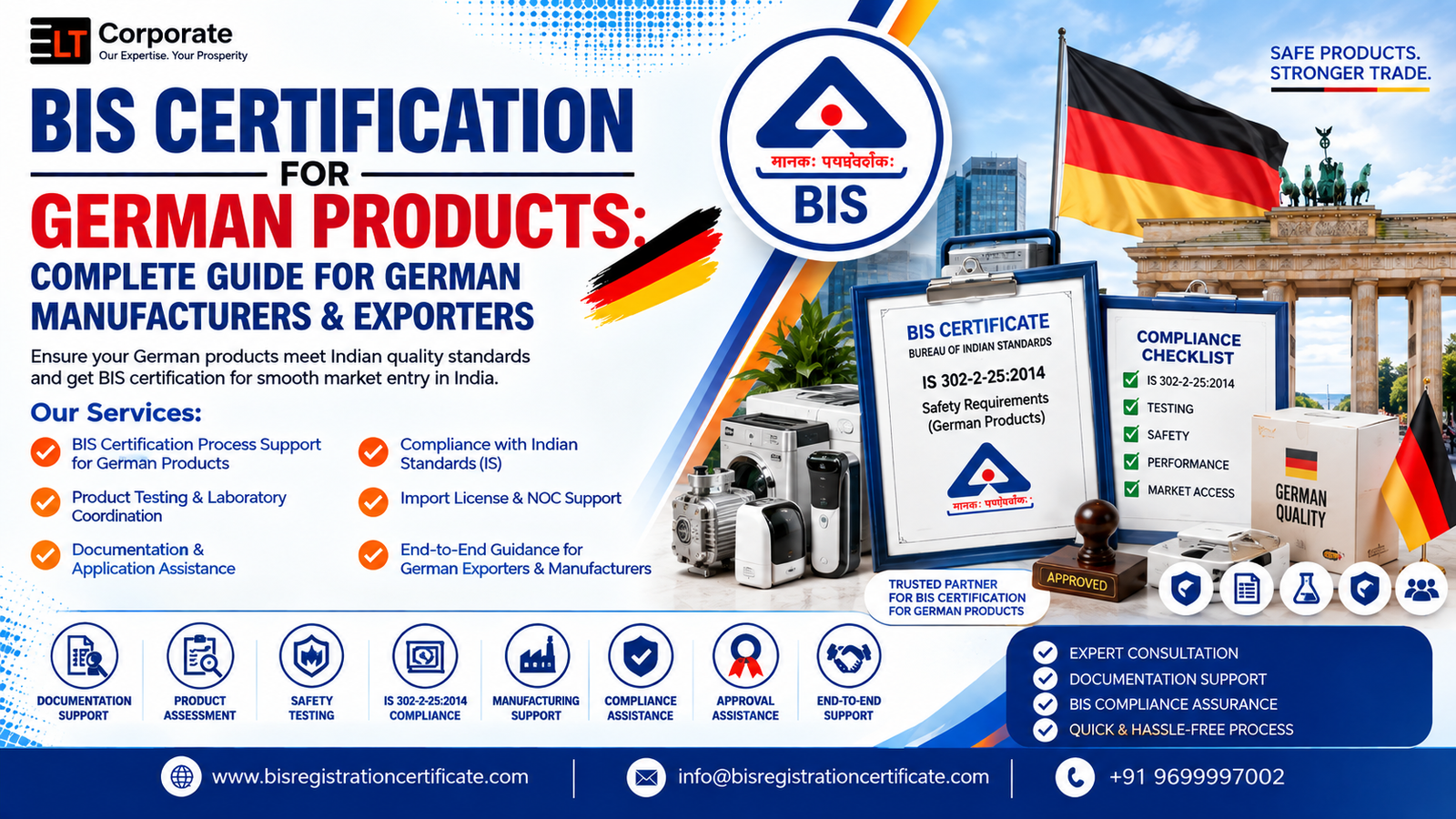
Germany is famous for engineering precision, but precision alone does not clear Indian customs. Every German manufacturer, exporter, or Indian importer bringing regulated goods into India must first secure BIS Certification for German products. Without it, shipments can be held at the port, penalized, or sent back at your cost. In this guide from the BIS Registration Certificate, we explain which German products need approval, which scheme applies, the step-by-step process, documents, timelines, and the mistakes that delay approvals.
Planning to Export to India? Get Free Expert Guidance on BIS Certification for Germany Products
Get Free Expert Consultation WhatsApp Us Call Now Contact UsWhy BIS Certification for German Products Is Mandatory in India
India regulates product quality through Quality Control Orders (QCOs). Once a product is notified under a QCO, it cannot be manufactured, imported, sold, stored, or distributed without valid BIS certification. This rule applies to imported goods exactly as it does to Indian-made goods, which means BIS Certification for German products is a legal requirement, not a formality.
- Customs clearance—Regulated goods without valid certification can be stopped at the port
- Legal sale in India—Distributors and dealers can only stock certified products
- Buyer trust – The ISI mark or BIS registration number signals tested quality
- Penalty protection—Non-compliance can lead to fines, seizure, and shipment rejection
Which German Products Need BIS Certification
German exports to India span many sectors. Categories that are commonly covered by BIS quality control orders include:
- Electrical appliances and components
- IT and consumer electronics
- Steel, metal, and industrial products
- Chemicals and polymers
- Machinery safety items and industrial equipment parts
- Automotive components and related products
How to Check If Your Product Is Covered
Not every German product is notified under a QCO. The applicable Indian Standard (IS) and scheme depend on the exact product, so always confirm the product category, HS code, and IS number before applying. Getting this first step wrong is the most common reason why BIS Certification for German Products takes longer than planned.
BIS Schemes That Apply to German Manufacturers
FMCS – Foreign Manufacturers Certification Scheme
FMCS is the route for German factories that want to use the ISI mark on products covered by Indian Standards. BIS reviews the application, inspects the German manufacturing unit, tests samples, and grants a license. A performance bank guarantee and an authorized Indian representative (AIR) are part of this route.
CRS – Compulsory Registration Scheme
CRS applies to electronics and IT products. Samples are tested at a BIS-recognized laboratory in India, and the manufacturer receives a registration number to display on the product. Factory inspection is generally not part of CRS.
Scheme X – Certificate of Conformity Route
Selected products are certified through the certificate of conformity route instead of a full license. Whether this applies depends on the product and the current BIS notification.
| Scheme | Typical Products | Factory Inspection | Testing |
|---|---|---|---|
| FMCS (ISI Mark) | Industrial, electrical, steel, chemicals | Yes, at the German factory | Sample testing as per IS standard |
| CRS | Electronics and IT products | Generally no | BIS-recognized lab in India |
| Scheme X | Selected notified products | Depends on product | As per scheme rules |
Step-by-Step Process for BIS Certification for German Products
- Identify the Standard and Scheme—Confirm the IS number and whether FMCS, CRS, or Scheme X applies
- Appoint an Authorised Indian Representative (AIR)—A mandatory local contact for BIS communication and compliance
- Register on the BIS Portal and File the Application—Submit product, factory, and manufacturer details online
- Sample Testing – Testing is completed at a BIS-recognized laboratory as per the applicable standard
- Factory Inspection (FMCS only) – BIS officers audit the manufacturing unit and quality control system
- Grant of License or Registration – BIS issues the license or registration number after all checks are cleared
- Marking and Surveillance – Apply the mark on products and maintain compliance through periodic surveillance
The timeline for BIS Certification for German products ranges from a few weeks under CRS to several months under FMCS, depending on testing schedules and inspection availability.
Ready to Start Your BIS Certification for Germany Products Application? Talk to BIS Registration Certificate Experts
Get Free Expert Consultation WhatsApp Us Call Now Contact UsDocuments Required for BIS Certification for German Products
Requirements vary by scheme, but German manufacturers should prepare the following:
- Manufacturer company registration and address details
- Factory layout, manufacturing process flow chart, and machinery list
- Quality control manual and in-house testing details
- Test reports from a recognized laboratory (where applicable)
- Product specifications, model list, and brand details
- Authorized Indian Representative appointment letter and supporting documents
- Authorized signatory details and declaration forms
- Trademark or brand authorization, if the brand owner differs from the manufacturer
For a broader checklist, see our guide on documents required for BIS registration.
Cost of BIS Certification for German Products
The total investment depends on the scheme, the number of products and models, and the current BIS fee notifications. Budget for these components:
- Government fees—application, processing, license, and marking fees
- Testing charges – Paid to the BIS-recognized laboratory
- Inspection costs—Applicable mainly under FMCS, including travel for BIS officers
- Bank guarantee – Required under the FMCS route
- Consultant and AIR fees – For representation, filing, and follow-up
Planning these costs early keeps your application on schedule and prevents surprise expenses during inspection.
Common Mistakes That Delay BIS Approval
- Choosing the wrong scheme or IS standard
- Submitting incomplete or inconsistent documents
- Using a laboratory that is not BIS-recognized
- Appointing an AIR late in the process
- Ignoring surveillance audits and renewal deadlines after certification
How the BIS Registration Certificate Supports German Manufacturers
BIS Registration Certificate, operated by ELT Corporate, handles the entire certification journey so German exporters can stay focused on production and shipping:
- Standard and scheme identification for your product
- AIR coordination and documentation
- Portal registration and application filing
- Testing and inspection coordination with BIS
- Renewal and surveillance support after grant
Our team manages BIS Certification for German products from the first document to the final license, with one point of contact throughout. You can also read how BIS registration works in our step-by-step application guide and how certification affects imports in our customs clearance guide.
Conclusion
For any German manufacturer targeting the Indian market, BIS Certification for German Products is the foundation of legal, uninterrupted trade. Choosing the right scheme, preparing complete documents, and working with a compliance partner that knows the BIS process can save months of delay. The BIS Registration Certificate is ready to guide you at every stage.
Get Your BIS Certification for Germany Products Done Faster with BIS Registration Certificate
Get Free Expert Consultation WhatsApp Us Call Now Contact UsFrequently Asked Questions
Yes, if the product is notified under a quality control order. In that case, BIS Certification for German Products is required before import, sale, or distribution.
FMCS applies to ISI-mark products, CRS applies to electronics and IT products, and some products fall under the certificate of conformity route.
Under FMCS, yes. BIS officers inspect the overseas factory. Under CRS, factory inspection is generally not required.
Yes, foreign manufacturers must appoint an AIR to handle communication and compliance with BIS.
It depends on the scheme, testing, and inspection scheduling. CRS is usually faster than FMCS.
Yes, from scheme identification and documentation to filing, testing coordination, and renewals.