
In India, hand pumps are widely used for rural water distribution, agriculture, public utilities and network consumer water systems.
Metal connectors used in hand pumps need to be strong, durable, corrosion resistant and correct in dimensions. Poor fine steel components can result in leakage, breakage, corrosion and failure of the hand pump machine.
This is why BIS certification plays an important position in ensuring first class and reliability of hand pump metal connectors.
The relevant Indian standard for hand pump steel components is IS 15500 Part IV:2021, as listed within the prestigious BIS Product Handbook catalog.
What is BIS Certificate for Hand Pump Steel Components?
The BIS certificate is an approval granted by the Bureau of Indian Standards to producers whose product conforms to the relevant Indian standard.
The certification for this product is covered below:
Product: Hand Pump Steel Components
Indian Standard: IS 15500 Part IV:2
Certification Scheme: BIS Scheme-I
Marking: ISI mark / well known mark
The BIS product manual states that a license has been granted for the use of the hand pump metal problem type standard mark in accordance with IS 15500 Part IV:2021.
What are Hand Pump Steel Components?
Hand pump steel components are the metallic parts used in deep well hand pump assemblies.
These components help in the proper functioning, strength, and durability of the hand pump.
Common steel components may include:
- Connecting rods
- Pump rods
- Flanges
- Pipes
- Handles
- Fasteners
- Steel fittings
- Stainless steel parts
- Other supporting steel components used in hand pumps
These parts are exposed to water, soil, pressure, movement, and outdoor conditions. Therefore, quality control is very important.
Why is BIS Certification Important?
BIS certification helps ensure that hand pump steel components meet required quality and safety standards.
It is important because:
- It confirms product quality.
- It improves market acceptance.
- It helps in government tenders.
- It builds buyer confidence.
- It reduces chances of product rejection.
- It ensures dimensional accuracy.
- It supports long service life of hand pumps.
- It helps prevent corrosion and premature failure.
For manufacturers, BIS certification also gives a competitive advantage in the Indian market.
Applicable Standard: IS 15500 Part 4:2021
The applicable standard for this product is IS 15500 Part 4:2021 – Hand Pump Steel Components.
This standard covers requirements related to:
- Raw material
- Dimensions
- Workmanship
- Anti-corrosive treatment
- Critical dimensions
- Flatness of flanges
- Straightness
- Formation of threads
- Product marking
The BIS Product Manual also mentions that raw materials include steel, stainless steel, and welding electrode requirements as per relevant clauses of IS 15500 Part 1.
Who Needs BIS Certification?
BIS certification may be required by manufacturers, suppliers, and importers dealing with hand pump steel components.
It is mainly useful for:
- Indian manufacturers
- Foreign manufacturers selling in India
- Importers of hand pump parts
- Government tender suppliers
- Water supply project contractors
- OEM suppliers
- Public health engineering suppliers
If the product is being supplied for government projects, public procurement, or regulated supply chains, BIS compliance becomes very important.
Key Requirements for BIS Certification
To obtain a BIS Certificate for Hand Pump Steel Components, the manufacturer must comply with the Indian Standard and BIS Product Manual requirements.
Important requirements include:
- Proper manufacturing facility
- Quality control system
- Testing arrangement
- Product conformity with IS 15500 Part 4:2021
- Correct raw material records
- Calibration records
- In-process inspection
- Final product testing
- Proper marking and labelling
- Maintenance of test records
BIS expects manufacturers to implement a Quality Assurance Plan with regular testing and in-process controls to ensure that products bearing the Standard Mark conform to the Indian Standard.
Sampling and Testing Requirements
As per the BIS Product Manual, each type of hand pump steel component must be tested.
The sample size is:
- One steel component
Testing may include:
- Dimension check
- Workmanship
- Raw material verification
- Anti-corrosive treatment
- Critical dimension check
- Flatness of flanges
- Thread formation
- Straightness
The Product Manual also lists major test equipment such as vernier caliper, thread plug gauge, snap gauge, dial calipers, and plain plug gauge.
BIS Certification Process for Hand Pump Steel Components
The BIS certification method generally involves the following steps.
- Product Introduction
First, the exact product and the relevant Indian standard are identified.
For hand pump metal components, the same old IS 15500 part 4:2021 is
- Preparation of the document
The producer must put together all the necessary files before filing the software.
These include corporate files, production information, check details, raw material information, and exceptional manipulation statistics.
- Application filing
The BIS utility is filed online with the government value along with the required information.
The software needs to be correct and holistic to avoid stagnation.
- Factory inspection
BIS officials look at the production premises.
During the inspection, they verify that:
- manufacturing systems
- Testing Facility
- Raw textile manipulation
- Quality control device
- Samples of the product
- Records and registration
- Five. Sample testing
5. Sample Testing
Samples shall be drawn and tested in accordance with the relevant Indian standard.
Depending on BIS requirements, testing can be performed at a BIS-diagnosed or NABL-approved laboratory.
- Review by BIS
The BIS gives an opinion on the record of the inspection, the check document, and the documents.
If all goes well, BIS presents the license.
- Grant of BIS License
After approval, the manufacturer gets a BIS license and can use the ISI mark / standard mark of the certified product.
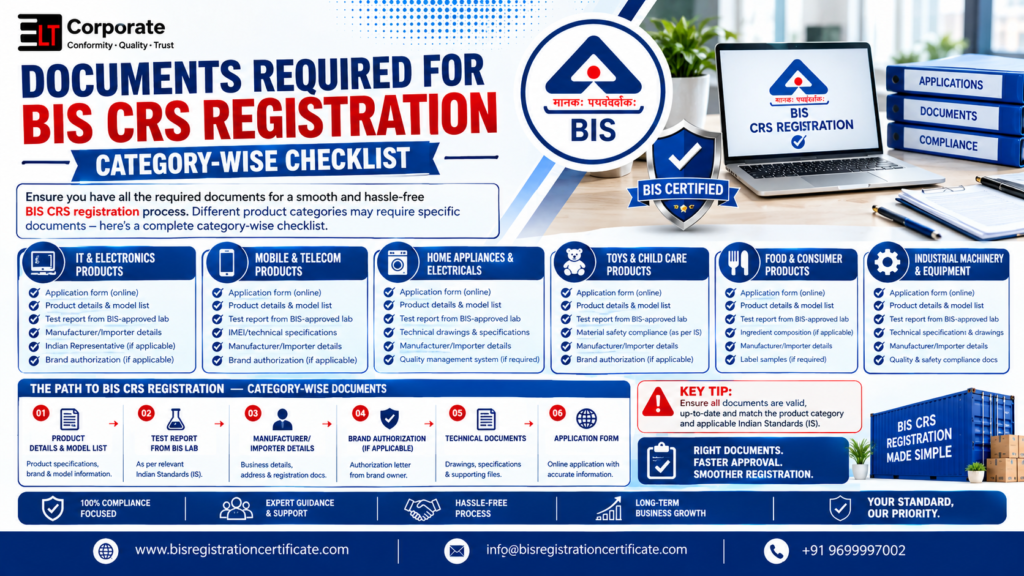
Documents Required for BIS Certification
The following documents are generally required:
- Company registration certificate
- Factory licence
- GST certificate
- Manufacturing process flow chart
- List of machinery
- List of test equipment
- Calibration certificates
- Raw material test certificates
- Quality control documents
- Product drawings or specifications
- Factory layout
- Authorized signatory details
- Trademark or brand details
- Test reports, if available
- Undertaking and declarations as required by BIS
For foreign manufacturers, additional documents may be required under the Foreign Manufacturers Certification Scheme.
Marking Requirements
Once the BIS licence is granted, the product must be marked properly.
The BIS Product Manual states that the Standard Mark should be marked on each hand pump steel component, provided the product conforms to the specification.
The licence number and BIS website details should also be marked at an appropriate place on the product or package.
Typical marking details may include:
- ISI Mark / Standard Mark
- BIS licence number
- Manufacturer name
- Product type
- Batch or lot number
- Relevant Indian Standard
- Other details as required
Common Challenges in BIS Certification
Manufacturers may face delays due to incomplete preparation.
Common challenges include:
- Wrong product classification
- Missing test equipment
- Incomplete documents
- Lack of calibration records
- Non-compliant raw material records
- Product dimension mismatch
- Factory not ready for inspection
- Incorrect marking details
- Delay in sample testing
Proper planning can help avoid these issues.
Timeline for BIS Certification
The timeline depends on document readiness, manufacturing unit readiness, time effort, inspection scheduling, and BIS assessment.
Generally, the process can take several weeks to even three months.
The timeline can also increase if:
- The documentation is incomplete
- The test fails
- Factory inspection inspection is raised
- Product samples want to be tested again
- Clarification through the BIS is required
Cost of BIS Certification
The cost depends on various factors.
It may include:
- BIS application fee
- Inspection charges
- Sample testing charges
- Marking fee
- Professional consultancy fee
- Documentation cost
- Testing equipment setup cost, if required
The exact cost should be calculated after reviewing the product type, factory location, testing requirement, and certification scope.
Benefits of BIS Certificate for Hand Pump Steel Components
BIS certification provides many business and compliance benefits.
Key benefits include:
- Legal and regulatory confidence
- Better product credibility
- Access to government tenders
- Increased buyer trust
- Reduced product rejection
- Improved quality control
- Stronger market position
- Better acceptance by institutional buyers
- Long-term brand value
For hand pump components, quality is directly linked with public water supply reliability. Therefore, BIS certification becomes highly valuable.
Why Choose a Professional Consultant?
BIS certification involves technical, legal, and procedural compliance.
An expert advisor can help with the following:
- Product well-known identity
- Document Education
- Submitting the application
- Factory preparation
- Testing coordination
- BIS Inspection Assistance
- Question response
- License furnish comply with-up
- Renewal and compliance helps
This saves time and reduces the chances of rejection or postponement.
Conclusion
BIS certification for hand pump steel components is important for manufacturers and suppliers who need to make a certain product good, attract the market and comply with Indian standards.
The applicable fashion is IS 15500 Part 4:2021, and certification is provided under BIS Scheme-I.
Manufacturers need to ensure thorough uncooked fabric control, trial, inspection, marking, and exceptional assurance prior to use for BIS certification.
A nicely designed utility can make the authentication method smoother and faster.