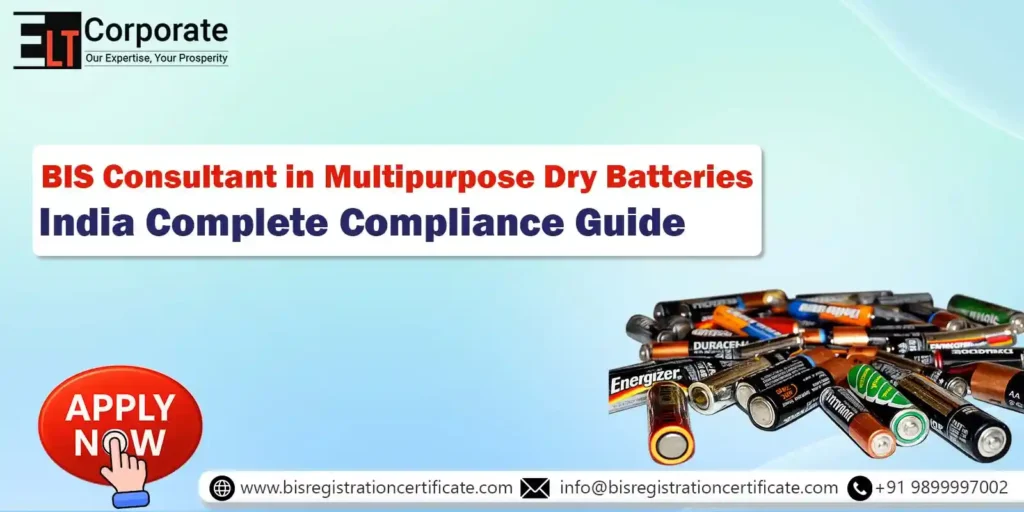
Multi-purpose dry batteries are widely used with common items such as remotes, toys, watches, flashlights, and medical devices. Due to their huge usage and capacity and safety hazards, the Government of India has made BIS certification of those batteries mandatory.
If you are a manufacturer, importer, or logo owner planning to sell dry batteries in India, then expertise in BIS compliance is critical.
What is BIS Certification?
The Bureau of Indian Standards (BIS) is the national authority responsible for ensuring product quality, protection and reliability in India.
BIS certification guarantees that products:
- Meet Indian conservation needs
- are safe for customers to use
- Maintain a steady staff
BIS certification under the Compulsory Registration Scheme (CRS) or ISI Marking Scheme (depending on the product type) is mandatory for multi-purpose dry batteries
Applicable Standard for Multipurpose Dry Batteries
Multipurpose dry batteries fall under the following Indian Standard:
- IS 8144:1993 – Safety and performance requirements for dry batteries
This standard covers:
- Leakage resistance
- Shelf life
- Performance under different conditions
- Safety parameters
Without compliance to this standard, products cannot be legally sold in India.
Is BIS Certification Mandatory for Dry Batteries?
Yes, BIS certification is mandatory for multipurpose dry batteries under Indian regulations.
Manufacturers must obtain:
- ISI Mark Certification (Scheme-I)
This ensures that every unit manufactured complies with the required Indian Standard.
Who Needs BIS Certification?
You must obtain BIS certification if you are:
- Indian manufacturer of dry batteries
- Foreign manufacturer exporting to India
- Importer or brand owner selling batteries under your label
Note: Foreign manufacturers must appoint an Authorized Indian Representative (AIR) to apply for certification.
Types of Dry Batteries Covered
The certification applies to various types of multipurpose dry batteries, including:
- AA batteries
- AAA batteries
- C and D size batteries
- 9V batteries
- Zinc-carbon batteries
- Alkaline batteries
BIS Certification Process for Dry Batteries
Here is a step-by-step process of bis certificate
1. Application Submission
Submit the application to BIS along with product and manufacturing details.
2. Documentation
Prepare and submit key documents
- Manufacturing license
- Factory layout
- Product specifications
- Test reports
- Quality control details
3. Product Testing
Samples are tested in BIS-recognised laboratories to ensure compliance with IS 8144.
4. Factory Inspection
BIS officials inspect the manufacturing facility to verify:
- Production process
- Quality control system
- Testing capabilities
5. Grant of License
After successful verification, BIS grants the license to use the ISI mark.
Documents Required for BIS Certification
You will need: Documents Required for BIS Certification
- Business registration certificate
- Manufacturing unit details
- Test reports from a BIS-approved lab
- List of machinery
- Quality control manual
- Authorised signatory details
BIS ISI Mark for Dry Batteries
Once certified, manufacturers must affix the ISI mark on their products.
The ISI mark indicates:
- Compliance with Indian standards
- Product safety and reliability
- Legal approval for sale in India
Selling non-certified batteries can result in:
- Product seizure
- Heavy penalties
- Legal action
Validity and Renewal
- BIS license is generally valid for 1–2 years
- Renewal is required before expiry
- Continuous compliance and surveillance audits are conducted
Common Challenges in BIS Certification
Many businesses face issues such as:
- Incorrect documentation
- Failed lab testing
- Non-compliant manufacturing setup
- Delay in inspection scheduling
This often leads to rejection or delays in certification.
Why BIS Certification is Important for Your Business
Getting BIS certification offers:
- Legal authorisation to sell in India
- Increased customer trust
- Better brand credibility
- Competitive advantage in the market
How ELT Corporate Can Help You
At ELT Corporate, we provide end-to-end BIS certification support for multipurpose dry batteries:
- Complete documentation support
- Testing coordination with approved labs
- Factory inspection preparation
- Application filing and follow-up
- Fast-track approval assistance
Avoid delays, rejections, and compliance risks — let experts handle your BIS certification process.
Conclusion
BIS certification for multipurpose dry batteries is not just a regulatory requirement—it’s a critical step to ensure safety, quality, and market access in India.
If you are planning to manufacture or import dry batteries, obtaining BIS certification should be your first priority.
Yes, BIS certification is mandatory under ISI marking scheme.
IS 8144:1993 is the applicable Indian Standard.
Yes, but they must appoint an Authorized Indian Representative (AIR).