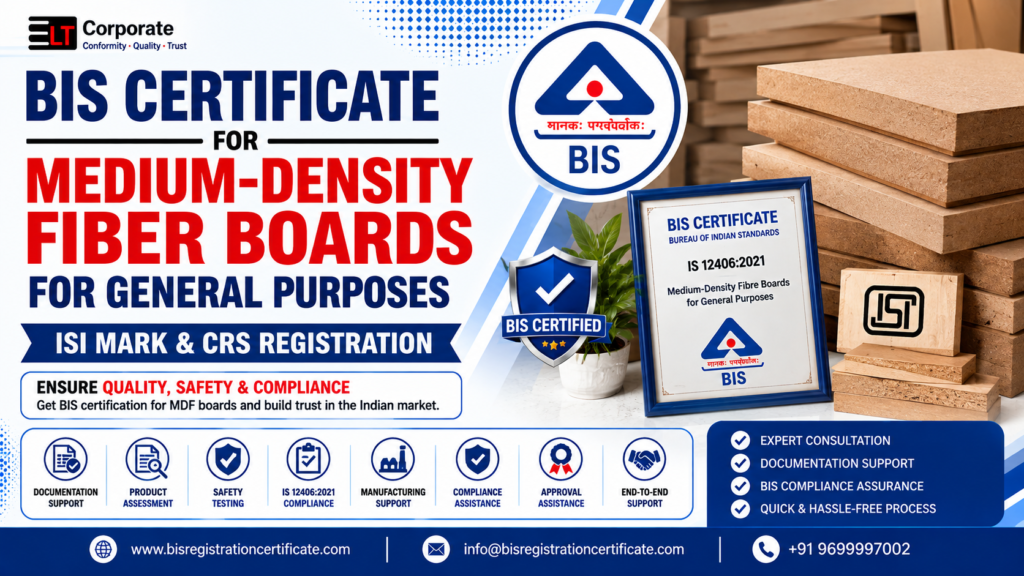
Medium Density Fiber (MDF) board is now an extremely commonly utilized engineered wood product in India’s interiors, furniture, and construction industry. The smooth, even density and its machinability make it a popular alternative to plywood and solid wood for partitions, cabinet doors, partitions, and trim for interiors. To make sure that MDF boards that are sold in India are of a similar quality and safety standards as well as safety requirements, they are required to be certified by the Bureau of Indian Standards (BIS), which has mandated certification according to IS 12406:2021.
If you are a manufacturer, importer, or marketer, Medium Density Fiber boards for general use—it is important to understand that this certification obligation is no longer an option—it’s an obligation of compliance to the law.
What is IS 12406:2021?
IS 12406:2021 is an Indian Standard titled “Medium Density Fiber Boards for General Purpose—Specification.” It defines the specifications for MDF boards created using wood fibers that are compressed and resin binders using pressure and heat, covering:
- The density range includes boards that have an average density of 600 kg/m³ and 900 kg/m³.
- Grades 1 and 2 (renamed from the previous SBG I and SBG II classifications in IS 12406:2003) Each with distinct specifications for mechanical and physical requirements
- Sizes, tolerances, and dimensions for length, thickness, and width, as well as squareness and straightness at the edge
- Mechanical and physical properties, such as the density, moisture content, linear expansion, water absorption, internal bond strength, and strength of screw withdrawal
- The content of formaldehyde is now a standard test required for boards that are oven-dry.
It’s important to keep in mind that this standard is only applicable to general-purpose MDF and is not applicable to pre-laminated, veneered, laminated, or specially treated or molded boards. They are subject to distinct standards, such as IS 144787 for prelaminated MDF.
Why BIS Certification is Now Mandatory
MDF certification has changed from a non-required ISI certification to becoming a mandatory requirement for compliance as per the Wood Based Boards (Quality Control) Order 2024 made through the Ministry of Commerce and Industry. According to the terms of this Quality Control Order (QCO):
- Medium Density Fibre Boards that are used for general purposes should be in conformity with IS 12406:2021 as well as carry the BIS Standard Mark. BIS Standard Mark
- The certification is part of Scheme I of Schedule II of Schedule II of the BIS (Conformity Evaluation) Regulations, 2018—often referred to by “The ISI Mark Scheme.”
- The order took effect on the 11th of February 2025 for the majority of manufacturers.
- Small businesses (as defined by the MSME Development Act, 2006) had time to do so to complete the process up to 11 May 2025.
- Micro-businesses were granted until the 11th of August in 2025.
- The QCO applies to import MDF boards too and not only local production.
- Infractions are punishable according to the BIS Act, 2016. BIS Act, 2016, and may result in fines or product confiscation, as well as disruption to business operations
In other words, the short version, no importer, manufacturer, or trader is legally able to sell general-purpose MDF boards within India without an official BIS license in accordance with IS 12406:2021.
Key Requirements Under IS 12406:2021
To be able to obtain and keep a BIS license in the field of MDF boards, producers must meet the following conditions:
1. Laboratory Setup
The manufacturing facility must have an in-house testing lab equipped to perform the tests required by IS 12406:2021 and the documented calibration plans for all testing equipment.
2. Grade and Formaldehyde Classification
Every batch should be classified according to the grade (Grade 1 or Grade 2) and formaldehyde class, as these determine the control unit that is used for making tests and marking.
3. Control Unit Testing
Boards that are of the same grade and class of formaldehyde, made with the identical batch of adhesive in eight hours (up to 1,000 boards), are a single control unit and have to be tested according to the specifications.
4. Physical and Mechanical Tests
Boards are tested for
- Density and variations from the mean density and variation from the mean
- Moisture content
- Linear expansion and thickness increase following the soaking of water.
- The strength of bonding between the internals (including after accelerated and cyclic testing for resistance to water)
- Strength of the screw withdrawal (face as well as edge)
- Dimensional tolerances (length and thickness, width and squareness)
5. Marking and Labelling
Certified boards must be marked with a Check BIS Standard Mark, along with clear labels of thickness, the grade, and details of the manufacturer as required by IS 12406:2021.
Step-by-Step Process to Get BIS Certification for MDF Boards
- Application submission to BIS via the online portal, including the product, the applicable standard (IS12406:2021), and the manufacturing unit’s details
- Document submission, which includes manufacturing layout, list of machines and test equipment information, and flow of manufacturing processes
- Factory audit conducted by an BIS officer to determine manufacturing capabilities as well as in-house testing facilities
- Tests on samples at a recognized BIS laboratory or in-house laboratory according to the test schedule in IS 12406:2021
- A license is granted once audit and test results are satisfactory, permitting the use of an ISI mark. ISI Mark on certified boards
- Renewal and surveillance Surveillance and renewal: BIS regularly conducts surveillance audits and market test samples to ensure conformity.
Who Needs This Certification?
- Domestic producers of general-purpose MDF boards
- Importers are bringing MDF boards to India to be sold.
- Distributors and traders who deal in MDF boards with their own brand or licensed brand
- Interior and furniture product producers that manufacture their own MDF instead of sourcing MDF that is certified
Documents Required for BIS Registration
- Factory registration / incorporation documents (GST, Udyam, MSME certificate, etc.)
- Layout plan for the factory and list of plants and machines
- Testing equipment is what is available at our facility.
- Production process flow chart
- Information on the raw materials and adhesives employed
- Address and signatory information of the authorized signatory. document
Why Choose ELT Corporate for Your BIS Certification
Finding the BIS certification process, including documentation, factory audits, and test report conformity, is time-consuming without the assistance of an expert. ELT Corporate assists MDF manufacturers and importers throughout India by providing:
- End-to-end BIS license application support for IS 12406:2021
- Factory audit preparation and documentation
- Collaboration with recognized testing laboratories of BIS
- Assistance for renewal and audits of surveillance
Conclusion
BIS Certification under IS 12406:2021 is a mandatory requirement for manufacturers looking to sell Medium Density Fibre Boards for general purposes in the Indian market. Beyond regulatory compliance, it serves as a mark of quality and safety that strengthens buyer confidence and opens doors to larger institutional and government contracts.
Given the technical documentation, factory audit, and testing requirements involved, partnering with an experienced consultancy like ELT Corporate can significantly simplify the certification journey and help manufacturers achieve compliance faster and with fewer roadblocks.
Frequently Asked Questions
Q1. Do you think BIS certification is required for all kinds of MDF boards?
BIS accreditation as per IS 12406:2021 is required only for general-purpose MDF boards. Prelaminated, veneered, or specially treated MDF boards are subject to different standards, like IS 14587.
Q2. From when will the Wood-Based Boards QCO apply to MDF manufacturers?
This Quality Control Order came into force on February 11, 2025, for the majority of manufacturers, with a timetable of 11 May 2025 for small companies, as well as 11 August 2025 in the case of micro businesses.
Q3. Does the QCO apply to imported MDF boards?
Yes. MDF boards imported from India must also be in conformity with IS 12406:2021 and bear the BIS Standard Mark before they are offered for sale in India.
Q4. What is the main difference between Grades 1 and 2? MDF according to IS 12406:2021?
Grade 1 and Grade 2 (previously SBG I and SBG II) differ in terms of their mechanical and physical property specifications, including density as well as internal bond strength and screw withdrawal strength, according to the standard.
Q5. How long will it take to receive a BIS license to use MDF boards?
The timeframes vary depending on the document preparation as well as the scheduling of factory audits and test results; however, the process usually takes between a couple of weeks and a few months from the time of application to approval.
Q6. What happens in the event that I offer MDF boards that do not have BIS certification?
Selling non-compliant MDF boards beyond that QCO deadline is considered a crime punishable in the BIS Act, 2016, and could lead to fines or product seizures, as well as legal enforcement.