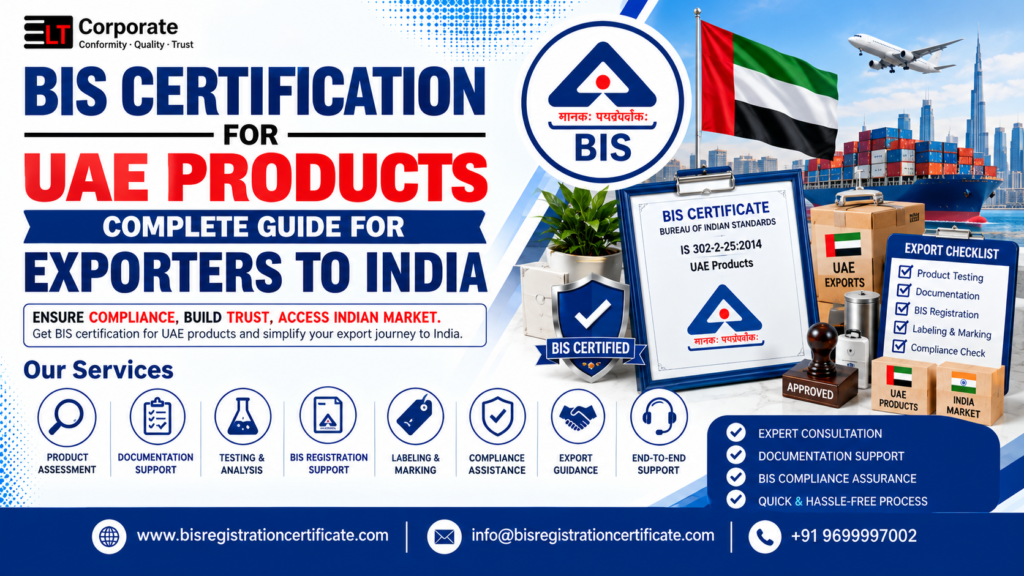
The UAE is one of India’s largest trading partners, and thousands of manufacturers in Dubai, Sharjah, Abu Dhabi, and the free zones ship electronics, electricals, cables, steel products, toys, cosmetics, and appliances to India. Many of these products are covered by Indian Quality Control Orders (QCOs). That means BIS certification for UAE products is mandatory before they can be imported, sold, or even cleared at an Indian port.
The India-UAE trade agreement (CEPA) reduces duties but does not exempt any product from BIS rules. This guide explains which UAE products need BIS certification, which scheme applies, the documents required, the process, and the timeline.
Get Your BIS Certification Done Faster, Without Rejections
Talk to our BIS experts and get a free eligibility check, document list and timeline for your product.
- Free Eligibility Check
- Pan-India and Foreign Manufacturers
- End-to-End Support
- Reply within 24 Hours
No obligation. Your details stay confidential.
What Is BIS Certification, and Why Does It Apply to UAE Manufacturers?
The Bureau of Indian Standards (BIS) is India’s national standards body. Under the BIS Act, 2016, products notified by the Government of India must carry a valid BIS licence and the ISI Certification or Standard Mark (or a CRS registration number for electronics) before they can be sold in India.
The rule applies equally to Indian and foreign manufacturers. A factory in Jebel Ali or Dubai Silicon Oasis is treated like any manufacturer abroad: if its product falls under a QCO, the brand must hold BIS certification before exporting to India.
BIS Schemes Applicable to UAE Products
1. Foreign Manufacturers Certification Scheme (FMCS)
FMCS applies to products that need the ISI Mark, such as cables, electrical fittings, cement, steel products, helmets, pressure cookers, water heaters, LED lamps, switches, and many industrial items. BIS grants the licence to the overseas factory after sample testing and a factory audit.
2. Compulsory Registration Scheme (CRS)
CRS applies to notified electronics and IT products such as mobile phones, laptops, power adapters, LED lights, CCTV cameras, smartwatches, headphones, and power banks. The product is tested at a BIS-recognized lab and registered under the manufacturer’s name, and the R-number is displayed on the product.
3. Other Schemes
Some categories fall under separate BIS rules, such as Hallmarking for gold jewelry, and certain products may also need PESO, WPC, or EPR compliance on top of BIS. Always confirm the exact regulatory route for your HS code.
Which UAE Products Need BIS Certification?
Typical UAE exports requiring BIS include:
- Electronics and IT: mobile phones, chargers, adapters, laptops, tablets, speakers, headphones, smartwatches, and CCTV cameras.
- Electrical products: cables and wires, switches, sockets, MCBs, fans, LED bulbs and luminaires, water heaters, and geysers.
- Industrial and construction items: steel bars, stainless steel products, cement, PVC pipes, tiles, safety helmets, and footwear.
- Consumer goods: toys, stainless steel utensils, pressure cookers, packaged drinking water, and certain cosmetic and personal care items (check current notifications).
QCO lists are revised from time to time, and some orders have been postponed or amended. Verify the current status of your product before applying.
Get Your BIS Certification Done Faster, Without Rejections
Talk to our BIS experts and get a free eligibility check, document list and timeline for your product.
- Free Eligibility Check
- Pan-India and Foreign Manufacturers
- End-to-End Support
- Reply within 24 Hours
No obligation. Your details stay confidential.
Key Requirement: Authorized Indian Representative (AIR)
A UAE manufacturer cannot apply to BIS directly without local representation. The brand must appoint an Authorized Indian Representative (AIR), who handles correspondence with BIS, submits the application, coordinates sample testing, and takes responsibility for compliance in India. The AIR must be an Indian-registered entity or resident, appointed through a formal authorization letter. A consultancy like ELT Corporate can act in this role or coordinate it for you.
Documents Required for BIS Certification for UAE Manufacturers
- Company documents: trade licence of the UAE entity, factory address proof, and business profile.
- Authorization: Authorized Indian Representative appointment letter and AIR identity and address documents.
- Technical documents: factory layout, manufacturing process flow chart, list of machinery and testing equipment, product test reports where available, and brand or trademark details.
- Product documents: product model list, circuit diagrams (for electronics), user manual, and labelling details.
- Quality documents: quality control plan and calibration records for testing equipment.
For a full list, see our guide on documents for BIS registration.
Step-by-Step BIS Certification Process for UAE Products
Step 1: Product and scheme identification. Confirm the Indian Standard (IS number) and whether the product falls under FMCS or CRS.
Step 2: Appoint the Authorized Indian Representative. Sign the authorization and submit identity documents.
Step 3: Application filing. The AIR files the application on the BIS portal with documents and the prescribed fee.
Step 4: Sample testing. Samples are sent to a BIS-recognized laboratory in India. For CRS products, testing is done on the specified standard. For FMCS products, samples may also be drawn during the audit.
Step 5: Factory inspection. For FMCS, a BIS officer visits the UAE facility to audit the manufacturing process, testing capability, and quality system. Audit travel costs are borne by the manufacturer.
Step 6: Grant of licence or registration. After a satisfactory test report and audit, BIS issues the licence or CRS registration.
Step 7: Marking the product. The ISI Mark or R-number is applied on the product and packaging as per BIS guidelines.
Step 8: Maintenance. Pay the annual minimum marking fee, keep testing records, and renew the licence before expiry.
Timeline and Cost
CRS registration typically takes around 4 to 8 weeks, depending on lab testing. FMCS licenses usually take 2 to 4 months or longer, since the factory audit must be scheduled. Costs depend on the product, number of models, test charges, audit expenses, and consultancy fees. Delays commonly come from incomplete documents, test failures, or audit scheduling.
What Happens If You Export Without BIS Certification?
Shipments of notified products without valid BIS certification can be held at Indian customs, have their clearance refused, or be returned. Selling uncertified products in India can also lead to penalties under the BIS Act. For import-side details, read our guide on BIS certificates for customs clearance.
Benefits of Getting BIS Certification for UAE Products
Legal market access to India’s large consumer and industrial market.
Smooth customs clearance with fewer shipment holds.
Buyer trust, since Indian importers and distributors prefer certified brands.
Competitive advantage over uncertified competitors.
Why Choose ELT Corporate for BIS Certification?
ELT Corporate Pvt Ltd is a BIS certification consultancy that supports foreign manufacturers from application to licence. Our team handles scheme selection, AIR support, documentation, lab coordination, audit preparation, and renewals, so UAE exporters can focus on production and sales.
Get Your BIS Certification Done Faster, Without Rejections
Talk to our BIS experts and get a free eligibility check, document list and timeline for your product.
- Free Eligibility Check
- Pan-India and Foreign Manufacturers
- End-to-End Support
- Reply within 24 Hours
No obligation. Your details stay confidential.
Conclusion
BIS certification for UAE products is a legal requirement for any notified product exported to India. UAE manufacturers should identify the right scheme (FMCS or CRS), appoint an authorized Indian representative, prepare accurate documents, and plan for testing and a factory audit. Starting early avoids shipment delays and keeps your products in the Indian market without interruption.
Frequently Asked Questions
Q1. Is BIS certification mandatory for products imported from the UAE?
Yes, if the product is covered under a quality control order. Country of origin does not matter.
Q2. Does the India-UAE CEPA exempt UAE products from BIS?
No. CEPA reduces customs duties, but BIS and other technical regulations still apply.
Q3. Can a UAE manufacturer apply for BIS directly?
Not without an authorized Indian representative, who files and manages the application in India.
Q4. Which scheme applies to UAE manufacturers?
FMCS for ISI Mark products and CRS for notified electronics.
Q5. Is a factory inspection required in the UAE?
For FMCS, yes. A BIS officer audits the factory. CRS generally relies on lab testing.
Q6. How long does BIS certification take for UAE products?
Roughly 4 to 8 weeks for CRS and 2 to 4 months or more for FMCS.
Q7. How long is a BIS licence valid?
Typically 1 to 2 years, and it can be renewed before expiry.
Q8. Can an importer in India get BIS on behalf of the UAE brand?
The licence is granted in the manufacturer’s name. The Indian importer or consultant can act only as the AIR.