
As India moves towards eco-friendly and biodegradable options, jute sapling bags are emerging as a sustainable replacement for plastic nursery bags. These natural, compostable bags not only support environmental protection but are also in line with the “Plastic Free” and “Atmanirbhar Bharat” initiatives of the Government of India.
To ensure the quality, durability and safety of such eco-friendly products, Bureau of Indian Standards certification plays an important role. Obtaining BIS Certificate for Jute Sapling Bags is mandatory for manufacturers who wish to sell or export their products in India with the “Standard Mark” as a symbol of trust.
What Is BIS Certification?
The Bureau of Indian Standards operates under the BIS Act, 2016, ensuring that products meet the required safety, performance and quality standards. For jute products, BIS certification guarantees that the bags are:
- Environmentally sustainable
- Free from harmful chemicals
- Strong enough to withstand the weight of plants and soil
- Manufactured as per Indian Standard Specifications
This certification increases consumer confidence and helps manufacturers gain access to larger institutional and export markets.
Read More: Introduction To Bureau Of Indian Standards
Applicable Standard for Jute Sapling Bags
Jute sapling bags generally fall under the following Indian standards:
- IS 14716:2000 – Jute bags for packaging
- IS 12669:1989 – Jute bags for agricultural use
- IS 9113:1979 – Jute bags for fertilizer packaging
Depending on the end use and design, the Bureau may refer to the nearest applicable standard or issue product-specific guidelines through the Textile Division Council.
Types of BIS Certification Schemes
BIS certification can be obtained under the Product Certification Scheme for Jute Sapling Bags. Depending on where you build, one of the following applies:
1. Domestic Manufacturers:
Certification under Scheme-I of BIS Regulations, 2018.
2. Foreign Manufacturers:
Certification under FMCS – Foreign Manufacturer Certification Scheme if the product is manufactured outside India but intended for Indian markets.
Step-by-Step Process to Obtain BIS Certification for Jute Sapling Bags
Below, we mentioned required documents for BIS certificate for jute sapling bags:
| Step | Description |
| 1. Identify Applicable IS Standard | Determine the correct Indian Standard (such as IS 14716 or IS 12669) relevant to your product. |
| 2. Prepare Documentation | Gather manufacturing details, product specifications, test reports, and process flow charts. |
| 3. Testing of Samples | Send product samples to a BIS-recognized laboratory for testing. |
| 4. Apply on BIS Portal | Submit the online application on the ManakOnline Portal with supporting documents. |
| 5. Factory Inspection | BIS officers conduct an on-site inspection to verify production capability and quality control systems. |
| 6. Grant of License (GOL) | After successful verification and test approval, BIS issues the license to use the ISI Mark. |
| 7. Renewal and Surveillance | The license is valid for two years and must be renewed periodically after performance evaluation. |
Read More: Process for getting BIS for Certification
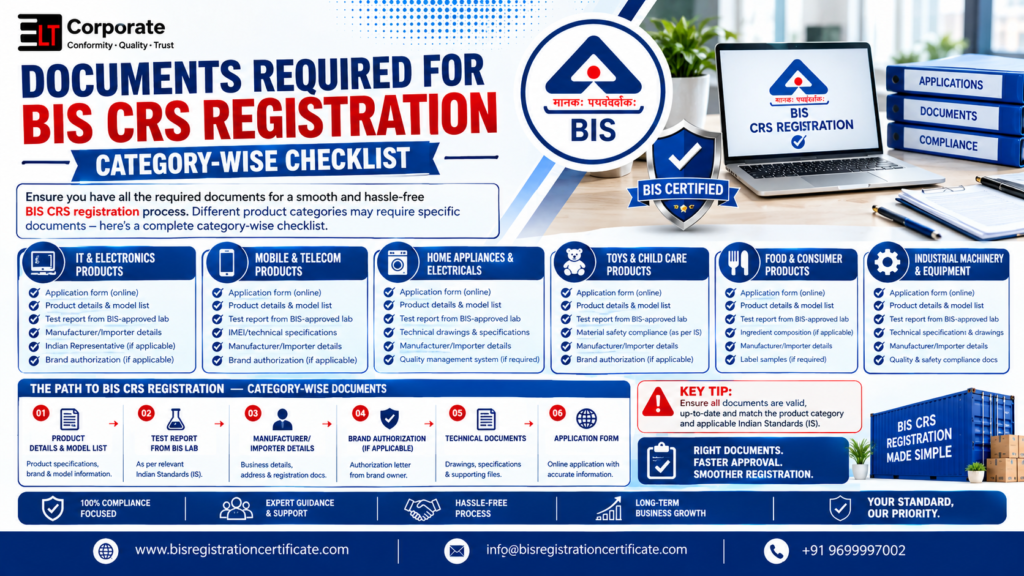
Documents Required BIS Certification for Jute Sapling Bags
Below we mentioned required documents for BIS certification for jute sapling bags
- Factory Registration Certificate (MSME/Enterprise/AOA/MOA)
- Product Specifications and Technical Details
- manufacturing process flow chart
- In-house testing equipment details
- Laboratory test reports (from BIS-approved laboratories)
- Authorized Signatory ID Proof
- Factory layout and photos
- quality control records
Read More: Documents Required For BIS Registration
Testing Parameters for Jute Sapling Bags
BIS evaluates jute sapling bags for the following:
- Tensile strength and burst resistance
- Biodegradability and eco-impact
- Load-bearing capacity
- moisture absorption and retention
- Fabric weight and construction quality
- sewing and seam durability
These tests ensure that the bags can maintain soil moisture, root growth and maintenance during planting.
Fees and Timelines
| Particulars | Estimated Cost (₹) |
| Application Fee | ₹1,000 – ₹2,000 |
| Testing Fee | ₹10,000 – ₹20,000 (depending on parameters) |
| BIS Audit Fee | ₹7,000 – ₹15,000 |
| Certification Fee | ₹25,000 – ₹35,000 approx. |
| Timeline | 30 – 45 working days for new license |
ELT Corporate – Your Partner for BIS Certification
ELT Corporate Pvt. Ltd., we assist manufacturers and exporters in obtaining BIS certification for Jute Sapling Bags with end to end support, including:
- Guidance on applicable IS Codes
- Documentation and Sample Preparation
- Coordination with BIS laboratories
- Application filing and inspection assistance
- License Renewal and Compliance Maintenance
Our experts ensure a hassle-free certification experience and help you market your products as eco-compliant, BIS-certified jute packaging solutions.
Conclusion
BIS certification for Jute Sapling Bags ensures product reliability, quality and environmental compliance – vital for India’s sustainable future. Manufacturers investing in BIS certification not only enhance brand credibility but also contribute to India’s green mission by promoting biodegradable packaging solutions.