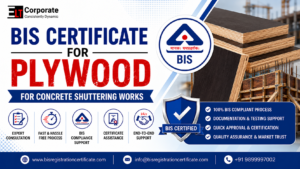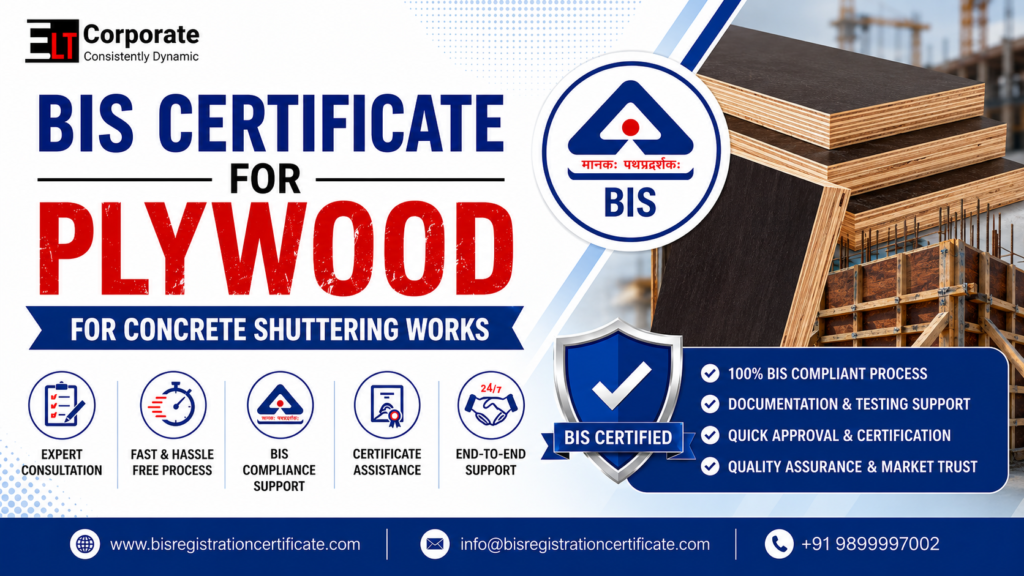
Concrete shuttering plywood forms an integral part of the building process; it molds the wet concrete and ensures that it sets well. Poor-quality concrete shuttering plywood could cause leaks, bends, and rough surfaces of concrete and could even pose structural hazards to the safety of the workmen on site. Only good-quality shuttering plywood should be used for the construction process, which the Bureau of Indian Standards (BIS) has made mandatory with regard to the IS 4990 certification for concrete shuttering plywood.
Indian manufacturers who manufacture concrete shuttering plywood need to have BIS certification (ISI mark) to legally sell their products.
This blog talks about all aspects of BIS certification for concrete shuttering plywood, from the standard, process, documents required, and testing till ELT Corporate helps you acquire the BIS certification without any fuss.
What is IS 4990?
IS 4990 is the Indian Standard specification for plywood used specifically in concrete shuttering (formwork) applications. Unlike regular commercial plywood, shuttering plywood must withstand repeated exposure to moisture, cement alkalinity, and mechanical stress from repeated reuse on construction sites.
The standard lays down requirements for:
- Bonding quality (BWP—Boiling Water Proof grade)
- Number of reuses (minimum reuse cycles)
- Surface finish (film-faced or resin-coated)
- Dimensional tolerances (thickness, length, width)
- Mechanical strength (bending, screw holding, and shear strength)
- Moisture resistance and glue adhesion
Why is BIS Certification Mandatory for Shuttering Plywood?
- Ensures plywood can withstand multiple reuse cycles without deforming
- Confirms boiling water proof (BWP) bonding for durability under wet concrete exposure
- Required for government construction tenders, PWD projects, and large infrastructure contracts
- Prevents structural defects like honeycombing or surface unevenness in cast concrete
- Builds trust with contractors, builders, and plywood distributors
- Mandatory compliance under BIS regulations for construction-grade plywood
Documents Required for BIS Certification (IS 4990)
| Document | Purpose |
| Factory address proof | Verify manufacturing location |
| List of manufacturing machinery | Confirm production capability |
| Raw material details (timber species, resin type) | Verify input material quality |
| In-house testing lab details | Confirm quality control setup |
| Product test reports (BIS-recognized lab) | Validate compliance with IS 4990 |
| GST registration certificate | Business verification |
| Factory layout plan | Reference for site inspection |
| List of technical/QC staff | Confirm technical competency |
BIS Certification Process for Shuttering Plywood
| Step | Description |
| 1. Application Submission | Apply online via the BIS Manak portal (Form V) with required documents |
| 2. Document Verification | BIS reviews factory details, raw materials, and manufacturing processes. |
| 3. Factory Inspection | BIS officer visits the plant to inspect machinery, pressing process, and QC setup |
| 4. Sample Testing | Plywood samples tested as per IS 4990 for bonding, strength, and reuse durability |
| 5. Compliance Review | BIS evaluates test results against standard benchmarks |
| 6. License Grant | ISI Mark license issued for shuttering plywood production |
The process generally takes 2 to 4 months, depending on document readiness and inspection scheduling.
Key Testing Parameters Under IS 4990
- Glue shear strength test — checks bonding strength under wet and dry conditions
- Boiling water test — confirms BWP-grade adhesive durability
- Moisture content test — ensures plywood is within acceptable moisture limits
- Screw withdrawal strength—measures resistance to fasteners used during shuttering
- Static bending strength & modulus of elasticity—evaluates load-bearing capability
- Number of reuse cycles—verifies plywood can be reused multiple times without damage
- General flatness and surface finish—ensures smooth concrete surface finish after casting
Grades and Types of Shuttering Plywood
| Type | Feature | Common Use |
| Film-faced shuttering plywood | Phenolic film coating on both sides | High-reuse commercial/industrial projects |
| Resin-coated plywood | Resin-impregnated surface | Mid-range reuse requirements |
| Standard BWP plywood | Boiling water-resistant bonding only | Basic shuttering applications |
Film-faced plywood typically offers the highest number of reuse cycles and the smoothest concrete finish, making it the preferred choice for large-scale infrastructure and high-rise construction projects.
Validity and Renewal
The BIS ISI license for shuttering plywood is generally granted for 1 to 2 years, subject to periodic BIS surveillance audits and market sample testing. Manufacturers should apply for renewal well ahead of expiry to avoid interruptions in production and sales.
Conclusion
BIS certification under IS 4990 is vital for shuttering plywood producers who wish to ensure their product’s longevity, safety, and the ability to participate in large private and public construction projects. The construction industry in India is growing; the need for a valid ISI mark gives manufacturers a significant competitive advantage as well as longer-term credibility in business.
Need Help Getting BIS Certification for Your Polyethylene Pipes?
📱 WhatsApp Us 📞 Call Now 📝 Free AssistanceFAQs
Q1. Are BIS certifications required for shuttering plywood producers?
Yes, plywood designed for use in concrete shutters must have an ISI Mark under IS 4990 to legally sell in India.
Q2. What is the meaning of BWP grade?
BWP signifies Boiling Waterproof. It indicates that the glue bonding of plywood can stand up to prolonged exposure to boiling water without separating.
Q3. What is the maximum number of times BIS-certified shuttering plywood is used?
The grade and quality of the wood will determine how long the certified shuttering plywood may typically be used: between 8 and 15 times.
Q4. How long will BIS certification take?
Typically, 2-4 months, dependent on the readiness of the document and the timeline for factory inspections.
Q5. Can importers and traders apply for BIS certification?
Yes, importers are able to make an application through the Foreign Manufacturers Certification Scheme (FMCS) for plywood that is manufactured outside of India.
Q6. What is the cost of BIS certification for shuttering plywood?
Costs depend on application fees, testing fees, inspection charges, and annual license fees—contact ELT Corporate for a customized quote.
Need help with Shuttering Plywood BIS Certification? WhatsApp us now →