Ceiling fans are among the most widely used electrical appliances in Indian homes, offices, schools, and factories. Because they run for long hours and involve live electrical parts, rotating blades, and heavy overhead mounting, poor-quality fans can cause electric shocks, overheating, fires, and even physical injury. To protect consumers, the Government of India has made BIS certification for ceiling fans mandatory.
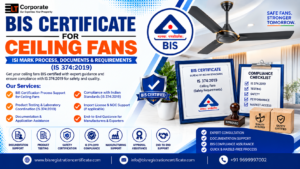
Under the Electric Ceiling Type Fans (Quality Control) Order, 2023, issued by the Department for Promotion of Industry and Internal Trade (DPIIT) in August 2023, no manufacturer or importer can sell electric ceiling fans in India without an ISI Mark license from the Bureau of Indian Standards. The applicable standard is IS 374:2019.
This guide explains what the BIS Registration Certificate for ceiling fans is, who needs it, the tests involved, documents required, the step-by-step process, and the risks of non-compliance.
Need BIS Certification for Ceiling Fans?
Talk to our experts for ISI Mark (IS 374:2019) licensing, testing and documentation support.
WhatsApp Call Now Contact Us Get Free Expert ConsultationWhat Is BIS Certification for Ceiling Fans?
BIS certification for ceiling fans is the license granted by the Bureau of Indian Standards that allows a manufacturer to place the ISI Mark on fans that conform to IS 374:2019. The certification is granted under Scheme-I of the BIS (Conformity Assessment) Regulations, 2018, which means the product is tested and the factory is audited before the license is issued.
The ISI mark on a fan tells the buyer that the product has been tested by a BIS-recognized laboratory and that the manufacturing unit follows a controlled quality system.
IS 374:2019: Scope of the Standard
IS 374:2019 covers electric ceiling-type fans and their regulators. Specifically, it applies to:
Fan Types Covered
- Single-phase, 50 Hz AC ceiling fans driven by a squirrel cage induction motor (capacitor type)
- Brushless DC (BLDC) motor ceiling fans
- Fans rated up to and including 250 V for household and similar purposes
- Fans supplied with or without speed regulators or remote control devices
What the Standard Specifies
The standard lays down requirements for electrical safety (insulation, protection against shock, and earthing), mechanical strength and stability, performance (air delivery, power consumption, and service value), temperature rise, endurance, and marking and labelling.
Is BIS Certification Mandatory for Ceiling Fans?
Yes. The Electric Ceiling Type Fans (Quality Control) Order, 2023, makes the ISI Mark compulsory for every ceiling fan that is manufactured, imported, stored, distributed, or sold in India. This applies equally to:
- Indian manufacturers producing fans domestically
- Foreign manufacturers exporting fans to India
- Importers and brand owners who get fans made under their own brand
Selling uncertified fans is a violation of the BIS Act, 2016. Penalties can include imprisonment of up to two years, a fine of not less than ₹2 lakh (which can extend to ten times the value of the goods), or both, along with seizure of stock.
Who Needs a BIS Certificate for Ceiling Fans?
- Ceiling fan manufacturers and assembly units
- BLDC and energy-efficient fan manufacturers
- Foreign manufacturers exporting ceiling fans to India (through the Foreign Manufacturers Certification Scheme, FMCS)
- Importers and traders selling fans under their own brand name
- Brands that outsource manufacturing to OEM units
Tests Conducted for BIS Certification of Ceiling Fans
Samples are tested at a BIS-recognized laboratory. The main tests include:
- Input power and air delivery at rated voltage
- Service value (air delivered per watt), which reflects efficiency
- Insulation resistance and high voltage (dielectric strength) tests
- Temperature rise of windings and parts during continuous running
- Endurance test to check long-term running reliability
- Mechanical tests covering blade strength, balance, canopy, and suspension stability
- Protection against electric shock and earthing continuity
- Marking and labelling verification
Only fans that pass all required tests move to the licensing stage.
Need BIS Certification for Ceiling Fans?
Talk to our experts for ISI Mark (IS 374:2019) licensing, testing and documentation support.
WhatsApp Call Now Contact Us Get Free Expert ConsultationDocuments Required for BIS Certificate for Ceiling Fans
Preparing documents properly is the biggest factor in avoiding delays. Typically you will need:
For Indian Manufacturers
- Application form with authorized signatory details
- Proof of factory ownership or rent agreement
- Business registration documents (GST, Udyam, company incorporation, or partnership deed)
- Factory layout and manufacturing process flow chart
- List of machinery and testing equipment with calibration certificates
- Details of the in-house testing laboratory
- Product details: model list, ratings, sweep sizes, motor type
- Brand name, trademark details, and BIS test report from a recognized lab
- Quality control plan and staff details
For Foreign Manufacturers
- All of the above for the overseas factory
- Appointment of an Authorized Indian Representative (AIR)
- Authorization letter and legal documents of the foreign entity
- Marking fee and license fee payment details
For a detailed checklist, read our guide on documents for BIS registration.
Step-by-Step Process to Get a BIS Certificate for Ceiling Fans
Step 1: Gap Analysis and Product Classification
Check your fan models against IS 374:2019 and group them into series or families to save testing costs.
Step 2: Sample Testing
Send samples to a BIS-recognized lab and obtain a test report.
Step 3: Online Application
Submit the application on the BIS portal with documents, a test report, and fees.
Step 4: Factory Inspection
A BIS officer audits the factory for quality systems, in-process controls, testing facilities, and record keeping. Random samples may be drawn for independent testing.
Step 5: Grant of License
After a satisfactory audit and review, BIS grants the license, and you can start marking fans with the ISI Mark and CM/L number.
Step 6: Surveillance and Renewal
BIS conducts periodic surveillance audits. The license must be renewed on time to keep the marking rights.
To understand the application system in general, see our guide on how to apply for BIS registration.
BIS Certification Timeline and Cost for Ceiling Fans
Timeline
For Indian manufacturers, the process generally takes around 30 to 45 days when the documents and testing are in order. For foreign manufacturers under FMCS, it commonly takes several months (often 3 to 6 months) because of additional verification and inspection steps.
Cost Factors
Total cost depends on the number of models, laboratory testing charges, BIS application and license fees, annual marking fees, factory inspection expenses, and consultancy support. Fan manufacturers with multiple sweep sizes should group models sensibly to reduce testing costs.
ISI Mark vs. BEE Star Label on Ceiling Fans
Many buyers confuse these two. They are separate requirements:
- The ISI Mark confirms safety and quality compliance under IS 374:2019.
- The BEE Star Label shows the energy efficiency rating on a 1 to 5 star scale.
A fan sold in India must comply with the BIS requirement, and star labeling under the Bureau of Energy Efficiency program applies separately. Manufacturers should plan for both.
Benefits of BIS Certificate for Ceiling Fans
- Legal compliance and freedom to sell across India
- Consumer trust: buyers actively look for the ISI Mark on electrical goods
- Eligibility for government and institutional tenders
- Safer products with fewer complaints, returns, and warranty claims
- Smooth customs clearance for importers (see BIS certificate for customs clearance)
- Stronger brand credibility against uncertified, low-cost competitors
Common Mistakes to Avoid
- Sending samples before checking the design against IS 374:2019
- Missing or uncalibrated testing equipment during factory inspection
- Listing too many separate models instead of grouping them into series
- Incorrect marking or labeling on the fan and packaging
- Ignoring license renewal dates and surveillance requirements
- Importing fans before the license is in place
How the BIS Registration Certificate Helps
At BIS Registration Certificate, our team supports ceiling fan manufacturers, importers, and foreign brands through the entire ISI Mark journey: gap analysis, sample coordination with BIS labs, documentation, application filing, audit preparation, and post-licence compliance. Our aim is a clean first-time approval with no avoidable delays. Learn more about our ISI Mark certification services.
Need BIS Certification for Ceiling Fans?
Talk to our experts for ISI Mark (IS 374:2019) licensing, testing and documentation support.
WhatsApp Call Now Contact Us Get Free Expert ConsultationConclusion
The BIS certificate for ceiling fans is no longer optional. Under the 2023 Quality Control Order, every manufacturer, importer, and brand owner must hold a valid ISI Mark license based on IS 374:2019 before placing fans in the Indian market. Getting it right means understanding the standard, preparing the factory and documents in advance, testing at a recognized lab, and clearing the BIS audit smoothly.
Manufacturers who approach this properly protect themselves from penalties and gain a real trust advantage with buyers. If you plan to manufacture or import ceiling fans, start the certification process early and work with an experienced consultant to avoid rejections and delays.
FAQs
Q1. Is BIS certification mandatory for ceiling fans in India?
Yes. The Electric Ceiling Type Fans (Quality Control) Order, 2023, makes ISI Mark certification under IS 374:2019 mandatory for manufacturing, importing, and selling ceiling fans.
Q2. Which standard applies to ceiling fans?
IS 374:2019 covers electric ceiling-type fans, including capacitor-type induction motor fans and BLDC fans, along with regulators.
Q3. Does the BIS rule apply to BLDC ceiling fans?
Yes. IS 374:2019 includes brushless DC motor ceiling fans, so BLDC fans also need the ISI Mark.
Q4. How long does it take to get a BIS certificate for ceiling fans?
Indian manufacturers can usually complete it in about 30 to 45 days if documents and testing are ready. Foreign manufacturers generally need several months.
Q5. Can foreign manufacturers apply for BIS certification?
Yes, under the Foreign Manufacturers Certification Scheme (FMCS). They must appoint an authorized Indian representative and undergo BIS inspection.
Q6. Can I import ceiling fans without BIS certification?
No. Imported fans must carry the ISI Mark from a BIS-licensed manufacturer; otherwise, they can be held at customs.
Q7. What is the penalty for selling ceiling fans without the ISI Mark?
Under the BIS Act, 2016, penalties include imprisonment, a fine of at least ₹2 lakh, or both, plus seizure of uncertified stock.
Q8. Is the ISI Mark the same as the BEE Star Label?
No. The ISI Mark relates to safety and quality, while the BEE Star Label indicates energy efficiency.
Q9. Do I need separate certification for the fan regulator?
Regulators supplied with the fan are covered in the fan certification under IS 374:2019. Confirm the exact scope with your consultant before applying.
Q10. How long is the BIS license valid?
The license is granted for a fixed period and must be renewed before expiry, along with continued compliance through surveillance audits.