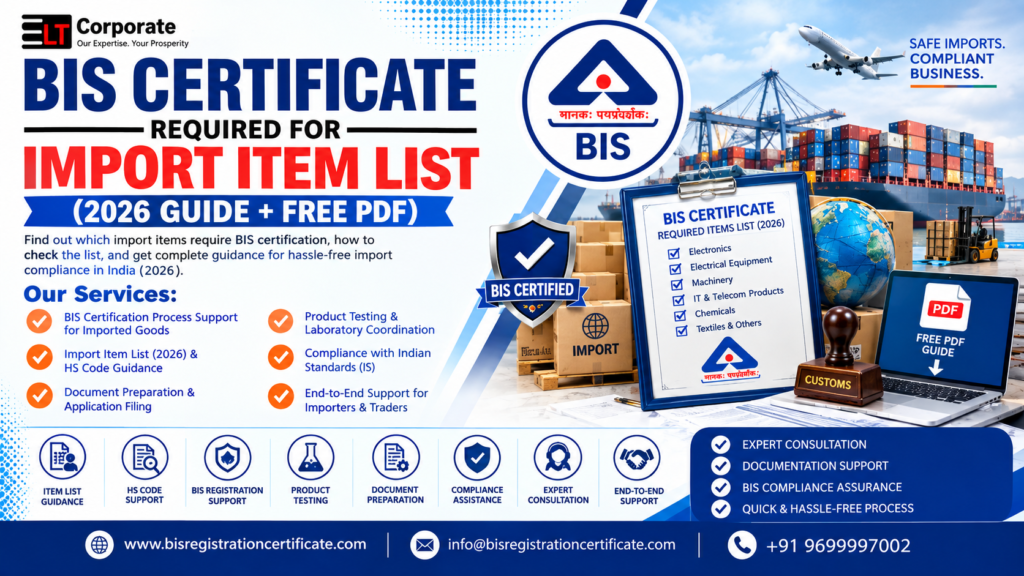
Importing goods into India without checking BIS rules is one of the most common reasons shipments get stuck at the port. If your product is covered under a mandatory Quality Control Order (QCO), customs can hold, reject, or order re-export of the consignment when a valid BIS license or registration is missing. This guide explains the BIS certificate required for the import item list, how to check whether your product is covered, the documents customs asks for, and how to get certified before your goods arrive.
Importing a BIS-Notified Product?
Get your product checked and BIS certified before your shipment arrives.
WhatsApp Call Now Contact Us Get Free Expert ConsultationWhat Is BIS Certification for Imports?
BIS certification is the approval issued by the Bureau of Indian Standards confirming that a product meets the relevant Indian Standard (IS). For imports, it means the product carries a valid BIS license (ISI mark) or registration (CRS) before it enters India.
Under the BIS Act, 2016, the government can make certification compulsory for specific products through QCOs. Once a QCO is in force, nobody can manufacture, import, sell, distribute, or stock those products without the required license and BIS mark.
Which Products Need a BIS Certificate for Import?
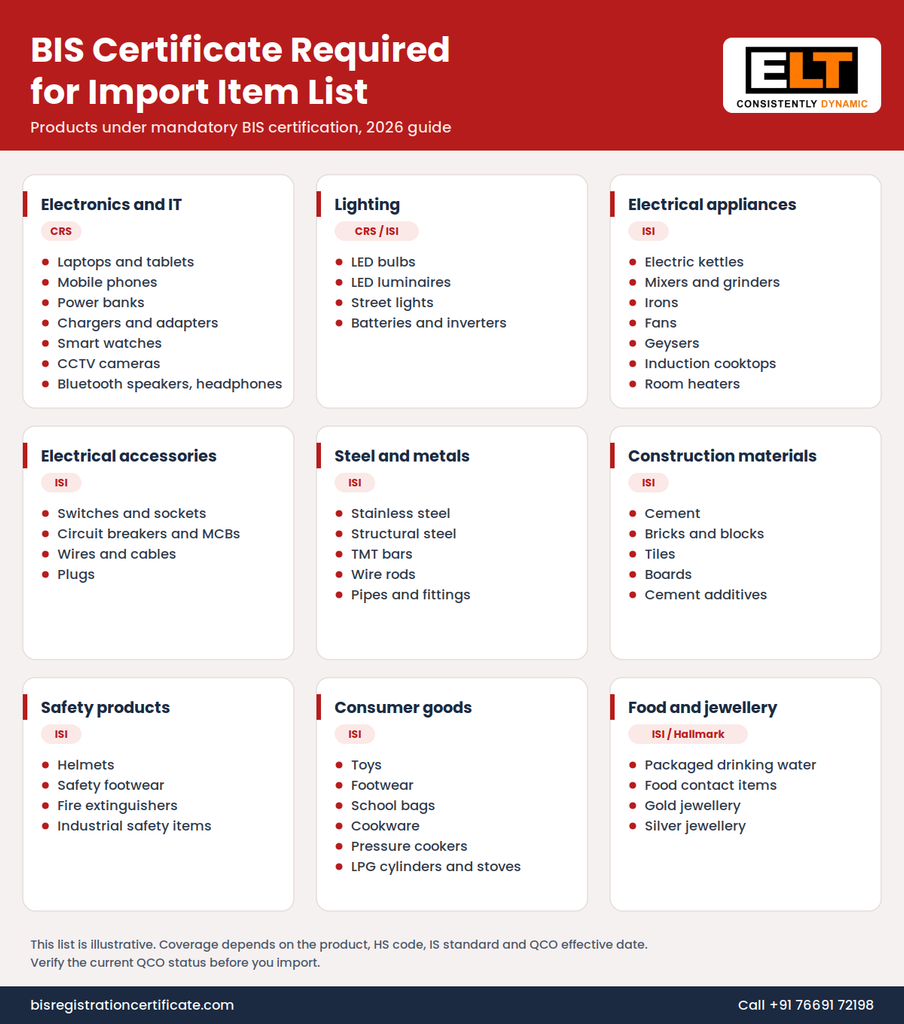
Only products notified under a QCO or the Compulsory Registration Scheme need BIS certification. The table below gives the main categories. Each product is linked to a specific Indian Standard (IS code) and a certification scheme.
| Category | Examples of Products | Scheme |
|---|---|---|
| Electronics and IT | Laptops, tablets, mobile phones, power banks, chargers and adapters, smart watches, Bluetooth speakers and headphones, CCTV cameras, LED displays and monitors | CRS (Compulsory Registration Scheme) |
| Lighting | LED bulbs, LED luminaires, street lights, batteries, and inverters | CRS / ISI Mark |
| Electrical appliances | Electric kettles, mixers and grinders, irons, fans, geysers, induction cooktops, room heaters | ISI Mark |
| Electrical accessories | Switches, sockets, circuit breakers, wires and cables, plugs, MCBs | ISI Mark |
| Steel and metals | Stainless steel, structural steel, TMT bars, wire rods, pipes, and fittings | ISI Mark |
| Construction materials | Cement, bricks and blocks, tiles, boards, cement additives | ISI Mark |
| Safety products | Helmets, safety footwear, fire extinguishers, industrial safety items | ISI Mark |
| Consumer goods | Toys, footwear, school bags, cookware, pressure cookers, LPG cylinders, and stoves | ISI Mark |
| Food and packaged water | Packaged drinking water, food contact items | ISI Mark / FSSAI-linked |
| Jewelry | Gold and silver jewelry | BIS Hallmarking |
Important: This list is illustrative, not complete. Coverage depends on the exact product, its HS code, its IS standard, and the date the QCO takes effect. New QCOs are added, and some are amended, deferred, or withdrawn, so always verify the current status before you place an order.
How to Check If Your Import Product Needs BIS Certification
Follow these steps before placing a purchase order:
- Identify your product and HS code. Get the exact technical name, model, and HS code from your supplier.
- Search the QCO list. Check the current QCO notifications on the Department for Promotion of Industry and Internal Trade (DPIIT), BIS, and DGFT websites.
- Match the Indian Standard. Confirm which IS code applies to your product.
- Check the effective date. A QCO applies only from its notified implementation date.
- Ask your supplier. Confirm whether the foreign manufacturer already holds a valid BIS license or CRS registration for that product.
- Confirm with a consultant if the product is a set, accessory, or component, because classification mistakes are common.
Applicability depends on the QCO and product standard, not on the HS code alone. Two products with similar HS codes can fall on opposite sides of the rule.
Importing a BIS-Notified Product?
Get your product checked and BIS certified before your shipment arrives.
WhatsApp Call Now Contact Us Get Free Expert ConsultationBIS Schemes That Apply to Importers
ISI Mark (Scheme I). For products such as steel, cables, electrical appliances, and cement. It involves product testing and factory inspection. See our ISI Mark certification service.
CRS (Compulsory Registration Scheme). For electronics and IT products. The manufacturer registers the product after testing in a BIS-recognized lab. No routine factory audit is required at the registration stage.
FMCS (Foreign Manufacturers Certification Scheme). Foreign manufacturers must use FMCS to obtain a BIS license so their goods can be legally imported into India. BIS may inspect the factory abroad.
Who holds the certificate? In most cases the foreign manufacturer holds the BIS license or registration, not the importer. The importer must import only from a manufacturer whose license is valid for that exact product and must verify it before every consignment.
Documents Customs Asks For
At clearance, importers should keep these ready:
- Valid BIS license (ISI mark) or CRS registration number of the manufacturer
- IS standard number and product model details
- Commercial invoice and packing list
- Bill of Entry
- HS code classification
- Product photographs showing the BIS mark or CRS registration number on the product or packaging
- Any exemption letter or approval, if claimed
For the documents needed to apply, read our guide on documents required for BIS registration.
Step-by-Step Process to Get BIS Certification for Import
- Confirm applicability using the QCO list and IS standard.
- Appoint an Authorised Indian Representative (AIR) if you are a foreign manufacturer applying under FMCS or CRS.
- Prepare documents: company details, manufacturing process, test equipment details, layout, and product specifications.
- Product testing at a BIS-recognized laboratory.
- Submit the application on the BIS portal with fees.
- Factory inspection (for ISI Mark and FMCS cases).
- Grant of license or registration, followed by marking the product as per BIS rules.
- Import and clear customs with the BIS details declared correctly.
You can also read our step-by-step guide on how to apply for BIS registration.
How Long Does It Take?
Timelines vary by scheme and product. CRS registrations are usually faster, while ISI Mark and FMCS licenses take longer because of testing and factory inspection. Delays typically come from incomplete documents, test failures, or slow response to BIS queries. Start the process well before your purchase order is shipped.
Penalties for Importing Without BIS Certification
Importing or selling QCO-covered products without a valid license or mark is an offense under the BIS Act, 2016. Consequences can include:
- Detention or seizure of the consignment at customs
- Re-export or destruction of goods
- Imprisonment of up to two years, a fine, or both, as provided under the Act
- Blocked sales on e-commerce platforms
- Loss of business reputation and buyer trust
For customs-related issues, see our guide on BIS certificates for customs clearance.
Exemptions and Special Cases
Some situations are treated differently, but only under specific conditions:
- Samples for R&D or testing in limited quantities, subject to the conditions in the relevant order
- Transitional relief for shipments where purchase orders or shipping documents pre-date the QCO effective date, if a government notification allows it
- Re-export or bonded goods not meant for the Indian market
Exemptions are narrow and documentation-heavy. Do not assume you qualify without checking the exact notification.
Common Mistakes Importers Make
- Assuming the supplier’s ISO or CE certificate is enough. It is not a substitute for BIS.
- Ordering goods before checking the QCO effective date
- Importing from a manufacturer whose license does not cover that model or IS standard
- Wrong HS code classification
- Missing BIS mark or registration number on the product
- Not verifying that the supplier’s license is still valid
How the BIS Registration Certificate Helps You
BIS Registration Certificate (by ELT Corporate) supports importers and foreign manufacturers from product applicability check to final license: QCO and IS standard mapping, document preparation, lab coordination, AIR support, application filing, and follow-up with BIS and customs guidance.
Importing a BIS-Notified Product?
Get your product checked and BIS certified before your shipment arrives.
WhatsApp Call Now Contact Us Get Free Expert ConsultationConclusion
The BIS certificate required for the import item list keeps growing, and customs checks BIS compliance strictly for notified products. The safest approach is to verify your product against the current QCO before ordering, confirm your supplier’s license is valid, and complete certification before shipment. A small delay in planning can lead to a stuck container, demurrage charges, or forced re-export.
If you are unsure whether your product needs BIS certification, our team can check it for you and guide you through the entire process.
FAQs
Q1. Is a BIS certificate mandatory for all imported products?
No. It is mandatory only for products notified under a quality control order or covered by CRS.
Q2. Who needs to get the BIS certificate, the importer or the foreign manufacturer?
Usually the foreign manufacturer holds the license or registration. The importer must ensure the goods come from a certified manufacturer and that the certificate covers the imported product.
Q3. Can I import a BIS-notified product without a BIS certificate?
No. Customs can detain or reject the consignment, and penalties can apply under the BIS Act, 2016.
Q4. Is an ISO or CE certificate accepted instead of BIS?
No. ISO and CE do not replace BIS for products under mandatory certification.
Q5. How do I know if my product falls under a QCO?
Check the product’s IS standard and HS code against the current QCO list on the DPIIT, BIS, and DGFT websites, or ask a BIS consultant.
Q6. What is the difference between ISI Mark and CRS?
ISI Mark is for products like steel, cables, and appliances and involves factory inspection. CRS is for electronics and IT products and is based on lab testing and registration.
Q7. Can samples be imported without BIS certification?
Limited quantities for R&D or testing may be allowed under specific conditions in the applicable notification.
Q8. How can foreign manufacturers get BIS certification?
Through the Foreign Manufacturers Certification Scheme (FMCS) or CRS, with an authorized Indian representative in India.
Q9. How long does BIS certification take?
It depends on the scheme and product. CRS is generally quicker than ISI Mark or FMCS. Complete documents and timely test reports speed things up.
Q10. Does the BIS certificate expire?
Yes. BIS licenses and registrations are valid for a fixed period and must be renewed on time.