Copper is among the most extensively employed industries in India that form the backbone of electrical wiring as well as power transmission and plumbing systems, as well as a variety of industrial applications where high conductivity and resistance are crucial. Because of its vital role in numerous downstream industries Due to its vital role in many downstream industries, the Bureau of Indian Standards (BIS) requires BIS certification for copper products in accordance with IS 191:2007 before they are able to be sold, manufactured, or sold on the Indian market.
ELT Corporate Pvt Ltd assists refiners and copper producers across India in obtaining this certificate efficiently, assisting them in remaining in compliance while also ensuring continuous production and supplies for downstream industry.
Need BIS Certification for Copper Products?
Get expert guidance from ELT Corporate — fast, transparent, and hassle-free BIS registration.
What Does IS 191:2007 Actually Cover?
IS 191:2007, which is titled “Copper – Specification (Fourth Revision),” is the authoritative Indian Standard for copper supplied in refinery shapes. It has undergone four revisions since the first time it was established, highlighting what the standards have changed to meet international standards and practices in the industry. The standard is specifically designed to cover copper that is cast horizontally or vertically, continuous cast forms, such as cakes, wire billets, ingots, billets, and cathodes.
These refinery shapes serve distinct downstream purposes: wire bars, cakes, and billets are primarily intended for fabrication into wrought products such as wires, rods, tubes, and sheets, while ingots are typically used for alloying purposes in both wrought and cast copper alloys. This distinction matters because a manufacturer’s certification scope must align precisely with the specific refinery shape and grade they produce—a wire bar producer and an ingot producer, for instance, are certifying against related but distinct sets of requirements within the same overarching standard.
An important regulatory update that copper manufacturers should be aware of is that the Quality Control Order covering this standard was officially notified and implemented, with BIS records confirming implementation from 1st December 2024. This means certification under IS 191:2007 is not simply a voluntary quality marker anymore for applicable product categories—it reflects an active regulatory framework that manufacturers must factor into their production and compliance planning.
Copper Grades Covered Under the Standard
One of the most technical aspects of the IS 191 standard is the classification of copper grades into separate classes, defined by specific chemical composition and purity standards that are appropriate for various applications at the end of the line: Electrolytic Cathode Grades (CU-CATH-1, CU-CATH-2—high-purity copper grades, with CU-CATH-1 requiring copper content of 99.99% or higher, used in applications demanding exceptional conductivity such as fine wire and precision instrumentation).
- F. Irrefined High Conductivity (FRHC) Copper is a popular industrial grade that has a copper content of about 99.85 percent and controlled sulfur, oxygen, and selenium levels. typically employed in transmission cables, busbars, and transformers, as well as motors.
- The deoxidized low phosphorus (DLP) and deoxidized high phosphorus (DHP) Copper is a good choice to be used in heat exchangers, chemical processing, and oxygen-sensitive environments in which the resistance to oxidation is essential.
Each grade comes with specific composition thresholds and the intended uses; producers must identify the quality or grade the manufacturing process produces, as BIS tests and certificates are performed against specific physical and chemical benchmarks that are associated with the grade—not the general “copper” class.
Why BIS Certification is Mandatory for Copper Products
Copper products are within the purview of the BIS’s Metallurgical Engineering Division, specifically the Copper and Copper Alloys Sectional Committee (MTD 8), and are accountable for ensuring and revising standards for copper as well as their alloy materials. Given copper’s extensive use in electrical infrastructure–where failure–certification of inconsistent purity or composition can directly translate into safety hazards, energy losses, or premature equipment failure—certification exists to ensure every batch of copper entering the supply chain meets a verified, consistent quality benchmark.
Without an official BIS certification, producers and refiners are not legally able to sell copper products that fall under the categories that are notified on the Indian market. Failure to comply could lead to the confiscation of product and financial penalties as per the Bureau of Indian Standards Act 2016 and a disruption of long-standing supply relationships with cable producers as well as electrical equipment producers and industrial fabricators that increasingly need certified raw materials in their own quality control processes.
Because copper is a key input in sectors such as power transmission as well as renewable energy infrastructure and electronic manufacturing, all of which are seeing significant expansion in India, holding a legitimate certification permits manufacturers to participate with confidence in industrial supply contracts as well as infrastructure projects for the government, in which certified raw material procurement is typically a primary purchase requirement.
Key Technical Requirements Under IS 191:2007
The standard lays down detailed requirements that manufacturers must satisfy before certification can be granted:
- Chemical Composition – precise limits on copper content and permissible levels of impurities such as oxygen, sulfur, selenium, and other trace elements, varying by grade
- Physical and Mechanical Properties – requirements covering density, tensile characteristics, and other physical benchmarks relevant to the copper’s intended downstream use
- Electrical Conductivity – conductivity benchmarks measured against the International Annealed Copper Standard (IACS), since electrical performance is one of copper’s most commercially critical properties
- Dimensional Tolerances – specific size, shape, and mass tolerances for each refinery shape, including wire bars, cakes, billets, and ingots, as defined in the standard’s dimensional tables
- Freedom from Defects – visual and structural inspection criteria to ensure cast products are free from defects that could compromise downstream fabrication or performance
- Sampling and Conformity Criteria—defined sampling protocols for lots of wire bars, cakes, ingots, or billets, specifying how many units must be inspected and the permissible number of defective units per lot
Manufacturers must also be prepared to issue test certificates for supplied copper that include the Standard Mark, the cast or control unit number, and corresponding test results, giving purchasers direct traceability back to the specific production batch.
Have Questions About Copper Certification?
Our BIS experts will guide you through documentation, testing, and licensing — start today.
Documents Required for BIS Certification
To apply for BIS certification under IS 191:2007, manufacturers typically need to submit:
- Factory address proof and manufacturing unit layout details
- List of manufacturing and testing equipment installed at the facility
- Details of raw material sourcing and in-house quality control processes
- In-house test reports covering chemical composition, conductivity, and dimensional parameters as per IS 191:2007
- Company registration certificate and authorized signatory details
- Details of technical and quality control personnel responsible for testing and inspection
Since the standard covers multiple grades and refinery shapes, applications should clearly specify exactly which grades and product forms are being certified, as ambiguity here is one of the more common causes of delay during BIS review.
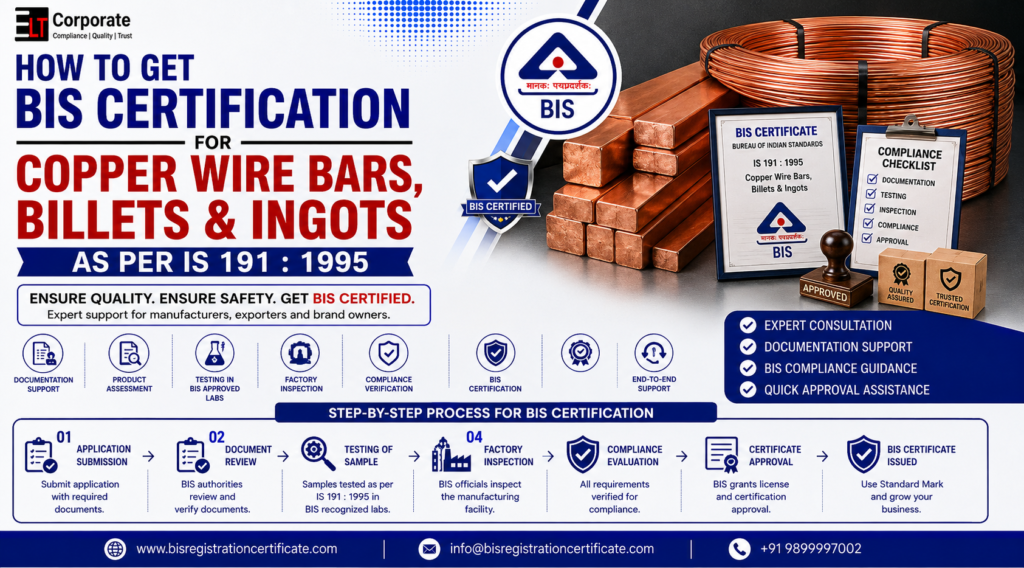
Our BIS Certification Process for Copper Manufacturers
We follow a structured process to help manufacturers and refiners secure certification without unnecessary delays:
- Grade and Product Applicability Check—confirming which copper grades and refinery shapes your production covers under IS 191:2007
- Documentation Preparation—compiling factory details, equipment lists, and quality control records
- Application Filing—submitting the complete application through the BIS online portal
- Factory Inspection Coordination—scheduling and preparing your facility for the BIS officer’s assessment visit
- Sample Testing – coordinating with BIS-recognized labs for chemical composition, conductivity, and dimensional testing
- Query Resolution—addressing any observations raised during review or inspection
- License Grant—securing your BIS license and Standard Mark authorization
Once certified, we also assist with ongoing compliance, including maintaining test records for traceability, supporting periodic surveillance inspections, and managing timely license renewal to avoid any compliance lapse—particularly important given the QCO’s active implementation status.
Why Choose ELT Corporate for This Certification
Certification for a technically layered standard like IS 191:2007 — spanning multiple grades, refinery shapes, and precise chemical benchmarks — requires close attention to technical detail and accurate documentation from the outset. ELT Corporate Pvt Ltd has helped manufacturers across the metals and metallurgical products sector secure BIS certification efficiently, with transparent pricing and realistic timelines. We manage the entire process end-to-end, from initial grade and product applicability assessment through to license renewal, so manufacturers can focus on production while we handle regulatory compliance.
Conclusion
With the Quality Control Order for copper actively implemented since December 2024, manufacturers and refiners supplying copper in the notified refinery shapes cannot afford to treat BIS certification under IS 191:2007 as optional. Getting certified—and staying current with compliance obligations—protects your business from regulatory risk while strengthening your position with cable manufacturers, electrical equipment producers, and industrial buyers who increasingly demand verified, traceable copper sourcing. ELT Corporate Pvt Ltd is ready to guide you through every step of this certification journey.
Ready to Get Started?
Let ELT Corporate handle your BIS certification from application to license grant.
Frequently Asked Questions
Q1. Is BIS certification mandatory for all copper products?
BIS certification under IS 191:2007 is mandatory for copper supplied in the refinery shapes and grades covered by the notified Quality Control Order, which has been implemented since December 2024.
Q2. What copper grades are covered under IS 191:2007?
The standard covers multiple grades, including electrolytic cathode grades (CU-CATH-1, CU-CATH-2), Fire Refined High Conductivity (FRHC) copper, and deoxidized grades like DLP and DHP, each with distinct composition requirements.
Q3. What refinery shapes does this standard apply to?
IS 191:2007 covers horizontally, vertically, and continuously cast wire bars, cakes, billets, ingots, and cathodes.
Q4. What testing is required under IS 191:2007?
Testing covers chemical composition, electrical conductivity (measured against IACS benchmarks), dimensional tolerances, and freedom from casting defects.
Q5. Do you assist with license renewal after certification?
Yes, we provide ongoing compliance support, including surveillance audit assistance and timely renewal management.