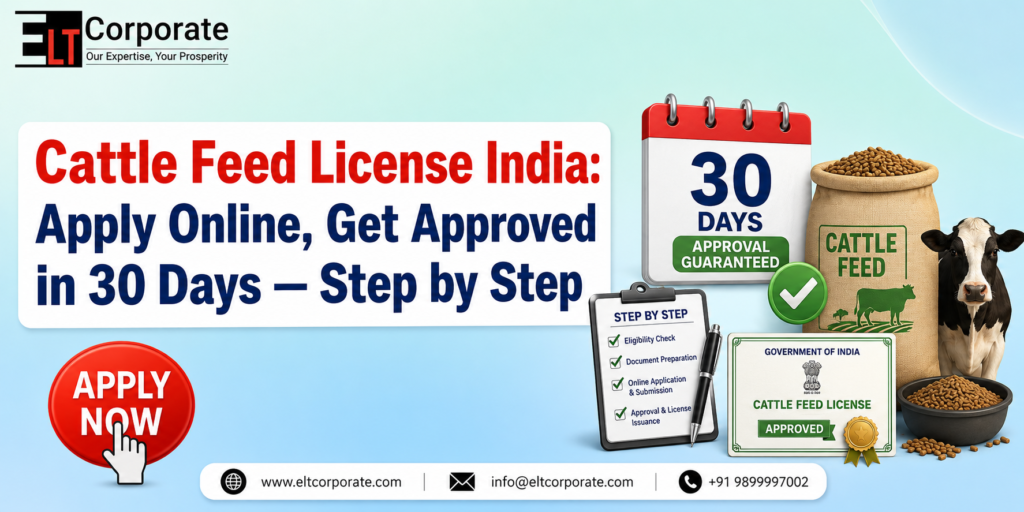
You’re thinking about creating a cattle-feed company in India; however, you are worried that the process for obtaining licenses will take months. The good news is that if you follow the correct steps and have your paperwork prepared, you can get your cattle feed permit approved in just 30 days.
There are many businesses that experience delays, but not because of the difficulty of the process, but due to incorrectly submitted documents or submitting applications for the incorrect department or failing to complete the smallest stage, which will send applications to the first.
This guide explains the exact steps to apply for a certificate online, what information is required to do so, and the best way to stay clear of the mistakes that slow others down.
First, Why Is a Cattle Feed License Non-Negotiable?
Before we get into the steps, let us be clear about what is at stake.
Operating a cattle feed business without a valid license is a punishable offense under state animal husbandry acts. Authorities carry out regular raids — especially on manufacturers and traders who are growing fast and becoming visible in the market.
Consequences of running without a license include:
- Fines ranging from ₹50,000 to ₹500,000+
- Seizure of your entire stock
- Forced shutdown of your facility
- Criminal charges against the business owner
Getting licensed is not just paperwork. It is what protects everything you have built.
Who Needs to Apply?
You need a cattle-feed license if you are:
- Manufacturing any type of cattle feed, dairy feed, or compound animal feed
- Selling or distributing packaged cattle feed products
- Running a wholesale or retail cattle feed trading business
- Supplying feed premix, supplements, or medicated feed
- Importing or distributing animal feed from other states or countries
Even small operations with just a few employees need to be registered. There is no exemption for small-scale businesses in most states.
What Licenses Will You Actually Need?
This is where many people get confused — and where most delays happen.
Depending on your business type, you may need one or more of the following:
1. State Animal Husbandry Department License This is the primary and most important license. Issued by your state government, it covers the manufacturing, storage, and sale of cattle feed within the state.
2. FSSAI License or Registration Required if your feed formula contains food-grade ingredients or additives that could enter the human food chain. Small businesses may need basic registration; larger operations need a full FSSAI license.
3. BIS Certification (IS 2052) is mandatory for certain categories of packaged and branded compound cattle feed. Without BIS certification, you cannot legally sell packed feed under a brand name in many states.
4. Drug License Needed only if your feed contains medicated additives, veterinary supplements, or probiotic compounds.
5. GST registration is required for all commercial businesses. Without GST, your business cannot issue proper invoices or operate legally at scale.
Not sure which licenses apply to you? This is exactly what a free consultation call helps figure out — so you do not waste time applying for the wrong things.
Documents You Need Ready Before You Apply
This is the most important section of this entire guide. Read it carefully.
Incomplete documents = automatic delay of 4 to 8 weeks.
Here is your complete checklist:
Identity and Business Documents
- PAN Card of owner or company
- Aadhaar Card or Voter ID of proprietor or all directors
- Passport-size photographs — 4 copies
- For firms: Partnership deed
- For companies: MOA, AOA, and Certificate of Incorporation
Premises and Address Proof
- Electricity bill or property tax receipt of the business address
- Rent agreement plus NOC from landlord (if premises are rented)
- Site plan or layout map of your manufacturing or storage unit
- Municipal or building completion certificate
Technical and Product Documents
- Complete list of raw materials and ingredients used in your feed
- Feed formulation or composition sheet for each product
- Lab test reports of feed samples from a government-approved testing lab
- Name, designation, and qualification certificate of your technical supervisor
Supporting Registrations
- GST Registration Certificate
- Udyam (MSME) Registration — strongly recommended, speeds up processing
- Trade License from local municipality
Pro tip: Get all documents scanned and organized in clearly labeled folders before you start the application. Inspectors and officers frequently ask for multiple copies on the spot.
Step-by-Step: How to Apply and Get Approved in 30 Days
Here is the exact process, broken down week by week.
Week 1 — Identify and Prepare
Day 1 to 3: Identify the correct license and department
Your first step is to confirm exactly which licenses you need based on your state, your product type, and your scale of operations. This single step can save you months. The process in Uttar Pradesh is different from Maharashtra, which is different from Rajasthan.
Day 4 to 7: Gather all documents
Use the checklist above. Do not skip the lab test reports—these take time to get from approved labs, so order them first. If you need to hire a technical supervisor, do that this week as well.
Week 2 — Submit Your Application
Days 8 to 10: Complete the online application form
Most major states now have fully online portals for animal husbandry licensing. Log in, create your business profile, fill in all required details carefully, and upload every document in the correct format and file size.
States with active online portals include:
- Uttar Pradesh — uphorticulture.gov.in and related portals
- Maharashtra — aaplesarkar.mahaonline.gov.in
- Rajasthan — sso.rajasthan.gov.in
- Other states may require physical submission at the District Animal Husbandry Office
Day 11 to 14: Pay the government fee and confirm submission
Government fees range from ₹500 to ₹10,000 depending on your state and business scale. Keep the payment receipt carefully — you will need it for follow-up.
Week 3 — Inspection
Day 15 to 21: Premises inspection by Animal Husbandry officer
After your application is received and verified, an officer from the animal husbandry department will visit your facility to inspect the following:
- Physical infrastructure and space
- Storage facilities and hygiene conditions
- Equipment and production setup
- Presence of a qualified technical supervisor on-site
This is the step where most businesses fail. Your premises must be 100% ready—equipment installed, storage organized, and your technical person present. An officer who finds a half-built unit will reject the application on the spot, and you will need to start over.
Week 4 — Testing and Approval
Day 22 to 28: Lab sample testing
Feed samples collected during inspection are sent to a government-approved lab for quality analysis. Results typically come back in 7 to 15 working days.
If your formulation is standard and your raw materials are traceable, testing clears quickly. If the lab raises any concerns, you may be asked to revise your formulation—which is why getting a lab test done before applying is so important.
Day 29 to 30: License issued
Once inspection and lab testing are cleared, your license is issued and dispatched—either digitally or as a physical certificate, depending on your state.
After Approval — What Happens Next?
The process of obtaining your license is just the beginning. Here’s what you’ll have to do to ensure you are compliant after approval:
Display your license: The original license must be visible at your manufacturing facility or business location throughout the day.
Maintain records: Keep production records, raw material purchase invoices, and sales records for at least three years. Inspectors can ask for these at any time.
Renew on time: Licenses are valid for 1 to 3 years depending on the state. Apply for renewal 45 to 60 days before the expiry date. Late renewal attracts fines and can suspend your operations.
Report changes: If you change your address, add a new product, or change your technical supervisor, you must inform the department and get your license amended.
4 Reasons Applications Get Rejected — and How to Avoid Them
1. Lab test reports missing or from an unapproved lab Always check the list of government-approved testing labs for your state before getting samples tested. Reports from non-approved labs are rejected without exception.
2. Technical supervisor not present during inspection The inspector will ask to meet your technical person in charge. If they are absent on inspection day, the visit fails and must be rescheduled — adding weeks to your timeline.
3. Premises not matching the layout submitted in documents If your physical unit does not match the floor plan you submitted, the officer will flag it as a discrepancy. Make sure your layout document is accurate before you apply.
4. Product formulation has unlisted ingredients If your feed formula contains any ingredient not listed in your application, the lab will catch it during testing. Always disclose the complete and accurate composition.
Frequently Asked Questions
Q1: Can I apply for a cattle feed license completely online?
Yes, in most major states. UP, Maharashtra, and Rajasthan have fully online portals. Some smaller states still require a physical application at the district office. Our team can tell you the exact process for your state.
Q2: What should I do if my application is not accepted?
Reapply again after addressing any issues flagged by an officer. A consultant’s help right from the beginning significantly decreases the likelihood of rejection.
Q3: Do I require an individual license for each location where I manufacture?
Yes. Each physical location must have an individual license and inspection.
Q4: How much does the entire process cost?
Government fees: ₹500 to ₹10,000 depending on state and scale. Lab testing: ₹2,000 to ₹8,000 approximately. Consultant support: varies by complexity and number of licenses needed.
Q5: Can I start selling cattle feed while my application is under review?
No. You must wait for your license to be issued before commercially selling or distributing any cattle feed products.