
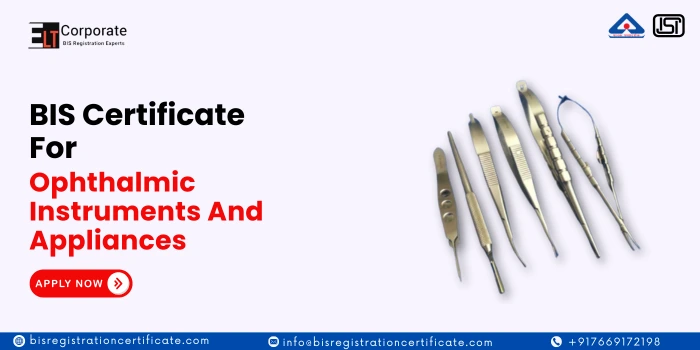
Whether you’re a manufacturer, supplier, or healthcare professional, obtaining BIS Certificate for Ophthalmic Instruments And Appliances is very important. Products like surgical microscopes, diagnostic equipment, and other tools are critical for patient safety and treatment effectiveness. Therefore, ensuring these devices meet the required BIS standards is vital before entering the Indian market. The BIS certificate guarantees that your ophthalmic instruments comply with national quality standards, enhancing credibility and marketability. This article will explore the BIS Certificate for ophthalmic instruments, the certification process, its benefits, and many more.
What Is BIS Certification For Ophthalmic Instruments And Appliances?
The BIS Certificate for ophthalmic instruments and appliances is an official approval ensuring these medical devices meet safety and quality standards set by the Bureau of Indian Standards. It acts as a stamp of approval, confirming that products like surgical microscopes and diagnostic tools are safe and effective.
Instruments undergo rigorous testing and evaluation to get BIS certification. For manufacturers and suppliers, having the BIS mark builds trust with healthcare providers and opens up wider market opportunities. It’s an essential step for anyone in the ophthalmic field looking to ensure product reliability and compliance with national standards.
Importance Of Obtaining BIS Certificate For Ophthalmic Instruments And Appliances Products?
Obtaining a BIS Certification for ophthalmic instruments and appliances is crucial for several reasons:
- Safety Guarantee: The certification ensures that products meet stringent safety and quality standards, protecting patients and healthcare providers.
- Regulatory Compliance: Many healthcare facilities and regulatory bodies require BIS certification to comply with national regulations, helping you avoid legal issues.
- Market Access: obtaining a BIS Certificate for your product can open doors to new markets and customers, as many distributors and healthcare institutions prioritise certified products.
- Consumer Trust: Patients and healthcare professionals are more likely to trust and choose products that have been certified. Hence, getting a BIS marked on your product will be very beneficial.
- Risk Management: The certification process involves thorough testing and evaluation, helping identify potential issues early on, which can minimise risks in product use.
- Competitive Advantage: In a crowded market, having a BIS Certificate can set you apart from competitors who may not have this certification, making your products more appealing.
Therefore, obtaining a BIS license for Ophthalmic Instruments And Appliances is not just a regulatory requirement; it’s a crucial step in ensuring quality, safety, and success in the market.
How Can You Obtain BIS Certification For Ophthalmic Instruments And Appliances?
Here, we have explained the step-by-step process for obtaining a BIS Certificate for ophthalmic instruments and appliances:
- Identify The Standards: Start by familiarising yourself with your product type’s specific standards and requirements. The BIS has guidelines depending on the instruments or appliances you want to certify.
- Prepare Your Documentation: Gather all necessary documents, including product specifications, manufacturing details, and any existing test reports. This paperwork is crucial for the application process.
- Testing: Your products must undergo testing at a BIS-recognized laboratory. This step ensures that your instruments meet the required safety and quality standards. Make sure to choose a lab that specialises in ophthalmic devices.
- Submit Your Application: Once you have your documents and test results, complete the BIS application form and submit it with all the necessary paperwork. This is where you officially apply for the certification.
- Factory Inspection: A BIS inspector will visit your manufacturing place to ensure everything complies with the standards. So, be prepared to demonstrate your processes and quality controls during this inspection.
- Receive Your Certificate: If your application is approved and everything checks out, you’ll receive your BIS Certificate for the ophthalmic instrument.
Documentation Required To Get BIS Certificate For Ophthalmic Instruments And Appliances
Here’s the list of documents needed to obtain BIS certification for ophthalmic instruments and appliances:
- Application Form
- Product Specifications
- Test Reports
- Quality Management System (QMS) Documents
- Manufacturing Process Details
- Labeling and Packaging Information
- Company Profile
- Compliance Certificates (if applicable)
- Fees Payment Proof
List Of Indian Standards Of BIS For Ophthalmic Instruments And Appliances
Here we have listed down products covered under the BIS certificate For Ophthalmic Instruments And Appliances:
| SI. No. | IS No. | TITLE |
|---|---|---|
| 1 | IS 10058: 1985 | Breaker and Holder, Razor Blade, Barraquer’s Pattern |
| 2 | IS 10058: 1985 | Punch, Lacrymal Bone, Beyer’s Pattern |
| 3 | IS 10058 : 1985 | Forceps, Fixation, Graefe’s Pattern (Modified) |
| (1 Revision) | ||
| 4 | IS 10389: 1983 | Fixation Hook, Eye, Guthrie’s Pattern |
| 5 | IS 10390: 1983 | Specification for muscle hook |
| 6 | IS 10408: 1983 | Spatula, Eye, Green’s Pattern |
| 7 | IS 10696: 1983 | Specification for round segment fused bifocal blanks |
| 8 | IS 10847: 1984 | Specification for Speculum with Screw Adjustment, Eye, Right and Left, Arruga’s Pattern |
| 9 | IS 10848: 1984 | Irrigator Anterior Chamber, Eye, Bishop Harmann’s Pattern |
| 10 | IS 11244: 1985 | Specification for trephine, bone lacrimal with handle |
| 11 | IS 12947: 1990 | Eye surgery instruments tonometers – Specification |
| 12 | IS 13783: 1993/IS0 8429: 1986 | Optics and optical instruments – Ophthalmology – Graduated dial scale |
| 13 | IS 14895: 2000 | Ophthalmic instruments – Spuds, foreign body – Waltons sizes 1 and 1.5 mm wide, stainless steel – Specification |
| 14 | IS 4382: 1967 | Specification for non – Tinted ophthalmic glass |
| 15 | IS 4569: Part 1: 1985 | Specification for scissors, eye: Part 1 corneal (Second Revision) |
| (2 Revision) | ||
| 16 | IS 4569: Part 2: 1985 | Specification for scissors, eye: Part 2 conjunctival, blunt and sharp – Point scissors (Second Revision) |
| (2 Revision) | ||
| 17 | IS 4569: Part 3: 1985 | Specification for scissors, eye: part 3 scissors, tenotomy (Second Revision) |
| (2 Revision) | ||
| 18 | IS 4569: Part 4: 1985 | Specification for scissors, eye: Part 4 scissors, enucleation (Second Revision) |
| (2 Revision) | ||
| 19 | IS 4569: Part 5: 1985 | Scissors, Eye – Part 5: Scissors, Spring Action, Vanna’s Pattern (Modified) |
| (2 Revision) | ||
| 20 | IS 4569: Part 6: 1985 | Specification for scissors, eye: Part 8 scissors, Iris (Second Revision) |
| (2 Revision) | ||
| 21 | IS 4790: 1989 | Eye Surgery Instruments – Knife, Corneal Splitting, Lang’s and Tooke’s Pattern (Modified) |
| (2 Revision) | ||
| 22 | IS 4978: 1985 | Specification for forceps, eye, fixation (Toothed) (First Revision) |
| (1 Revision) | ||
| 23 | IS 5157: 1981 | Specification for forceps, eye, and Iris (First Revision) |
| (1 Revision) | ||
| 24 | IS 5232: 1990 | Eye Surgery Instruments – Forceps, Eye, Cilia, Beer’s |
| (2 Revision) | Pattern (modified) | |
| 25 | IS 5367: 1969 | Forceps, Eye, Strabismus for Advancement (Prince’s and Worth’s Patterns) |
| 26 | IS 5668: 1989 | Eye surgery instruments – Forceps, eye, dissecting, serrated, fine specification (First Revision) |
| (1 Revision) | ||
| 27 | IS 5678: 1970 | Forceps, Eye, Conjunctival, Suture (Moorfield’s Pattern) |
| 28 | IS 5721: 1970 | Forceps, Eye, Peripheral Iridectomy (Sinclair’s pattern) |
| 29 | IS 5722: 1970 | Hook, Eye, Iris (Tyrrell’s Pattern) |
| 30 | IS 6420: 1989 | Eye Surgery Instruments – Retractor, Eye Lachrymal Sac, Muller’s Pattern (Modified) |
| (1 Revision) | ||
| 31 | IS 6472: 1971 | General requirements for tinted ophthalmic glass |
| 32 | IS 6473: 1972 | Specification for trial spectacle lens sets |
| 33 | IS 7006: 1973 | Specification for visual acuity test charts |
| 34 | IS 7734: 1975 | Forceps, Eye, Peripheral Iridectomy, Traquair’s Pattern |
| 35 | IS 7758: 1975 | Curette, Eye, Evacuation, Moorfield’s Pattern |
| 36 | IS 7762: 1975 | Specification for hook, eyelid |
| 37 | IS 7767: 1975 | Spatula, Eye, Cyclodialysis, Sinclair’s Pattern |
| 38 | IS 7786: 1975 | Retractor, Eyelid, Desmarre’s Pattern |
| 39 | IS 8106: 1976 | Needle Holder, Eye, Kalt’s Pattern |
| 40 | IS 8109: 1976 | Needle Holder, Eye, Castroviejo’s Pattern |
| 41 | IS 8181: 1976 | Specification for repositor, Iris |
| 42 | IS 8257: 1976 | Specification for ophthalmoscope |
| 43 | IS 8260: Part 1: 1976 | Glossary of terms relating to ophthalmic lenses and spectacle frames: Part 1 Ophthalmic lenses |
| 44 | IS 8771: 1985 | Needle Holder, Eye, Scissors and Forceps Combined, Castroviejo’s Pattern (Modified) |
| (1 Revision) | ||
| 45 | IS 8772: 1985 | Needle Holder, Eye, Barraquer’s Pattern (Modified) |
| (1 Revision) | ||
| 46 | IS 8773: 1985 | Dissector, Lacrimal Sac, Lang’s Pattern (Modified) |
| (1 Revision) | ||
| 47 | IS 8810: 1985 | IS 10009: 1981 |
| (1 Revision) | ||
| 48 | IS 9061: 1989 | Eye Surgery Instruments – Dilators, Punctum, Wilder’s Pattern (Modified) |
| (1 Revision) | ||
| 49 | IS 9062: 1987 | Probes, Lacrimal, Bowman’s Pattern (Modified) |
| (1 Revision) | ||
| 50 | IS 9134: 1987 | Trephine, Corneal, Castroviejo’s Pattern (Modified) |
| (1 Revision) | ||
| 51 | IS 9329: 1987 | Speculum, Eye, Clark’s Pattern (Modified) |
| (1 Revision) | ||
| 52 | IS 9378: 1987 | Speculum, Eye, Castroviejo’s Pattern (Modified) |
| (1 Revision) | ||
| 53 | IS 9626: 1990 | Eye Surgery Instruments – Calipers Castroviejo’s Pattern (Modified) |
| (1 Revision) | ||
| 54 | IS 9688: 1992 | Eye surgery instruments – Hooks, strabismus – Specification ( first revision) |
| (1 Revision) | ||
| 55 | IS 9983: 1981 | Specification for wire Vectis and lens expression, eye |
| 56 | IS 9984: 1981 | Specification for cannula, air injection, eye |
| 57 | Rougine for Lacrimal SAC, rolleth’s Pattern (Modified) | Ophthalmic instruments – Eye refractometers |
| 58 | IS/ISO 10940: 2009/ISO 10940:2009 | Ophthalmic Optics — Chart Displays for Visual Acuity Measurement — Printed, Projected and Electronic ( First Revision ) |
| (1 Revision) | ||
| 59 | IS/ISO 10939: 2017/ISO 10939:2017 | Ophthalmic instruments Slit-lamp microscopes First Revision |
| (1 Revision) | ||
| 60 | IS/ISO 10342: 2010/ISO 10342:2010 | Ophthalmic instruments – Fundus cameras |
| 61 | IS/ISO 10938: 2016/ISO 10938:2016 Oph | Ophthalmic instruments – Direct ophthalmoscopes |
| 62 | IS/ISO 10943: 2011/IS/ISO 10943:2011 | Ophthalmic instruments – Indirect ophthalmoscopes |
| 63 | IS/ISO 11979: Part 1: 2018/ISO 11979-1:2018 | Ophthalmic implants Intraocular lenses Part 1:Vocabulary First Revision |
| (1 Revision) | ||
| 64 | IS/ISO 10942: 2006/ISO 10942:2006 | Ophthalmic implants Intraocular lenses Part 10: Clinical investigations of intraocular lenses for correction of ametropia in phakic eyes First Revision |
| (1 Revision) | ||
| 65 | IS/ISO 11979: Part 10:2018/ISO 11979-10:2018 | Ophthalmic implants – Intraocular lenses: Part 2 Optical properties and test methods |
| 66 | IS/ISO 11979: Part 2:1999/IS/ISO 11979-2:2014 | Ophthalmic implants – Intraocular lenses: Part 3 mechanical properties and test methods |
| 67 | IS/ISO 11979: Part 3:2006/IS/ISO 11979-3:2014 | Ophthalmic implants – Intraocular lenses: Part 4 labelling and information |
| 68 | IS/ISO 11979: Part 5: 2006/ISO 11979: Part 5: 2006 | Ophthalmic implants – Intraocular lenses: Part 5 biocompatibility |
| 69 | IS/ISO 11979: PART 4:2008/ISO 11979: PART 4: 2008 | Ophthalmic implants – Intraocular lenses: Part 6 shelf – Life and transport stability testing |
| (1 Revision) | ||
| 70 | IS/ISO 11979: PART 6:2014/IS/ISO 11979-6:2014 | Ophthalmic implants Intraocular lenses Part 7: Clinical investigations of intraocular lenses for the correction of aphakia First Revision |
| (1 Revision) | ||
| 71 | IS/ISO 11979: PART 7:2018/ISO 11979-7:2018 | Ophthalmic implants Intraocular lenses Part 8 Fundamental requirements First Revision |
| (1 Revision) | ||
| 72 | IS/ISO 11979: Part 9: 2006/ISO 11979: Part 9: 2006 | Ophthalmic Implants – Intraocular Lenses: Part 5 Biocompatibility |
| 73 | IS/ISO 11986: 2017/ISO 11986:2018 | Ophthalmic optics Contact lenses and contact lens care products Determination of preservative uptake and release |
| 74 | IS/ISO 11979: PART 8:2018/ISO 11979-8:2017 | Ophthalmic instruments – Retinoscopes |
| 75 | IS/ISO 12865: 2006/ISO 12865:2006 | Ophthalmic instruments – Perimeters |
| 76 | IS/ISO 16671: 2015/IS/ISO 16671:2015 | Ophthalmic implants – Irrigating solutions for ophthalmic surgery |
| 77 | IS/ISO 12866: 1999/ISO 12866:1999 | Ophthalmic implants – Ocular endotamponades |
| 78 | IS/ISO 18369: Part 2: 2017/ISO 18369-2:2017 | Ophthalmic optics – Contact lenses Part 2: Tolerances First Revision |
| (1 Revision) | ||
| 79 | IS/ISO 18369: Part 3: 2017/ISO 18369-3:2017 | Ophthalmic optics Contact lenses Part 3: Measurement methods First Revision |
| (1 Revision) | ||
| 80 | IS/ISO 18369:Part 4: 2017/ISO18369-4:2017 | Ophthalmic optics Contact lenses Part 4: Physicochemical properties of contact lens materials First Revision |
| (1 Revision) | ||
| 81 | IS/ISO 18369 :Part1 : 2017/ISO 18369-1:2017 | Ophthalmic optics Contact lenses Part 1 Vocabulary classification system and recommendations for labelling specifications First Revision |
| (1 Revision) | ||
| 82 | IS/ISO 16672: 2015/ISO 16672:2015 | Ophthalmic optics – Spectacle frames – Lists of equivalent terms and vocabulary |
| 83 | IS/ISO 8596: 2017/ISO 8596:2017 | Ophthalmic optics Visual acuity testing Standard and clinical optotypes and their presentation First Revision |
| (1 Revision) | ||
| 84 | IS/ISO 8598: 1996/ISO 8598 | Optics and optical instruments – Focimeters |
| 85 | IS/ISO 8598: Part 1 :2014/IS/ISO 8598-1:2014 | Optics and optical instruments – Focimeters: Part 1 general purpose instruments |
| 86 | IS/ISO 8612: 2009/ISO 8612:2009 | Ophthalmic instruments – Tonometers |
| 87 | IS/ISO 7998: 2005/ISO 7998:2005 | Ophthalmic optics – Spectacle frames – Measuring system and terminology |
| 88 | IS/ISO 8980: Part 1: 2017/ISO 8980-1:2017 | Ophthalmic optics Uncut finished spectacle lenses Part 1 Specifications for single-vision and Multifocal Lenses (First Revision) |
| (1 Revision) | ||
| 89 | IS/ISO 8624: 2011/ISO 8624:2011 | Ophthalmic optics – Uncut finished spectacle lenses: Part 3 transmittance specifications and test methods |
| 90 | IS/ISO 8980: Part 3:2013/IS/ISO 8980-3:2013 | Ophthalmic optics – Uncut finished spectacle lenses: Part 4 specifications and test methods for anti – Reflective coatings |
| 91 | IS/ISO 8980: Part 4:2006/IS/ISO 8980-4:2006 | Ophthalmic optics – Uncut finished spectacle lenses: Part 5 minimum requirements for spectacle lens surfaces claimed to be abrasion-resistant |
| 92 | IS/ISO 9801: 2009/ISO 9801:2009 | IS/ISO 8980: Part 5:2005/IS/ISO 8980-5:2005 |
Can I Export Ophthalmic Instruments Without BIS Certificate?
No, you can only export Ophthalmic Instruments And Appliances to India with a BIS certificate since the BIS mark ensures compliance with safety and quality standards.
What Is The HS Code For Ophthalmic Instruments And Appliances?
901850 is the HS Code for Ophthalmic Instruments And Appliances. It’s a standardised global code for classifying goods in trade, helping customs accurately identify products, set tariffs, etc.