
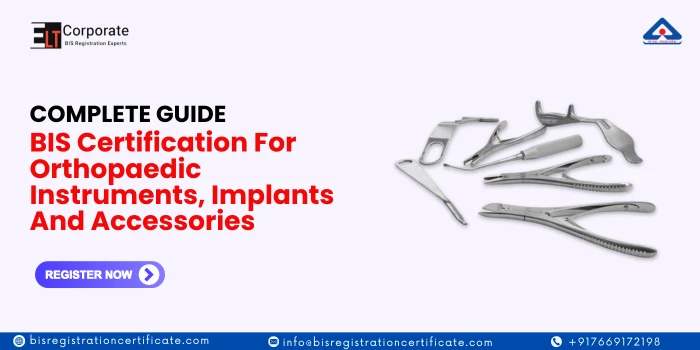
If you are looking for BIS certification for Orthopaedic Instruments, Implants and Accessories, understanding its importance is crucial. Obtaining a BIS certificate will ensure that your products meet strict safety and quality standards, which is important in the medical field.
According to BIS, you not only enhance the credibility of your products but also provide peace of mind to healthcare providers and patients alike. In this article, we’ll dive into the BIS registration for Orthopaedic Instruments, Implants and Accessories, its significance for manufacturers and the orthopaedic industry, and how it ultimately contributes to better patient care. Whether you’re a manufacturer seeking certification or a healthcare professional wanting to understand its significance, this guide will address your concerns and clarify how BIS certification can benefit you.
What Is BIS Certification?
BIS certification is a quality mark that ensures any product’s quality, reliability, and safety to the consumers. It helps maintain quality and safety in various sectors, including healthcare. By adhering to established standards, BIS certification provides a framework that manufacturers must follow to guarantee their products meet essential safety requirements.
This is especially crucial in healthcare, where the safety and efficacy of medical instruments and implants can directly impact patient outcomes. Obtaining BIS certification not only enhances consumer confidence but also helps manufacturers improve their processes and products.
Why Is BIS Certification Important For Orthopaedic Instruments?
BIS certification is important for Orthopaedic instruments, implants & accessories for several reasons:
- Quality Assurance: BIS certification ensures that orthopaedic instruments meet specific quality and safety standards, essential for BIS medical devices used in surgeries and treatments.
- Safety Standards: It help in reducing the risk of infections and complications by ensuring that instruments are made from safe, high-quality materials designed to minimize any potential harm.
- Regulatory Compliance: Many healthcare facilities and regulatory bodies require BIS certification as part of compliance with national regulations, making it a prerequisite for market entry.
- Consumer Trust: obtaining BIS certification provides confidence among healthcare professionals and patients regarding the reliability and efficacy of the instruments.
- Market Access: having BIS certification for Orthopaedic Instruments, Implants and accessories will open up more opportunities in both domestic & international markets, as it is often recognized as a mark of quality.
Who Needs BIS Certificate For Orthopaedic Instruments, Implants And Accessories?
BIS certification is required for manufacturers of orthopaedic instruments, implants, and accessories to ensure product safety and quality. Apart from this, Importers bringing these items into India must also obtain certification. If you are a distributor or wholesaler then you need to verify that the products they sell are BIS certified, as healthcare facilities look for this certification when purchasing to ensure they are using safe and effective products.
Essentially, anyone involved in the production, importation, distribution, or use of these medical devices in India needs to comply with BIS certification requirements.
Also Read: BIS Certificate For Surgical Instruments
How To Obtain BIS Certification For Orthopaedic Instruments?
If you’re unsure about how to get a BIS certificate for orthopaedic instruments, implants and accessories, we’ve mentioned down steps:
- Understand Certification Requirements: First, research for the BIS standards that apply to orthopaedic instruments. Familiarize yourself with the relevant Indian Standards (IS) that outline safety and quality criteria.
- Prepare Documentation: after knowing the standard you need to gather all necessary documents. Such as QMS documentation, technical specifications, manufacturing process details, safety and performance testing results, etc.
- Implement Quality Management System (QMS): Establish a QMS that aligns with ISO 13485 standards. This ensures that your manufacturing processes are consistent and meet quality requirements.
- Submit Application: Submit your application to BIS, including all required documents and payment of the application fee. This can be done online or in person at a BIS office.
- Factory Inspection: once the application is submitted, be ready for a factory audit by BIS officials. They will inspect your manufacturing facility and processes to ensure compliance with BIS standards.
- Product Testing: Your instruments may need to undergo testing at a BIS-recognized laboratory. Ensure that all required tests are performed to verify compliance with applicable standards.
- Issuance Of Certificate: If both the inspection and testing are successful, you will receive your BIS certification for orthopaedic instruments, implants and accessories. This certification allows you to use the BIS mark on your products.
Documentation Required To Get BIS Certification For Orthopaedic Instruments
Here’s the list of documentation required for BIS certificate for Orthopaedic Instruments, Implants And Accessories
- Application Form
- QMS Documentation
- Technical Specifications
- Manufacturing Process Documentation
- Safety and Performance Test Reports
- Product Labels and User Manuals
- Certificate of Incorporation
- Declaration of Conformity
- Previous BIS Certifications (if any)
- Fee Payment Receipt
Also Read: Requirements for BIS certification
When Should You Consider Getting BIS Certificate For Orthopaedic Instruments, Implants And Accessories?
Here are major situations when you should consider obtaining BIS certification for orthopaedic instruments, implants, and accessories:
- Entering the Indian Market: If you plan to sell orthopaedic products in India, BIS certification is often mandatory to comply with local regulations and ensure market access.
- Enhancing Product Credibility: BIS certification enhances the credibility of your products, reassuring customers and healthcare providers of their quality and safety.
- Meeting Regulatory Requirements: If your instruments or implants are subject to specific regulatory standards in India, obtaining BIS certification will help you meet these legal obligations.
- Exporting Products: For companies looking to export to India, having BIS certification can facilitate smoother entry into the market, as it demonstrates compliance with local standards.
- Improving Quality Management: If you aim to establish or improve your quality management systems, pursuing BIS certification can help you implement best practices and continuous improvement processes.
- Gaining Competitive Advantage: In a crowded marketplace, BIS certification can differentiate your products, giving you an edge over competitors who may not have certification.
- Building Trust with Stakeholders: Certification fosters trust with stakeholders, including investors, suppliers, and healthcare professionals, by demonstrating a commitment to quality and safety.
By considering these factors, you can determine the right timing for pursuing BIS certification for your orthopaedic instruments, implants, and accessories.
Also Read: Medical textile products list
List Of Indian Standards Of BIS For Orthopaedic Instruments, Implants And Accessories
Here we have listed down the indian standard for BIS certification for Orthopaedic Instruments, Implants And Accessories, you can check them here:
| SI. No. | Indian Standards | Title | |
|---|---|---|---|
| 1 | IS 10121: Part 1: 1982 | Specification for metal bone screws – Mechanical requirements and methods of test Part 1 screws with asymmetrical thread, variable fitting (Spherical), Stainless Steel | |
| 2 | IS 10121: Part 2: 1982 | Specification for metal bone screws – Mechanical requirements and methods of test: Part 2 screws with asymmetrical thread, constant fitting (Spherical), stainless steel | |
| 3 | IS 10128: 1982 | Specification for pin, Knowles | |
| 4 | IS 10155: 1982 | Specification for blade plate, femoral, lower | |
| 5 | IS 10235: Part 1: 1982 | Glossary of terms: Part 1 general medical terms for surgical implants | |
| 6 | IS 10235: Part 2: 1982 | Glossary of terms in orthopaedics: Part 2 Mechanics and materials for implants | |
| 7 | IS 10235: Part 3: 1982 | Glossary of terms in orthopaedics: Part 3 orthopaedic surgery | |
| 8 | IS 10326: 1982 | Spreader, Plaster Cast, Henning’s Pattern | |
| 9 | IS 10327: 1982 | Bender, Plaster, Bohler’s Pattern | |
| 10 | IS 10338: 1982 | Specification for saw, plaster, hand | |
| 11 | IS 10349: 1982 | Rasp for Hip Prothesis, Thompson’s and Moore’s Patterns | |
| 12 | IS 10727: 1983 | Specification for nail, square, Ulna | |
| 13 | IS 10728: 1983 | Specification for nail, square, radius | |
| 14 | IS 10729: 1983 | Specification for nail set, Kutcher | |
| 15 | IS 10730: 1983 | Osteotome, Whitchurch Howell’s Pattern | |
| 16 | IS 11034: 2019/ISO 8828: 2014 | Implants for surgery? guidance on care and handling of orthopaedic implants (Second Revision) | |
| (2 Revision) | |||
| 17 | IS 11567: Part 1: 1986 | Specification for holes and slots for metal bone plates: Part 1 corresponds to screws with asymmetrical thread and spherical – Surfaces | |
| 18 | IS 11567: Part 3: 1986 | Specification for holes and slots in metal bone plates: Part 3 corresponds to screws with asymmetrical thread and conical – Surfaces | |
| 19 | IS 11567: Part 4: 1986 | Specification for holes and slots in metal bone plates: Part 4 corresponding to screws with symmetrical thread and conical undersurfaces | |
| 20 | IS 11568: 1986 | Forceps, Bone Holding, Semb’s Pattern | |
| 21 | IS 11569: 1986 | Specification for cervical collar | |
| 22 | IS 11953: 1986 | Specification for driver and bender for rush intramedullary pin | |
| 23 | IS 12088: 1987 | Specification for bone plate, dynamic compression | |
| 24 | IS 12172: 1987 | Specification for distraction cervical collar | |
| 25 | IS 12304: 1987 | Specification for Plastic Cervical Collar | |
| 26 | IS 12375: Part 1: 2015/ISO 7206-1: 2008 | Implants for surgery – Partial and total hip joint prostheses: Part 1 Classification and designation of dimensions (Second Revision) | |
| (2 Revision) | |||
| 27 | IS 12375: Part 2: 2018/ISO 7206-2:2011 | Implants for surgery – Partial and total hip joint prostheses: Part 2 articulating surfaces made of metallic, ceramic and plastic materials (First Revision) | |
| (1 Revision) | |||
| 28 | IS 12375: Part 4: 2016/ISO 7206-4: 2010 | Implants for surgery – Partial and total hip joint prostheses: Part 4 Determination of endurance properties and performance of stemmed femoral components (First Revision) | |
| (1 Revision) | |||
| 29 | IS 12375: Part 6: 2018/ISO 7206-6:2013 | Implants for surgery – Partial and total hip joint prostheses: Part 6 endurance properties testing and performance requirements of neck region of stemmed femoral components (First Revision) | |
| (1 Revision) | |||
| 30 | IS 12376: Part 1: 2015/ISO 7207-1: 2007 | Implants for surgery – Components for partial and total knee joint prostheses: Part 1 classification, definitions and | |
| (2 Revision) | designation of dimensions (Second Revision) | ||
| 31 | IS 13423: 1992 | Good manufacturing practices for orthopaedic implants – Guide | |
| 32 | IS 14227: 1995/ISO 8615 | Implants for surgery – Fixation devices for use in the ends of the femur in adults | |
| 33 | IS 14228: 1996/ISO 8827 | Implants for surgery – Staples with parallel legs for orthopaedic use – General requirements | |
| 34 | IS 14229: 1995/ISO 9585 | Implants for surgery – Determination of bending strength and stiffness of bone plates | |
| 35 | IS 14239: Part 1: 2018/ISO 9714-1: 2012 | Orthopaedic drilling instruments: Part 1 drill bits, taps and countersink cutters (First Revision) | |
| 36 | IS 14240: 1995 | Orthopaedic implants – General requirements for marking, packaging and labelling | |
| 37 | IS 5089: 1969 | Specification for blade plate, Blount type | |
| 38 | IS 5347: Part 1: 1986 | Requirements for orthopaedic implants: Part 1 general requirements (Second Revision) | |
| (2 Revision) | |||
| 39 | IS 5347: Part 17: 2002/ISO 13782 | Requirements for orthopaedic implants: Part 17 metallic materials – Unalloyed tantalum for surgical implant applications | |
| 40 | IS 5393: 1969 | Specification for screws, bone | |
| 41 | IS 5394: 1969 | Specification for prostheses, hip | |
| 42 | IS 5395: Part 1: 1989/ISO 5837/1-1985 | Specification for Surgical Implants – Intramedullary nailing systems for bone surgery: Part 1 Intramedullary nails with cloverleaf or v-shaped cross – section (Second Revision) | |
| (2 Revision) | |||
| 43 | IS 5396: 1969 | Specification for guide pin for kuntscher nail | |
| 44 | IS 5397: 1969 | Specification for reamer, flexible for kuntscher nail (Meddulary canal) | |
| 45 | IS 5574: 1970 | Specification for forceps, wire cutting, compound action, orthopaedic | |
| 46 | IS 5580: 1970 | Specification for chisels, Stille pattern, orthopaedic | |
| 47 | IS 5581: 1970 | Specification for Stirrup, Bohler’s | |
| 48 | IS 5583: 1970 | Specification for osteotomes, Stille pattern, orthopaedic | |
| 49 | IS 5585: 1970 | Specification for mallet, rubber-capped | |
| 50 | IS 5589: 1970 | Specification for saw handle, bone amputation, orthopaedic | |
| 51 | IS 5590: 1970 | Specification for saw blade, bone amputation | |
| 52 | IS 5601: 1970 | Specification for gouges, Stille pattern, orthopaedic | |
| 53 | IS 5803: 1970 | Specification for twist drill used in orthopaedic surgery | |
| 54 | IS 5847: 1970 | Specification for pin chuck for introducing Steinman pins | |
| 55 | IS 5848: 1996/ISO 5838-2 | Implants for surgery – Skeletal pins and wires – Steinmann | |
| (1 Revision) | skeletal pins – Dimensions (First Revision) | ||
| 56 | IS 6187: 1971 | Specification for saw, wire (Gigli Pattern) | |
| 57 | IS 6233: 1971 | Specification for forceps, bone cutting (Stille Liston Pattern) | |
| 58 | IS 6252: 1971 | Scissors Bandage, Lister’s Pattern | |
| 59 | IS 6281: 1971 | Specification for Awl, bone | |
| 60 | IS 6289: 1971 | Specification for staple, epiphyseal, orthopaedic | |
| 61 | IS 6319: 1971 | Specification for clamp, bone, Lowman type | |
| 62 | IS 6371: 1971 | Forceps, Bone Holding, Lane’s, Lane-fagge’s and Fergusson’s Patterns | |
| 63 | IS 6484: 1972 | Forceps, Gouge, Orthopaedic Fergusson’s Pattern | |
| 64 | IS 6485: 1972 | Specification for forceps, gouge, angular, orthopaedic | |
| 65 | IS 6486: 1972 | Forceps, Gouge, Orthopaedic Lane’s Pattern | |
| 66 | IS 6501: 1972 | Forceps, Gouge, Orthopaedic, Stille Luer’s Pattern | |
| 67 | IS 6801: Part 1: 1999 | Orthopaedic instruments – Drive connections: Part 1 keys for use with screws with hexagon socket heads (SecondRevision) | |
| (2 Revision) | |||
| 68 | IS 6801: Part 2: 1987 | Specification for drive connections for orthopaedic instruments Part 2 Screwdrivers for single slot head screws, screws with cruciate slot and cross-recessed head screws (First Revision) | |
| (1 Revision) | |||
| 69 | IS 6975: 1973 | Specification for reamer, trochanteric, orthopaedic | |
| 70 | IS 6976: 1973 | Specification for awl, Kutcher, diamond pointed | |
| 71 | IS 6982: 1973 | Specification for a gauge for intramedullary nails | |
| (1 Revision) | |||
| 72 | IS 7055: 1973 | Specification for drivers, Kutcher, nail, orthopaedic | |
| 73 | IS 7102: 1973 | Specification for screw, bone, Leinbach, medullary | |
| 74 | IS 7105: Part 1: 1973 | Specification for extractor for Kutcher’s nail: Part 1 handle type | |
| 75 | IS 7105: Part 2: 1986 | Specification for extractor for Kutcher’s nail: Part 2 striker type | |
| 76 | IS 7106: 1973 | Specification for extractor, staple, orthopaedic | |
| 77 | IS 7107: 1973 | Specification for punch, staple, orthopaedic | |
| 78 | IS 7108: 1973 | Specification for hammer for Kuntscher nail extractor | |
| 79 | IS 7109: 1973 | Specification for starter, staple, orthopaedic | |
| 80 | IS 7110: 1984/ISO 5837-2 | Specification for pins, rush, intramedullary (First Revision) | |
| (1 Revision) | |||
| 81 | IS 7111: 1973 | Specification for inserter, staple, orthopaedic | |
| 82 | IS 7398: 1974 | Forceps, Bone Holding, Farabeuf’s Pattern | |
| 83 | IS 7435: 1974 | Rongeur, Ruskin’s Pattern | |
| 84 | IS 7442: 1974 | Forceps, Bone Cutting, Straight and Angular, Liston’s Pattern | |
| 85 | IS 7629: 1975 | Specification for bender, plate, orthopaedic | |
| 86 | IS 7650: 1975 | Specification for drill, hand, bone, universal, micro and Kirschner | |
| 87 | IS 7817: 1975 | Specification for impactor for hip prosthesis | |
| 88 | IS 7818: 1975 | Specification for broach, Moore type, for hip prosthesis | |
| 89 | IS 7819: 1975 | Specification for mallet, nylon headed, orthopaedic | |
| 90 | IS 7841: 1975 | Specification for compression plate, muller type | |
| 91 | IS 7846: 1975 | Specification for extractor for Hip Prosthesis | |
| 92 | IS 8261: Part 1: 1976 | Specification for pins and wires, skeletal, traction: Part 1 Kirschner wires | |
| 93 | IS 8261: Part 2: 1976 | Specification for pins and wires, skeletal, traction: Part 2 guide wires | |
| 94 | IS 8261: Part 3: 1976 | Specification for pins and wires, skeletal, traction: Part 3 pins and wires, fixation and threaded | |
| 95 | IS 8332: 1977 | Specification for the handle, saw, Gigli | |
| 96 | IS 8608: 1977 | Specification for countersinks, pilot type, for orthopaedic use | |
| 97 | IS 8641: 2015 | Implants for surgery – Acrylic resin cements (Third Revision) | |
| (3 Revision) | |||
| 98 | IS 8755: 1977 | Method for testing biological compatibility of metals for surgical implants | |
| 99 | IS 8922: 1978 | Specification for depth gauge for orthopaedic use | |
| 100 | IS 8926: 1978 | Bone Skid, Murphy Lane’s Pattern | |
| 101 | IS 9265: 1979 | Clamp, Compression, Muller’s Pattern | |
| 102 | IS 9829: Part 1: 1996/ISO 5835 | Implants for surgery – Metal bone screws: Part 1 with hexagonal drive connection, spherical under the surface of the head, asymmetrical thread – Dimensions (First Revision) | |
| (1 Revision) | |||
| 103 | IS 9829: Part 2: 1996/ISO 9268 | Implants for surgery – Metal bone screws: Part 2 with conical under – Surface of head – Dimensions (First Revision) | |
| (1 Revision) | |||
| 104 | IS/ISO 12891: Part 1: 2015/ISO 12891-1: 2015 | Retrieval and analysis of surgical implants: Part 1 Retrieval and handling | |
| 105 | IS/ISO 12891: Part 2: 2014/ISO 12891-2: 2014 | Retrieval and analysis of surgical implants: Part 2 Analysis of retrieved surgical implants | |
| 106 | IS/ISO 13356: 2015/ISO 13356: 2015 | Implants for Surgery – Ceramic Materials Based on Yttria- Stabilized Tetragonal Zirconia ( Y-TZP ) | |
| 107 | IS/ISO 13781: 2017/ISO 13781:2017 | Implants for surgery, homopolymers, copolymers and blends on poly (Lactide) – In vitro degradation testing | |
| 108 | IS/ISO 21534: 2007/ISO 21534: 2007 | Non – Active surgical implants – Joint replacement implants- Particular requirements | |
| 109 | IS/ISO 21535: 2007/ISO 21535: 2007 | Non – Active surgical implants – Joint replacement implants- Specific requirements for hip-joint replacement implants | |
| 110 | IS/ISO 21536: 2007/ISO 21536 :2007 | Non – Active surgical implants – Joint replacement implants- Specific requirements for knee-joint replacement implants | |
| 111 | IS/ISO 5832 (Part 4): 2014/ISO5832-4: 2014 | Implants for Surgery – Metallic Materials Part 4 Cobalt- Chromium-Molybdenum Casting Alloy | |
| 112 | IS/ISO 5832: Part 1: 2016/ISO 5832-1:2016 | Implants for surgery – Metallic materials: Part 1 Wrought stainless steel | |
| 113 | IS/ISO 5832: Part 11: 2014/ISO 5832-11: 2014 | Implants for surgery – Metallic materials: Part 11 Wrought Titanium 6-Aluminium 7-Niobium alloy | |
| 114 | IS/ISO 5832: Part 6: 1997/ISO 5832-6:1997 | Implants for surgery – Metallic materials: Part 6 Wrought Cobalt-Nickel-Chromium-Molybdenum alloy | |
| 115 | IS/ISO 5832: Part 7: 2016/ISO 5832-7:2013 | Implants for surgery – Metallic materials: Part 7 Forgeable and cold-formed Cobalt-Chromium-Nickel-Molybdenum- Iron alloy | |
| 116 | IS/ISO 5832-2: 2018/ISO 5832-2: 2018 | Implants for surgery – Metallic materials: Part 2 Unalloyed titanium (First Revision) | |
| (1 Revision) | |||
| 117 | IS/ISO 5832-3: 2016/ISO 5832-3: 2016 | Implants for surgery – Metallic materials: Part 3 Wrought Titanium 6 -Aluminium 4 -Vanadium alloy (First Revision) | |
| (1 Revision) | |||
| 118 | IS/ISO 5832-5: 2005/ISO 5832- 5: 2005 | Implants for surgery – Metallic materials: Part 5 wrought cobalt – Chromium – Tungsten – Nickel alloy | |
| 119 | IS/ISO 5832-8: 1997/ISO 5832- 8: 1997 | Implants for surgery – Metallic materials: Part 8 wrought cobalt – Nickel – Chromium – Molybdenum – Tungsten – Iron alloy | |
| 120 | IS/ISO 5832-9: 2007/ISO 5832- 9: 2007 | Implants for surgery – Metallic materials: Part 9 wrought high nitrogen stainless steel | |
| 121 | IS/ISO 5834: Part 1: 2005/ISO 5834: Part 1: 2005 | Implants for surgery – Ultra – HighMolecular – Weight polyethene: Part 1 powder form | |
| 122 | IS/ISO 5834: Part 2: 2011/ISO 5834: Part 2: 2011 | Implants for surgery – Ultra – HighMolecular – Weight polyethylene: Part 2 moulded forms | |
| 123 | IS/ISO 5838: Part 1: 2013/ISO 5838-1:2013 | Implants for Surgery Metallic Skeletal Pins and Wires Part 1 General Requirements | |
| 124 | IS/ISO 6474: Part 1: 2010/ISO 6474: Part 1: 2010 | Implants for surgery – Ceramic materials: Part 1 ceramic materials based on high-purity alumina | |
| 125 | IS/ISO 6474: Part 2: 2012/ISO 6474-2:2012 | Implants for surgery – Ceramic materials Part 2 Composite Materials based on a High-Purity Alumina Matrix with Zirconia Reinforcement | |
Is BIS Certification Mandatory For All Orthopaedic Products?
Yes, BIS certification is mandatory for all orthopaedic products sold in India to ensure compliance with safety standards.