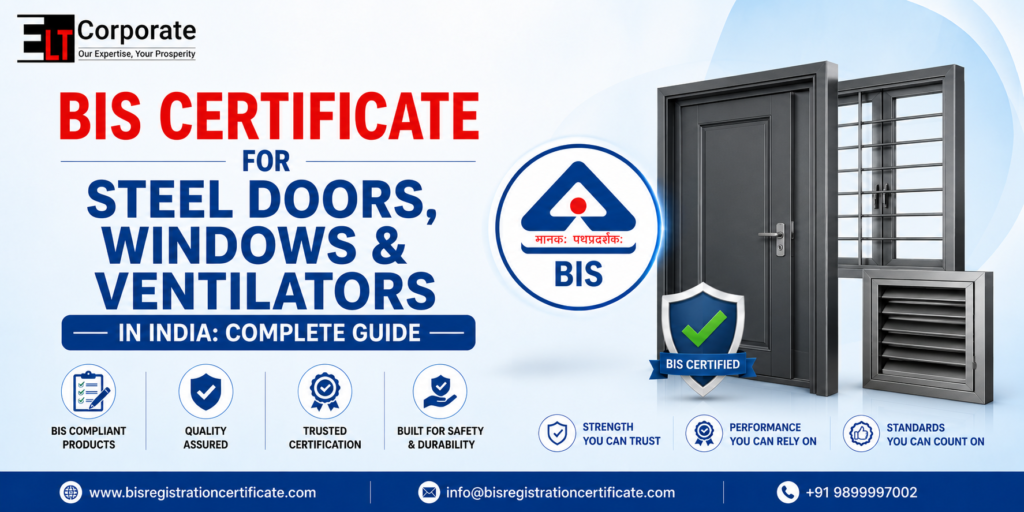
Walk into any serious construction site in India today, and you’ll notice steel doors, windows, and ventilators everywhere—schools, hospitals, government offices, and factories. There’s a reason for that. Steel holds up. It doesn’t warp in monsoon humidity, it shrugs off termites, and it survives fire better than most alternatives. But strength alone doesn’t get a product onto a government tender or into a builder’s good books. That requires a BIS certificate.
If you manufacture or sell these products, here’s what you actually need to know about getting certified without the jargon.
What Does BIS Certification Actually Mean?
The Bureau of Indian Standards (BIS) is the body that decides on what “quality” means on paper for a variety of categories of products in India. If a window or door bears BIS standard marks, it’s telling the buyer: the BIS standard mark that tells the purchaser that it was tested is a benchmark that has been established that isn’t an assumption.
For windows, doors, doors made of steel, and ventilators in particular, this certification proves that the product’s structural integrity is built to a consistent size and able to withstand everyday wear and tear without breaking over the course of three years.
The Standard That Matters: IS 1038
The majority of the items in this category can be traced back to IS 1038. It was, that is, the Indian Standard governing steel doors, windows, and ventilators. It outlines the grade of the material, the fabrication process, dimension tolerances, and finishing specifications that manufacturers must meet.
During testing and factory audits, assessors typically look at:
- The grade and quality of steel used
- Dimensional accuracy of frames, shutters, and ventilator panels
- Weld strength and joint integrity
- Surface finish and resistance to corrosion
- Hardware — hinges, locks, stays — and how well it holds up
- Overall structural rigidity
Miss any one of these, and certification doesn’t happen.
Why Bother Getting Certified?
Here’s the honest answer: in many cases, you don’t have a choice. Government housing schemes, public infrastructure projects, and institutional buildings increasingly require BIS-marked steel fixtures before they’ll even look at your quotation.
But beyond compliance, there’s real business value here. A BIS certificate tells buyers your product passed independent scrutiny, which cuts down the back-and-forth in sales conversations. It also reduces your own exposure — if a door frame buckles or a window hinge fails, having met a recognized standard gives you a defensible position. And it opens the door (no pun intended) to government tenders, which is where a lot of the real volume in this industry lives.
How the Certification Process Actually Works
It’s not an overnight process, so plan accordingly.
You start by submitting an application to BIS with details about your manufacturing setup, product specs, and existing quality control practices. From there, BIS sends officials to inspect your factory—they’re checking your processes, your raw material sourcing, and whether your in-house testing actually works the way you say it does.
Samples get pulled during this visit and sent to a BIS-recognized lab for testing against IS 1038. If those samples pass and the factory checks out, you get the license and the right to put the BIS mark on your products. That’s not the end, though—BIS keeps coming back. Surveillance audits and market sample checks continue even after certification, so consistency matters as much as that first pass.
Paperwork You’ll Need
Expect to submit the manufacturing permit, machine and layout list for the facility, quality control test reports, and information on the source of your raw materials, as well as information about the technical personnel who oversee production.
Where Manufacturers Usually Get Stuck
Smaller firms tend to trip up in two areas The first is upgrading the in-house testing equipment to BIS standards and maintaining their raw material quality in a way that is consistent enough to pass surveillance audits without flagging any issues. Neither is impossible; however, both require planning ahead rather than rushing to the inspection.
Conclusion
A BIS certificate for steel doors, windows, and ventilators isn’t just a stamp for the file — it’s what gets you taken seriously by builders, government buyers, and anyone procuring at scale. The process takes effort, but for manufacturers serious about this market, it’s not really optional anymore. Get the groundwork right early, and the certification itself becomes far less of a headache.
Talk to our BIS experts
FAQs
Q1. Is BIS certification mandatory for steel doors, windows, and ventilators?
It’s mandatory for government tenders and most institutional projects and strongly advisable for open-market sales even where it isn’t legally required.
Q2. What Indian Standard applies to these items?
IS 1038 defines the standard that governs standard for steel windows, doors, and ventilators.
Q3. How long will the certification process last?
Most of the time, it takes a few months dependent on how well-prepared your facility is and how fast samples pass tests.
Q4. Do you need to renew the certificate?
Yes, it requires regular renewal. BIS performs surveillance audits every now and then.
Q5. Can a small manufacturer apply?
Yes, scale isn’t the barrier. What matters is whether your facility and processes meet IS 1038 requirements.