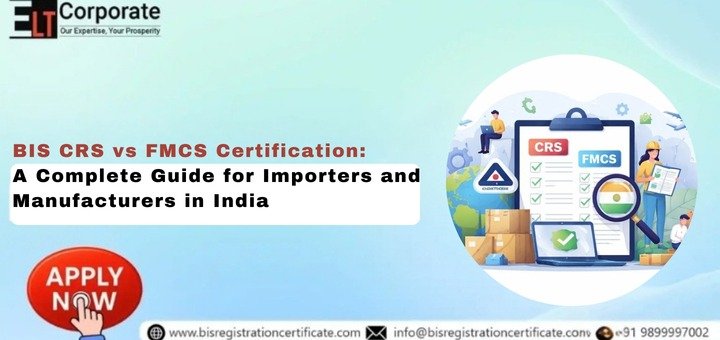
The BIS Compulsory Registration Scheme (CRS) and the Foreign Manufacturers Certification Scheme (FMCS) serve very different purposes in India: the CRS is primarily for electronic/IT products (Indian or foreign manufacturers) that are notified by MeitY, while the FMCS is an ISI-marked scheme specifically for non-electronic products manufactured outside India that fall under the mandatory BIS Quality Control Order (QCO).
What Is BIS and Why Does It Exist?
The Bureau of Indian Standards (BIS), a national organization in India responsible for product quality, safety, and standards.
Its purpose is simple:
- Protect consumers
- Ensure product safety
- Maintain uniform quality across industries
Under the BIS Act, 2016, the government has the power to make certification mandatory for certain products before they are:
- Manufactured
- Imported
- Sold
- Distributed in India
If your product falls under a notified category and you do not have the correct BIS approval, the product is not legally allowed in the Indian market.
Read More: Introduction To Bureau Of Indian Standards
Understanding the Three BIS Certification Schemes
BIS Certification is divided into three main schemes, each designed for a specific type of product and manufacturer.
Scheme I – ISI Mark Scheme
For Indian manufacturers producing goods that require the ISI mark.
Scheme II – CRS (Compulsory Registration Scheme)
For electronics and IT products, made in India or abroad.
Scheme III – FMCS (Foreign Manufacturers Certification Scheme)
For foreign manufacturers producing non-electronic products that require ISI marking.
This article focuses on CRS and FMCS, as these two cause the most confusion for importers and overseas manufacturers.
What Is BIS CRS Certification?
The Compulsory Registration Scheme (CRS) was introduced in 2012, jointly by BIS and the Ministry of Electronics and Information Technology (MeitY).
The government observed that electronic and IT products were entering the Indian market in large volumes, often without consistent safety testing. CRS was introduced to ensure that such products meet minimum safety and performance standards.
CRS applies only to products that are officially notified by MeitY.
Products Covered Under CRS
CRS covers electronic, IT, and related products that are widely used by consumers.
Examples include:
- Mobile phones and smartphones
- Laptops and tablets
- LED lamps and luminaires
- Power adapters and chargers
- Power banks
- UPS systems
- Smart TVs
- Electronic toys
- Solar modules and components
The official CRS product list currently includes 75+ notified categories, and this list is updated periodically.
Who Needs CRS Certification?
CRS applies to:
- Indian manufacturers
- Foreign manufacturers
- Importers selling CRS-covered products
Important clarification:
The CRS registration should always be issued in the name of the manufacturer, not the importer or trader; as an importer, you must work directly with the manufacturer to obtain a CRS Registration for your product..
How does CRS Certification Work?
CRS is a product-based certification, not a factory-based one.
The general process includes:
- Identifying the correct Indian Standard (IS)
- Product testing in a BIS-recognized laboratory in India
- Submission of test reports and documents
- Online application through the CRS portal
- Grant of registration number by BIS
No factory inspection is conducted under CRS.
Key Features of CRS Certification
- No BIS factory audit
- Testing mandatory in India
- Self-declaration of conformity
- Registration validity: 2 years
- Renewable before expiry
- BIS Registration Number must be printed on:
- Product
- Packaging
- User manual (where applicable)
CRS is considered faster and simpler compared to FMCS.
When is CRS Mandatory?
CRS applies only when:
- The product is electronic or IT-based, and
- It appears on MeitY’s notified CRS list
If a product is electronic but not listed, CRS does not apply.
If a product is listed under CRS, FMCS does not apply, even if the manufacturer is foreign.
What Is BIS FMCS Certification?
The Foreign Manufacturers Certification Scheme (FMCS), which came into effect in 2000, facilitates the certification of products requiring the “ISI” mark by foreign manufacturers.
The FMCS is responsible for ensuring that the quality of goods produced abroad is the same as that of locally produced products in India.
Unlike CRS, FMCS focuses heavily on:
- Manufacturing processes
- Quality control systems
- Factory capability
Products Covered Under FMCS
FMCS applies to non-electronic products that fall under mandatory BIS standards or Quality Control Orders (QCOs).
Common examples include:
- Cement
- Steel products
- Industrial valves
- Pipes and fittings
- Household appliances
- Chemicals and fertilizers
- Electrical accessories not covered under CRS
FMCS covers 300+ product categories.
Who Needs FMCS Certification?
FMCS applies when:
- The manufacturer is located outside India
- The product requires ISI marking
- The product is not covered under CRS
Foreign manufacturers must comply with Indian standards in the same way Indian manufacturers do.
Authorized Indian Representative (AIR)
One major requirement under FMCS is the appointment of an Authorized Indian Representative (AIR).
The AIR:
- Acts as the legal contact point in India
- Communicates with BIS
- Takes responsibility for compliance
- Coordinates audits and renewals
Without an AIR, FMCS certification cannot proceed.
How Does FMCS Certification Work?
FMCS is a factory-based certification.
The process includes:
- Identification of applicable Indian Standard
- Submission of application to BIS
- Appointment of AIR
- Factory inspection by BIS officials
- Sample testing in BIS-approved labs
- Grant of BIS license with ISI mark
Factory inspection is mandatory and non-negotiable.
Key Features of FMCS Certification
- Mandatory BIS factory audit
- Detailed review of manufacturing process
- Annual license validity
- Surveillance inspections possible
- ISI mark usage allowed only after approval
FMCS is more detailed, time-consuming, and cost-intensive than CRS.
BIS CRS vs FMCS: A Complete Comparison
| Parameter | BIS CRS (Scheme-II) | BIS FMCS (Scheme-III) |
| Who It Applies To | Indian and foreign manufacturers of electronics and IT goods | Foreign manufacturers of non-electronic goods under BIS standards |
| Regulating Authority | Ministry of Electronics & Information Technology (MeitY) | Bureau of Indian Standards (BIS) |
| Type of Mark | Self-declaration of conformity (No ISI Mark) | ISI Mark (Standard Mark) |
| Testing | Conducted at BIS-recognized labs in India | Factory inspection and product testing |
| Factory Audit | Not required | Mandatory |
| License Validity | 2 years | 1 year |
| Application Mode | Online via crsbis.in | Through BIS FMCD (bis.gov.in/fmcs) |
| Authorized Indian Representative (AIR) | Required only for foreign entities | Mandatory |
| Average Timeline | 20–30 working days | 4–6 months |
| Typical Product Range | 75+ notified electronics / IT products | 300+ non-electronic product categories |
| Output | BIS Registration Number (e.g., R-XXXXXXX) | BIS License Number (e.g., CM/L-XXXXXXX) |
| Marking on Product | Registration number on product and packaging | ISI Mark with Standard Number |
| Approximate Cost | ₹25,000 – ₹40,000 | USD 3,000 – USD 5,000 (varies by audit, testing & license) |
Which Scheme Is Right for You?
CRS Is Right If:
- Your product is electronic or IT-based
- The product is listed under CRS
- You want quicker market entry
- No factory inspection is preferred
FMCS Is Required If:
- You are a foreign manufacturer
- The product is non-electronic
- ISI marking is mandatory
- You are prepared for audits and annual renewals
There is no flexibility here. The scheme is decided by product category, not preference.
The Cost of Choosing the Wrong Scheme
Many businesses make decisions based on assumptions rather than verification.
Common mistakes include:
- Applying FMCS for CRS products
- Importing samples without BIS clarity
- Incorrect labeling
- Missing IS standards
Real Example
A foreign LED lighting manufacturer assumed ISI marking was required and applied under FMCS.
Since LED lamps fall under CRS, the application was rejected.
The shipment remained stuck at port until CRS registration was completed leading to avoidable costs and delayed sales.
Legal Consequences of Non-Compliance
Under the BIS Act, 2016:
- Fines up to ₹2 lakh
- Import restrictions by DGFT
- Product seizure
- License cancellation
- Legal prosecution in severe cases
Non-compliance also damages brand trust and distributor relationships.
Pre-Application Checklist
Before applying, confirm:
- Correct Indian Standard (IS code)
- Correct BIS scheme (CRS or FMCS)
- Proper product labeling
- Authorized Indian Representative (if required)
- Testing lab recognition
- Complete documentation
Preparation saves months of correction later.
How ELT Can Help?
ELT provides a comprehensive and practical approach to facilitating your company through the entire BIS Certification process. Our job is to make sure you know what you need for your product and help guide you through each individual step in the application process. Our experts will support the generation of required documentation, assist in establishing and maintaining the basic requirements for compliance, and communicate on a regular basis with the government agencies as needed. ELT will continue to support you in any follow-up compliance as well as any future applications or renewals, taking away the stress associated with navigating through this complex process, thus allowing you to concentrate on your core business operations.
Conclusion: CRS and FMCS Are Not Interchangeable
CRS and FMCS serve entirely different purposes.
CRS exists to regulate electronics and IT products through testing.
FMCS exists to regulate foreign manufacturing quality through inspection and ISI marking.
Choosing the correct scheme ensures:
- Smooth customs clearance
- Faster approvals
- Legal market access
- Long-term compliance stability
Frequently Asked Questions (FAQs)
1. What is the difference between BIS CRS and FMCS certification?
CRS is for electronics and IT products and focuses on product testing, while FMCS is for foreign non-electronic products, requiring factory inspection and the ISI mark.
2. Which products need BIS CRS registration?
CRS applies to electronic and IT goods listed under MeitY notifications, such as mobile phones, laptops, LED lamps, power adapters, and UPS systems.
3. Who needs FMCS certification in India?
Foreign manufacturers producing non-electronic goods that require ISI marking must obtain FMCS certification before importing their products into India.
4. How long does it take to get CRS or FMCS certification?
CRS certification usually takes 20-30 working days, while FMCS certification can take 4-6 months due to mandatory factory inspections and detailed compliance checks.
5. Can ELT help with both CRS and FMCS certifications?
Yes, ELT provides complete support for both schemes, including scheme identification, documentation, testing coordination, factory audits, AIR appointment, approvals, and renewal management.