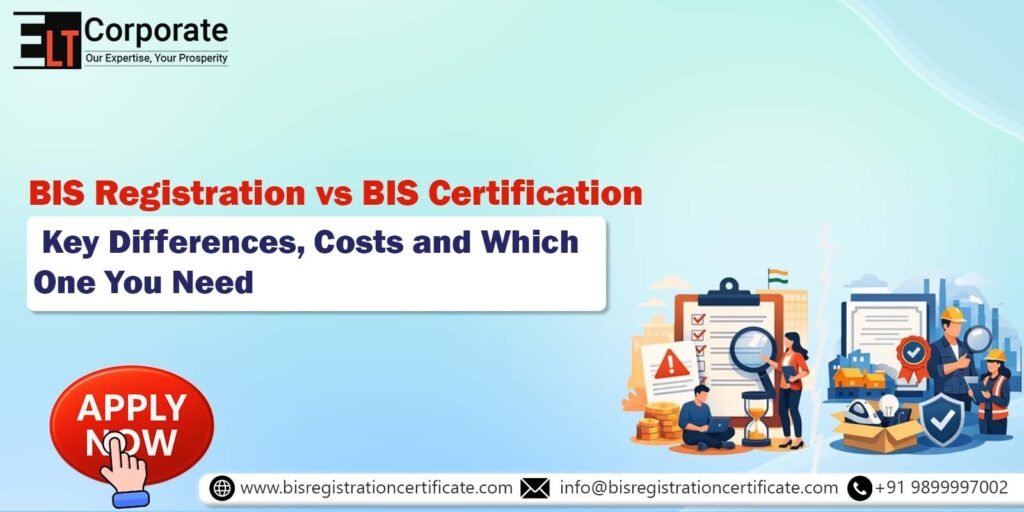
Navigating the world of Indian product compliance can feel like a maze, especially when terms like BIS Registration and BIS Certification are used interchangeably. For manufacturers, importers, and business owners in vibrant markets like Delhi, Mumbai, Pune, Bengaluru, or Chennai, understanding these distinctions isn’t just about paperwork—it’s about market access, legal compliance, and consumer trust. This guide will clearly lay out the BIS Registration vs BIS Certification difference, helping you identify exactly which standard applies to your products.
Why is BIS Compliance Crucial for Your Business?
The Bureau of Indian Standards (BIS) is India’s national standards body, ensuring quality, safety, and reliability of products. Complying with BIS standards isn’t just a legal obligation; it’s a strategic advantage. It opens doors to the vast Indian market, safeguards your brand reputation, and prevents costly penalties. Adhering to these standards fosters consumer confidence, which is invaluable for long-term business success.
Required Documents for BIS Compliance
Below we mentioned required documents for BIS compliance
- Application form (online submission)
- Proof of manufacturing unit address (e.g., factory license, electricity bill)
- List of manufacturing machinery and equipment
- Product test report from a BIS-recognized laboratory
- Technical specifications and drawings of the product
- Declaration of Conformity (for Registration/CRS)
- Trademark registration certificate
- Business registration documents (e.g., Company PAN, GSTIN)
- Authorized Indian Representative (AIR) details (for foreign manufacturers)
- Factory layout plan
- Quality control system details
Validity of BIS Compliance
Typically, a BIS Registration (under CRS) is valid for two years and can be renewed if the product and manufacturing process remain compliant. BIS Certification (under the ISI Mark scheme) is generally granted for one year initially, extendable for another two years, and then can be renewed every five years, subject to satisfactory surveillance and renewal audits. Regular surveillance audits are a key part of maintaining BIS Certification.
Understanding the Process: From Application to Compliance
The journey to BIS compliance generally involves a few key steps, though they differ slightly for registration versus certification. For BIS Registration (CRS), the primary steps include product testing at a BIS-recognized lab, submitting an online application with the test report and required documents, and then receiving the registration number. This is largely a self declaration scheme. For BIS Certification (ISI Mark), the process is more extensive. It
starts with an application, followed by a preliminary factory inspection by BIS officials to assess manufacturing infrastructure and quality control. Product samples are then drawn for testing at a BIS-approved lab. If both factory assessment and product testing are satisfactory, a license is granted. This scheme involves ongoing surveillance checks.
Read More: Process for getting BIS for Certification
Common Mistakes to Avoid
Ensure a smooth application process by sidestepping these frequent errors:
- Providing Incomplete Documentation: Missing even minor documents can cause significant delays. Double-check all requirements.
- Ignoring Product Testing Standards: Ensure your product fully meets the specified Indian Standard (IS) before testing.
- Choosing a Non-Accredited Lab: Test reports from labs not recognized by BIS are invalid.
- Not Appointing an AIR (for foreign applicants): Foreign manufacturers must have an Authorized Indian Representative.
- Overlooking Renewal Deadlines: Allowing your registration or license to expire can lead to market disruption.
- Misunderstanding the Scheme: Confusing Registration (CRS) with Certification (ISI Mark) can lead to applying for the wrong process.
What Happens If You Ignore It?
Non-compliance with BIS standards carries significant risks and severe penalties. Selling products that fall under mandatory BIS schemes without the proper registration or certification can lead to fines, product seizures, and even imprisonment for repeat offenses. Your goods could be banned from the market, leading to substantial financial losses and irreparable damage to your brand reputation. Ignoring these mandates not only puts your business at risk but also endangers consumer safety.
Cost Involved in BIS Compliance
The costs for BIS Registration and Certification can vary based on product type, testing complexity, and whether you’re a domestic or foreign manufacturer. Here’s a rough range for key expenses:
| Cost Component | BIS Registration (CRS) | BIS Certification (ISI Mark) |
| Application Fees | INR 1,000 – 5,000 | INR 5,000 – 15,000 |
| Product Testing Fees | INR 25,000 – 1,00,000+ | INR 30,000 – 1,50,000+ |
| Factory Inspection Fees (if applicable) | Not applicable | INR 10,000 – 50,000 (plus travel) |
| Consultant/Service Charges | INR 30,000 – 70,000+ | INR 50,000 – 1,50,000+ |
| Annual Marking Fee/License Fee | Not applicable | INR 5,000 – 20,000+ (based on turnover) |
Note: These are rough estimates and can fluctuate based on specific product, laboratory, and scheme requirements. Foreign manufacturers may incur higher costs for factory audits and local representation.
How ELT Corporate Pvt. Ltd. Can Help You?
Navigating the intricacies of BIS compliance can be complex, especially with constantly evolving regulations. ELT Corporate Pvt. Ltd. specializes in simplifying this journey for businesses across India, including in major industrial hubs like Delhi, Mumbai, Pune, Bengaluru, and Chennai. We offer end-to-end support, from identifying the correct scheme for your product to managing document preparation, liaising with testing labs, and coordinating with BIS officials. Our experts ensure a smooth, efficient, and timely compliance process, allowing you to focus on your core business.
Conclusion: Making an Informed Choice for Your Business
Understanding the key **bis registration vs bis certification difference** is fundamental for any business operating in India. While BIS Registration (CRS) focuses on self-declaration for electronic and IT goods, BIS Certification (ISI Mark) involves comprehensive factory inspections and continuous quality control for a broader range of products. Choosing the correct path ensures legal compliance, market acceptance, and builds invaluable consumer trust. Don’t let confusion hold your business back; ensure your products meet India’s stringent quality standards.
FAQs
Q1: Which BIS scheme do I need for my LED bulbs if I manufacture them in Bengaluru?
LED bulbs fall under the Compulsory Registration Scheme (CRS). Therefore, you would need BIS Registration. The fastest way involves preparing all documents accurately and getting your product tested at an approved lab.
Q2: As an importer of consumer electronics in Mumbai, what are my unique compliance requirements?
As an importer of consumer electronics, you will typically need BIS Registration (CRS) for your products. You must also appoint an Authorized Indian Representative (AIR) to handle the application process on your behalf if your foreign manufacturer doesn’t have a presence in India.
Q3: What are the actual financial penalties for selling non-compliant products in Delhi?
Selling non-compliant products can lead to significant fines, potentially reaching lakhs of rupees. Additionally, your goods can be seized, and in some cases, business owners may face imprisonment. These penalties aim to deter the sale of sub-standard goods.
Q4: Are there simplified BIS processes or cost exemptions for startups in Pune developing IoT devices?
While there aren’t direct cost exemptions for startups, the BIS CRS process for IoT devices (if applicable) is generally simpler than ISI certification. You should first determine if your specific IoT device falls under a mandatory Quality Control Order (QCO) to ascertain the exact compliance requirement.
Q5: What makes BIS Registration and BIS Certification two different processes?
The primary difference lies in their scope and compliance mechanism. BIS Registration (CRS) is for specific electronic goods and involves self-declaration with product testing. BIS Certification (ISI Mark) is for a wider range of products and requires factory inspection, comprehensive quality control, and ongoing surveillance, making it generally more stringent.