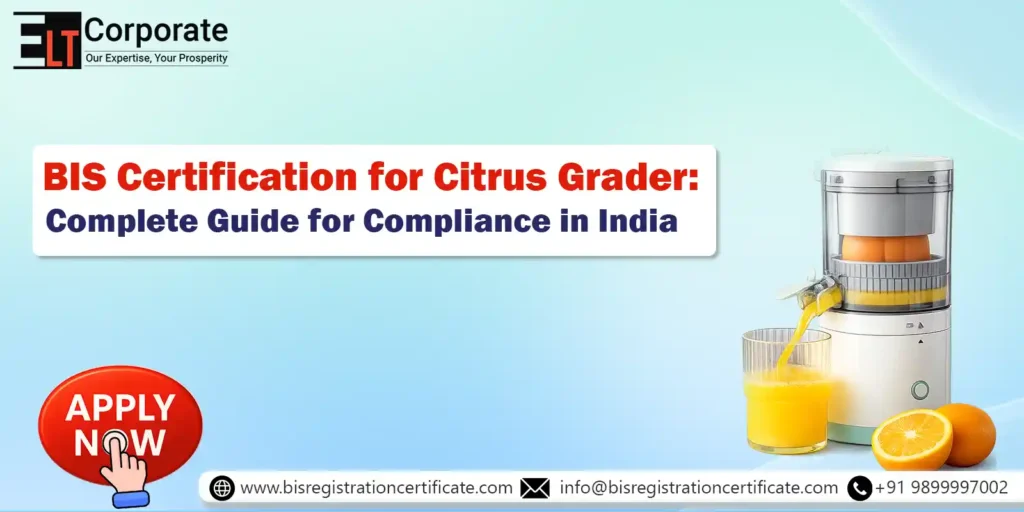
If you are manufacturing or importing citrus grading machines in India, ensuring compliance with the Bureau of Indian Standards (BIS) is crucial. A Citrus Grader is widely used in the agricultural and food processing industry to sort fruits like oranges, lemons, and sweet lime based on size, weight, and quality.
To maintain safety, performance, and quality standards, obtaining a BIS Certificate for Citrus Grader becomes essential—especially if the product falls under mandatory certification schemes.
This guide explains everything you need to know about BIS certification for citrus graders, including applicable standards, process, documents, and benefits.
What is a Citrus Grader?
A Citrus Grader is an automated or semi-automated machine used for:
- Sorting citrus fruits based on size and weight
- Removing defective or damaged fruits
- Improving packaging efficiency
- Ensuring uniformity for export-quality produce
These machines are critical in large-scale agricultural processing units and export businesses.
Is BIS Certification Mandatory for Citrus Graders?
Currently, Citrus Graders may fall under voluntary certification unless specifically notified under:
- BIS CRS (Compulsory Registration Scheme)
- ISI Certification Scheme (Scheme-I)
However, certification becomes mandatory in the following cases:
- If notified under Omnibus Technical Regulation (OTR)
- If electrical components are covered under CRS
- If required by tenders, buyers, or export norms
Many government tenders and large buyers prefer or require BIS-certified machinery.
Applicable BIS Standards for Citrus Graders
While there is no single exclusive standard for citrus graders, they are generally covered under:
Relevant Indian Standards (Indicative)
- IS standards for food processing machinery
- IS standards for electrical safety (if motorized)
- IS standards for agricultural machinery safety and performance
Exact standard identification depends on:
- Machine type (manual / automatic / electrical)
- Capacity and application
- Components used
Expert classification is highly recommended to avoid rejection.
Types of BIS Certification Applicable
1. ISI Mark Certification (Scheme-I)
Applicable for:
- Domestic manufacturers
- Quality assurance of machinery
Includes:
- Factory inspection
- Product testing
- Ongoing surveillance
2. CRS Registration (if electronics involved)
Applicable when:
- Citrus grader includes electronic components
- Falls under notified electronic categories
3. FMCS (Foreign Manufacturer Certification Scheme)
Applicable for:
- Foreign manufacturers exporting to India
Includes:
- BIS audit of foreign manufacturing unit
- Indian representative requirement
Step-by-Step Process for BIS Certification
Below, we mentioned the process of BIS certificates.
Step 1: Product Classification
Identify applicable IS standard and certification scheme.
Step 2: Documentation Preparation
Prepare technical documents, drawings, and specifications.
Step 3: Testing of Product
- Testing in BIS-recognized laboratory
- Ensure compliance with relevant standards
Step 4: Application Filing
Submit application with BIS portal.
Step 5: Factory Inspection
- BIS officer visits manufacturing unit
- Verifies quality control process
Step 6: Grant of License
After successful evaluation, BIS license is issued.
Documents Required for BIS Certification
Below, we mentioned required documents for bis certificate
- Company incorporation certificate
- Manufacturing process details
- Product specifications and drawings
- Test reports from BIS-approved lab
- Quality control documents
- ISO certification (if available)
- Factory layout
- Authorization letter (for foreign manufacturers)
Key Challenges in BIS Certification
Many businesses face delays due to:
- Incorrect product classification
- Incomplete documentation
- Test failures
- Lack of BIS compliance knowledge
- Improper factory setup
These issues often lead to rejection or long delays.
Benefits of BIS Certification for Citrus Grader
- Legal compliance in India
- Increased credibility and trust
- Eligibility for government tenders
- Smooth import/export process
- Better market acceptance
- Reduced risk of penalties
Penalty for Non-Compliance
Selling non-compliant products may result in:
- Product seizure
- Heavy penalties
- Legal action
- Ban on sale/import
Why Choose ELT Corporate for BIS Certification?
At ELT Corporate, we provide end-to-end BIS certification services:
- Accurate product classification
- Complete documentation support
- Coordination with BIS authorities
- Testing and compliance assistance
- Faster approval process
We act as your regulatory + legal partner, ensuring zero rejection risk.
Conclusion
Obtaining a BIS Certificate for Citrus Grader ensures compliance, enhances credibility, and opens doors to larger markets, including government tenders and exports.
However, the process involves technical classification, documentation, and regulatory coordination—making expert guidance essential.
Is BIS mandatory for LED bulbs?
Yes, under CRS scheme, BIS certification is compulsory.
Can I import LED bulbs without BIS?
No, import is not allowed without BIS registration.
How long does BIS certification take?
Typically 30–45 days if documents are complete.