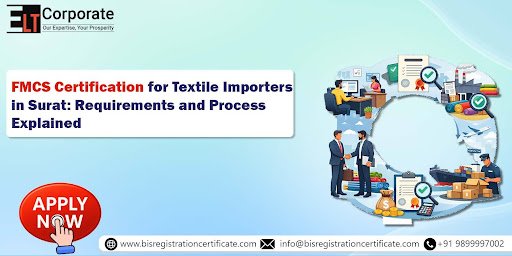
Surat, often called the textile hub of India, is a global hub of fabrics, Strands and garments. With thousands of businesses importing textiles and raw materials from overseas, regulatory compliance plays an important role in making sure smooth customs clearance and uninterrupted trade. One such important compliance requirement is FMCS certification.
This blog explains what is FMCS certification, why it is needed for textile importers in Surat, eligibility criteria, required documents and complete application process.
What is FMCS Certification?
FMCS (Foreign Manufacturers Certification Scheme) is a certification issued by the Bureau of Indian Standards. It allows foreign manufacturers to export regulated products to India, while ensuring that those products comply with Indian quality and safety standards.
For textile importers in Surat, FMCS certification becomes mandatory while importing textile products covered under BIS registration mandatory or certification schemes.
Why FMCS Certification is Important for Textile Importers in Surat
Surat based textile traders import on a large scale:
- synthetic threads
- clothes
- technical textiles
- textile machinery components
FMCS certification ensures:
- Compliance with Indian Standards (IS)
- fast customs clearance
- avoid punishment, confiscation, or disapproval
- Improve market credibility and confidence
Without valid FMCS certification, shipments may be detained at ports, causing delays and financial losses.
Who Needs FMCS Certification?
FMCS certification is required when:
- The product falls under BIS mandatory certification
- The manufacturer is located outside India
- The Indian importer (Surat-based business) is importing such products
Important: The certificate is issued in the name of the foreign manufacturer, but Indian importers must ensure their overseas suppliers hold valid FMCS approval.
Textile Products Covered Under FMCS
Some textile-related products that may require FMCS certification include:
- man-made fibers and yarns
- Industrial and technical textiles
- some protective and special clothing
- Textile Machinery Parts (Notified by BIS)
Coverage may change over time, so it is necessary to check the latest BIS notification.
Key Requirements for FMCS Certification
To obtain FMCS certification, the following conditions must be met:
1. Manufacturing Unit Inspection
- BIS officials inspect the foreign manufacturing facility
- Quality control, testing, and production processes are evaluated
2. Product Testing
- Samples are tested in BIS-recognized laboratories
- Products must comply with relevant Indian Standards (IS)
3. Quality Assurance System
- Manufacturer must maintain:
- In-house testing facilities
- Consistent quality control procedures
Documents Required for FMCS Certification
The following documents are typically required:
- Manufacturing process flow chart
- Quality control plan
- Test reports from recognized labs
- Factory layout and machinery list
- Authorization letter (Indian Representative)
- Business license of foreign manufacturer
- Product technical specifications
Step-by-Step Process to Obtain FMCS Certification
Below we mentioned steps to obtain FMCS certificate
Step 1: Application Submission
Online application submitted to BIS
Product details and manufacturer information provided
Step 2: Document Review
BIS reviews technical documents and test reports
Step 3: Factory Audit
BIS officials visit the foreign manufacturing unit
Compliance with Indian standards is verified
Step 4: Sample Testing
Product samples tested in approved laboratories
Step 5: Grant of Certification
Upon successful inspection and testing, FMCS license is issued
Manufacturer is allowed to use BIS Standard Mark
Validity and Renewal of FMCS Certificate
- FMCS certification is generally valid for 1–2 years
- Renewal requires:
- Continued compliance
- Updated documents
- Surveillance audits (if applicable)
Challenges Faced by Surat Textile Importers
Common challenges include:
- Lack of awareness about BIS/FMCS rules
- Delays due to incorrect documentation
- Coordination with foreign manufacturers
- Failed product testing
Working with experienced compliance consultants can significantly reduce delays and errors.
How FMCS Certification Benefits Surat’s Textile Businesses
- Enables global sourcing without legal hurdles
- Prevents shipment detention and penalties
- Enhances brand reputation and customer trust
- Supports scalable import operations
Conclusion
For textile importers in Surat, FMCS certification is not just a regulatory formality – it is a vital business necessity. makes sure that foreign suppliers comply with BIS FMCS norms helps businesses avoid costly disruptions and maintain a competitive edge in the textile market.
If you regularly import textiles or related products, the smartest move is to review your product category under BIS regulations and acquire FMCS certification in advance.
Is FMCS certification mandatory for textile importers in Surat?
Yes, FMCS certification is required to ensure imported textile machinery meets Indian safety and quality standards before customs clearance.
What is the basic process to obtain FMCS certification?
The process includes document submission, inspection/testing by a BIS-recognized agency, and final approval by the Chief Inspector of Factories.
How long does it take to get FMCS certification for textile imports?
Typically, it takes a few weeks depending on document completeness, inspection scheduling, and compliance with prescribed standards.