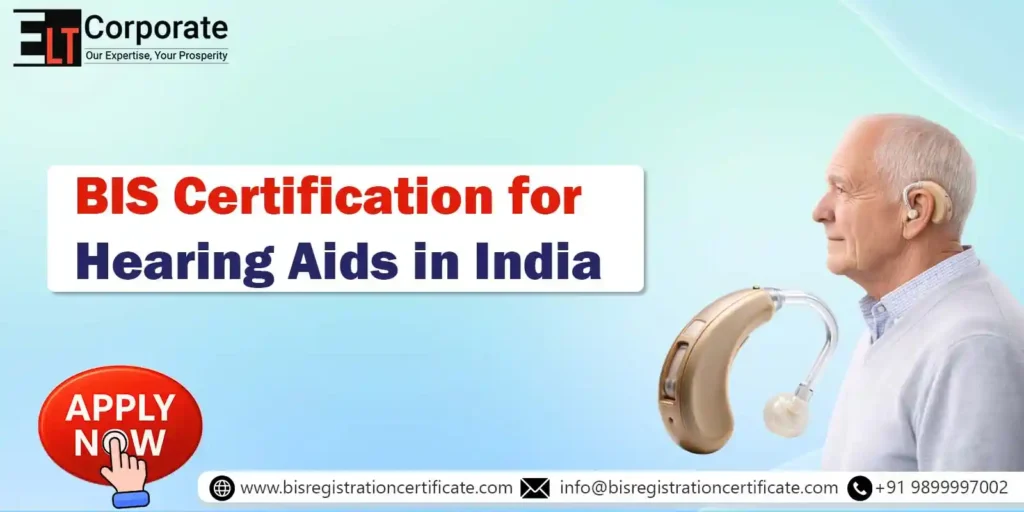
In today’s rapidly evolving healthcare sector, hearing aids are considered essential medical devices that significantly improve the quality of life for individuals with hearing impairments. However, before these devices can be manufactured, imported or sold in India, they must comply with regulatory requirements – one of the most important being BIS certification.
If you are a manufacturer, importer or distributor of hearing aids, it is important to understand BIS compliance to avoid legal issues and ensure smooth market entry.
This guide will tell you everything you need to know about BIS certification for hearing aids, including applicability, process, documentation, cost and how ELT Corporate can help.
What is BIS Certification?
BIS (Bureau of Indian Standards) is the national standard body of India responsible for ensuring product quality, safety, and reliability.
Under BIS, products are regulated through:
- ISI Mark Scheme (for domestic manufacturers)
- CRS (Compulsory Registration Scheme) (for electronics and IT products)
- FMCS (Foreign Manufacturer Certification Scheme) (for foreign manufacturers)
Is BIS Certification Mandatory for Hearing Aids?
Yes, BIS certification can be mandatory depending on the type of hearing aid.
Hearing aids generally fall under:
- Electronic medical devices
- May be covered under CRS scheme (if notified)
- Also regulated under CDSCO (Medical Device Rules, 2017)
Important:
- If notified under BIS → BIS certification is mandatory
- If not → may still require CDSCO registration (MD-14 / MD-15 for import)
Applicable BIS Standards for Hearing Aids
Hearing aids must comply with relevant Indian Standards, often aligned with IEC standards:
| Standard | Description |
|---|---|
| IS/IEC 60118 Series | Electroacoustics – Hearing Aids |
| IS 616 / IEC 60065 or IEC 62368 | Safety requirements (depending on design) |
| IEC 60601 (if applicable) | Medical electrical equipment safety |
Types of BIS Certification for Hearing Aids Applicable
1. CRS (Compulsory Registration Scheme)
Applicable if hearing aids fall under notified electronics:
- Registration with BIS
- Testing in BIS-recognized lab
- Self-declaration of conformity
2. FMCS (For Foreign Manufacturers)
- Required for foreign brands exporting to India
- BIS audit + factory inspection
3. ISI Mark (Domestic Manufacturers)
- Mandatory if product is notified
- Requires factory inspection and quality control system
Step-by-Step BIS Certification for Hearing Aids Process
Below we mentioned BIS Certification process
Step 1: Product Classification
- Identify whether hearing aid falls under CRS / ISI / FMCS
Step 2: Testing in BIS Lab
- Sample testing as per applicable standards
Step 3: Documentation Preparation
- Technical file
- Test reports
- Manufacturer details
Step 4: Application Submission
- Apply through BIS portal
Step 5: Factory Inspection (if applicable)
- For ISI / FMCS schemes
Step 6: Grant of Certification
- BIS certificate issued
- Permission to use ISI Mark / CRS Registration Number
Documents Required for BIS Certification for Hearing Aids
Here is a checklist:
For Manufacturer:
- Business license / Incorporation certificate
- ISO certificate (if available)
- Manufacturing process details
- Factory layout
For Product:
- Product specification
- Circuit diagram
- User manual
- Test reports from BIS lab
For Importers:
- Authorization letter from manufacturer
- Import Export Code (IEC)
- Brand authorization
BIS Certification Fees for Hearing Aids
| Component | Cost (Approx.) |
|---|---|
| Testing Fee | ₹25,000 – ₹1,00,000 |
| Application Fee | ₹1,000 – ₹50,000 |
| Inspection Fee | ₹50,000 – ₹2,00,000 |
| Annual License Fee | As per scheme |
Timeline for BIS Certification
- CRS Registration: 15–30 days
- ISI / FMCS Certification: 30–90 days
Common Challenges in BIS Certification
Many companies face issues such as:
- Incorrect product classification
- Rejection due to incomplete documents
- Delay in lab testing
- Compliance mismatch with standards
This is where expert guidance becomes crucial.
BIS vs CDSCO for Hearing Aids
| Parameter | BIS | CDSCO |
|---|---|---|
| Focus | Product Quality | Medical Safety |
| Requirement | Standard compliance | Licensing |
| Mandatory | If notified | Yes (medical device) |
| Forms | CRS / ISI / FMCS | MD-14 / MD-15 |
Why Choose ELT Corporate?
At ELT Corporate, we provide end-to-end BIS and CDSCO compliance services:
- Product classification & strategy
- Documentation preparation (DMF, Technical file)
- BIS application filing
- Liaison with BIS authorities
- CDSCO licensing (MD-14, MD-15)
- Faster approvals with expert handling
We position ourselves as a 360° regulatory, compliance, and legal consulting firm for medical devices.
Conclusion
BIS certification for hearing aids is not just a regulatory requirement—it is a gateway to quality assurance and market trust in India.
Whether you are a startup, importer, or global manufacturer, ensuring compliance with BIS standards is essential for:
- Legal market entry
- Consumer safety
- Brand credibility
Is BIS certification mandatory for all hearing aids?
Not all, but if notified under BIS schemes, it becomes mandatory.
Can I import hearing aids without BIS?
No, if BIS is applicable, import without certification is illegal.
Do hearing aids require CDSCO approval?
Yes, hearing aids are classified as medical devices and require CDSCO licensing.